
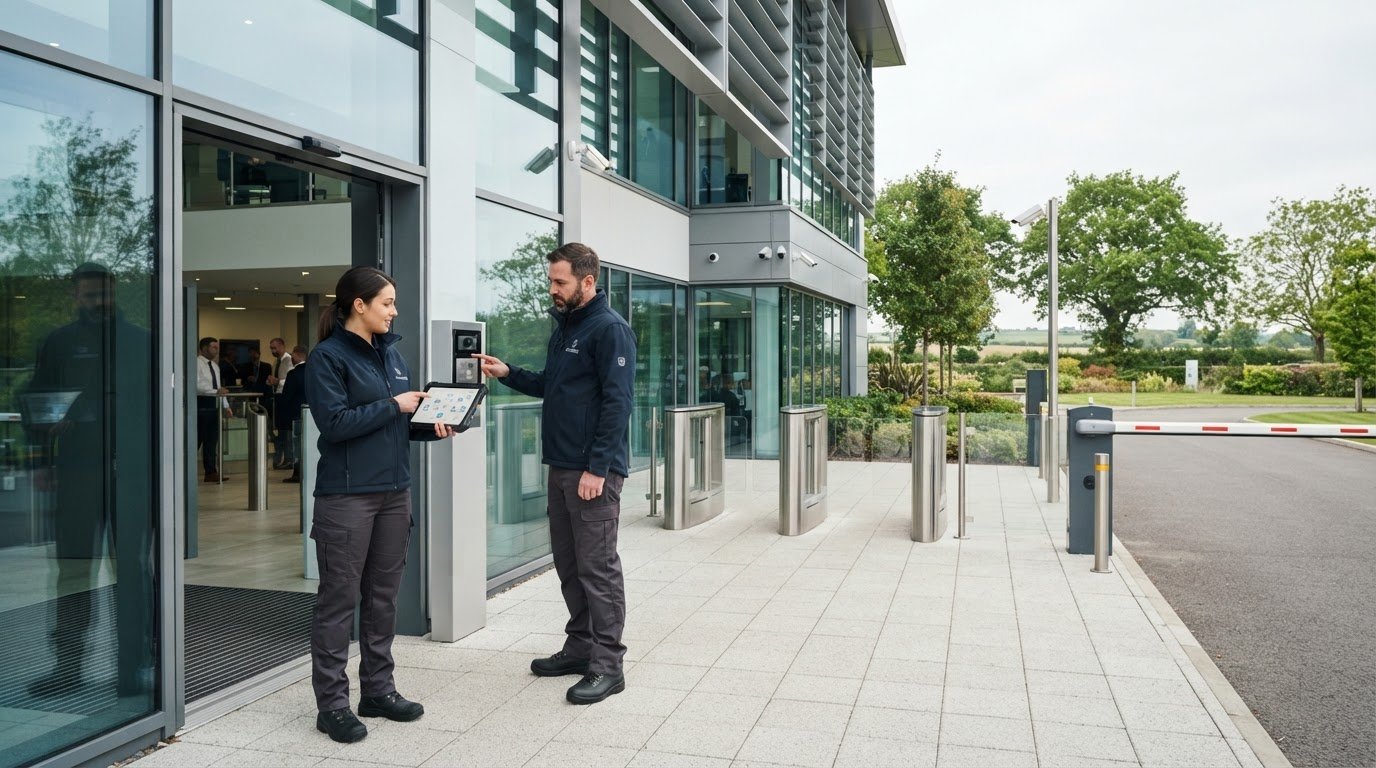
What if every device is installed, but the complete security process still hasn’t been tested? For a commercial site, installation completion doesn’t automatically mean a system is ready for day-to-day use. A security system commissioning service Essex businesses can use checks how equipment and its intended operating sequences work together, not just whether individual components power on.
Before staff begin using a system, you need clear evidence that access control, speed gates or barriers, IP CCTV and video intercoms perform as intended. You also need to know what has been tested, whether anything remains outstanding and who is responsible for each part of the handover.
This guide explains what professional commissioning involves and how Links Integrated Systems coordinates the process around commercial site operations. You’ll learn what can be tested against the system design, what records and user guidance support a considered handover, and how preparation can help reduce disruption. The aim is a practical route from completed installation to a system that’s ready for use.
Key Takeaways
- Commissioning checks whether a commercial security system performs against its agreed design and intended use, rather than relying on installation completion alone.
- A security system commissioning service Essex businesses use can cover access control, IP CCTV, intercoms, speed gates and barriers, with testing shaped around the project scope.
- Understand the difference between assumed readiness and documented test results, including how outstanding issues are recorded before handover.
- Prepare your site by arranging access, making relevant stakeholders available and gathering current drawings, device schedules and functional requirements.
- Use commissioning to clarify handover responsibilities and establish a practical basis for operating and maintaining the system.
Why commercial security system commissioning matters for Essex sites
A commercial security system can be physically installed and still leave important questions unanswered. Does an authorised person’s credential release the right entrance? Can a visitor call the correct point through an intercom? Does the gate respond as intended? Commissioning checks these operational journeys against the agreed design, helping establish what works before the system is relied on every day.
Commissioning is the structured testing and recording of a security system’s operation against its agreed design and intended use. It is more than switching equipment on. That distinction matters on Essex sites where staff, visitors, vehicles and security teams may all interact with different parts of the same installation.
What does security system commissioning verify?
Testing can cover the installed devices, their configuration and the operating sequences set out for the project. The scope depends on the system design and agreed commissioning plan. Results should be based on observed behaviour, not assumptions. If a function cannot be tested or an issue is found, it should be recorded as an exception rather than presented as verified.
Which commercial systems can require commissioning?
Commissioning may cover access control, IP CCTV, IP video intercoms, speed gates and barriers, either as individual systems or as connected parts of a site’s security arrangements. For example, checks can follow an authorised entry route, a visitor call or a gate operation. Gate requirements vary by site, so the commercial speed gates and barriers specification guide provides useful selection context.
Commissioning has a different purpose from installation and maintenance. Installation puts equipment in place and connects it according to the project design. Commissioning tests and documents how that arrangement operates against its intended functions. Ongoing maintenance supports the system after handover through planned inspection and servicing. Treating these as separate stages gives site teams a clearer record of what was installed, what was tested and what needs attention later.
Security depends on the whole workflow, not simply on each device appearing operational. A reader may power on, for instance, but the relevant user journey also depends on the correct access decision and door response. Video monitoring is more useful when the intended views and recording functions have been checked. Intercoms and barriers need to support the site’s visitor and vehicle procedures. A general overview of security alarm systems also illustrates how device behaviour and maintenance contribute to system readiness, although commissioning here is tailored to commercial access and video systems.
For a commercial site, a structured security system commissioning service Essex organisations can use turns an installation into an assessed, documented system. Clear test outcomes help those responsible for site operations understand how the security arrangements are intended to work and where outstanding actions remain. Links Integrated Systems provides commissioning for commercial security infrastructure in Essex, as well as London, Kent, Surrey and Hertfordshire.
What a security system commissioning service tests, step by step
A useful commissioning process follows a clear sequence: establish what the system is meant to do, check the installed arrangement, test agreed functions, record findings and prepare the handover. The scope is project-specific. It depends on the design, the devices installed and the operating sequences agreed for the site.
Commissioning should follow the approved system design so that test results show whether the installed system performs its intended functions. Without that reference point, a device might appear to work while the wider user journey remains untested.
From design review to functional checks
Before testing begins, the commissioning team reviews available design information, device schedules and agreed operating sequences. This establishes which functions and locations are in scope and what evidence is needed to assess them. The security system commissioning service Essex organisations need should reflect project requirements rather than assume one universal checklist suits every installation.
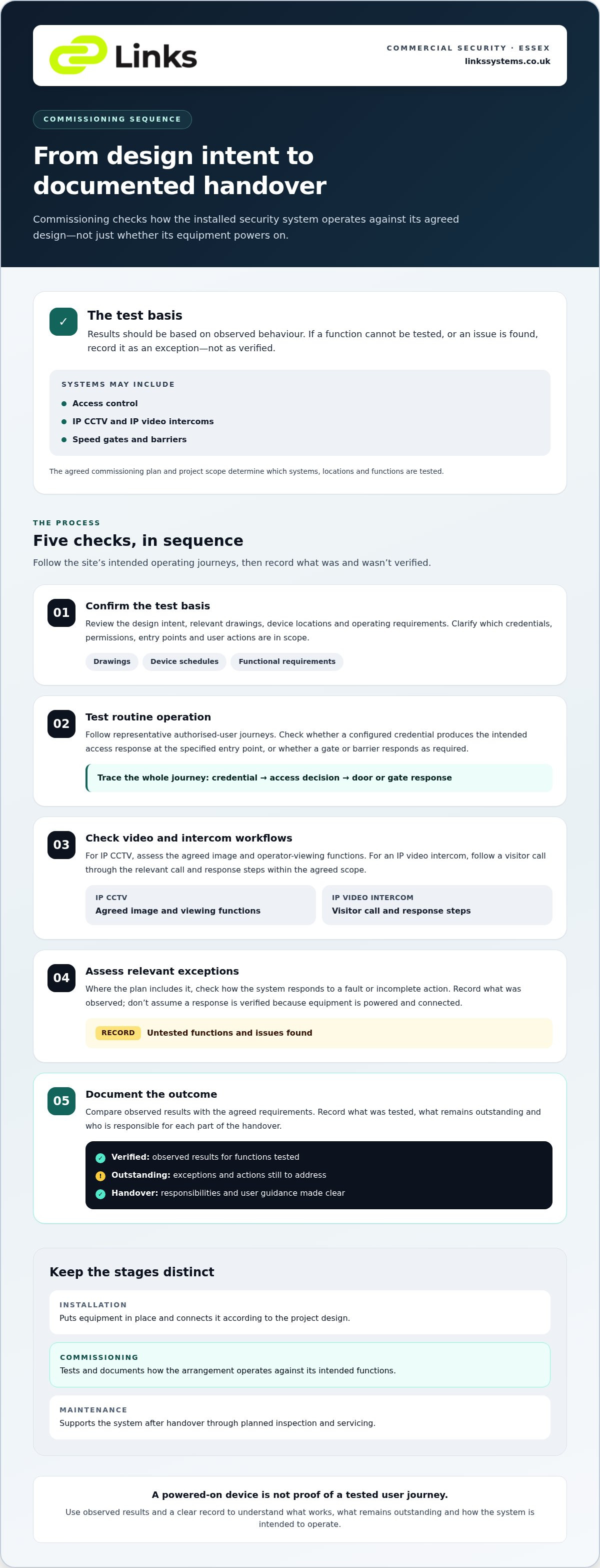
- Confirm the test basis. Check the design intent, relevant drawings, device locations and operating requirements. Clarify which credentials, permissions, entry points and user actions are part of the agreed test scope.
- Test routine operation. Follow representative authorised-user journeys. For example, check whether a configured credential produces the intended access response at a specified entry point, or whether a gate or barrier responds as set out in the project requirements.
- Check video and intercom workflows. For IP CCTV, assess the agreed image and operator viewing functions. For an IP video intercom, follow a visitor call through the relevant call and response steps within the agreed scope.
- Assess relevant exceptions. Where included in the plan, check how the system responds to a fault or an incomplete action. Record what was observed. Don’t assume a response has been verified simply because the equipment is powered and connected.
- Document the outcome. Compare observed results with the project requirements. Record tests that fail, remain incomplete or cannot be accessed, identifying the affected device or workflow and any outstanding action.
Interface testing, faults and handover records
Where systems connect, commissioning can test the interfaces included in the design and agreed scope. For instance, a planned sequence may involve access control and a gate, or an intercom call followed by an operator action. Integration depends on how the systems are designed to work together. Don’t assume every installed component shares an interface.
Findings should distinguish successful checks from exceptions. If a test is blocked by site access or a required function isn’t available, the record should identify that limitation rather than imply a pass. Handover information can bring together the checks completed, results observed and outstanding actions, with responsibilities assigned through the project process. It gives site stakeholders a practical reference without implying that every issue has been resolved during commissioning.
For commercial sites in Essex, Links Integrated Systems structures commissioning around the installed equipment and its agreed operating requirements. This gives project teams a defined route from design review to recorded results and handover. Explore commercial security commissioning support to see how the service fits into your project.
How commissioning addresses concerns about system readiness
Installation completion confirms that equipment has been fitted, but it doesn’t show by itself that every agreed function has been exercised. A reader can be mounted and powered, for example, without anyone testing whether a particular credential grants access at the correct entrance. Commissioning closes this evidence gap by checking selected operational journeys and recording what happened.
This distinction is useful for project managers and facilities teams preparing to take day-to-day responsibility. It replaces an assumption of readiness with a clearer view of which functions were tested, what the results showed and whether any limitations remain.
Installation complete does not always mean operationally verified
Consider an access credential intended to open a staff entrance. The reader may appear active, but the credential could have the wrong permission, the entry point could be mapped incorrectly, or an interface in the door-release sequence may not respond as intended. Until the agreed user journey is exercised, its operation remains unverified.
Commissioning can identify these issues within the scope of the planned checks, including configuration, device response, connected interfaces or site access that prevents a test. It doesn’t mean every possible scenario is tested. The security system commissioning service Essex businesses arrange should make clear which functions and operating sequences are included, so recorded findings have a defined context.
What useful commissioning evidence gives the project team
A useful record is specific enough to guide action. It should help stakeholders distinguish between a test that produced the expected result, one that revealed a fault and one that could not be completed. Clear notes also help facilities teams understand what was checked before accepting responsibility for routine operation.
- Assumed readiness: Equipment is installed, so the system is presumed to work as intended.
- Documented outcome: A defined function is exercised, the observed response is recorded, and any limitation or outstanding action is identified.
For each relevant check, project records can identify the function or device, the outcome observed and any follow-up required. If access to an area was unavailable, or a setting prevented completion, that limitation should be visible rather than hidden within a general sign-off. Outstanding work can then be assigned through the project’s agreed responsibilities, without suggesting it has already been resolved.
A recorded test result confirms only the function observed under the test conditions; it does not, by itself, establish wider regulatory compliance or guarantee future reliability. This boundary matters. Commissioning provides evidence about defined checks at a point in the project, while ongoing operation depends on the system’s use and continued care. It can help teams make an informed handover, but it cannot rule out every future fault or interruption.
For facilities managers, this evidence supports practical decisions: which functions are ready for use, what needs attention and what operating information should be passed to staff. The result is a more accountable handover, with verified outcomes kept distinct from assumptions and outstanding actions.
Preparing an Essex commercial site for commissioning
Good preparation helps commissioning fit the realities of a working site. An office, commercial development or professional premises may have occupied areas, scheduled deliveries, reception activity and restricted equipment rooms. Agreeing access and timing in advance helps the project team carry out planned checks without avoidable disruption to staff, visitors or site operations.
For a security system commissioning service Essex businesses can prepare by bringing the right information and people together. Facilities, security, IT and project representatives may each hold details needed to understand the installed system, provide access or make decisions during testing. Their involvement should reflect their responsibilities and the agreed commissioning scope.
Information and access to arrange before testing
Share current design drawings, device schedules, configuration information and agreed functional requirements with the commissioning team. Include approved changes made during the project, so checks use the latest information rather than superseded plans. Arrange access to controlled areas and equipment locations, and have authorised test credentials available where needed. Identify site contacts who can witness relevant workflows and answer operational questions.
Coordinate commissioning around Essex site operations
Choose testing windows with the site’s normal activity in mind. A reception workflow may be easier to observe when the relevant staff are present, while checks near a delivery entrance should account for vehicle movements. Agree how affected teams will be informed and how entrances will be managed during tests. For gates, barriers and controlled entrances, plan safe access and communication with the people responsible for site operations.
Preparation also means identifying who can approve temporary operational arrangements and who should receive updates if a test cannot proceed as planned. This is useful where facilities, security and IT responsibilities sit with different teams. A shared plan helps coordinate commissioning without assuming every stakeholder needs to attend every check.
Use this checklist before the visit:
- Documents: Gather current drawings, device schedules, configuration details, approved changes and functional requirements.
- Access: Arrange entry to relevant rooms, controlled areas, equipment locations and test points.
- People: Name site contacts and confirm which facilities, security, IT or project representatives need to be available.
- Operations: Agree suitable testing windows around occupancy, deliveries, reception activity and other site-specific demands.
- Credentials and workflows: Prepare authorised test credentials and identify the user journeys that need to be observed.
- Communication: Decide how staff will be notified about tests involving entrances, gates or barriers, and who will coordinate activity on site.
These steps give the commissioning team a practical basis for working across Essex premises, while keeping the plan tailored to the building and its operating conditions. Links Integrated Systems coordinates commercial system commissioning around site requirements and the installed equipment, serving businesses in Essex as well as London, Kent, Surrey and Hertfordshire. Read more about commercial security commissioning.
Arrange commercial security system commissioning in Essex
Links Integrated Systems commissions commercial physical security systems in Essex, including access control, IP CCTV, IP video intercoms, speed gates and barriers. The work is shaped around the equipment installed, the project design and the site’s operational needs. Checks and handover requirements can reflect how your premises manage staff entry, visitors, vehicles and security monitoring.
A security system commissioning service Essex businesses arrange should have a clearly understood scope. Whether commissioning forms part of a new installation, an upgrade or work on a system already in operation, the project team can establish which devices, workflows and interfaces need attention. Relevant objectives might include validating agreed access permissions, confirming a visitor call sequence or recording outstanding commissioning actions.
What to include in a commissioning enquiry
A concise project outline helps establish the right starting point. Include the system types involved and whether the work relates to a new project, an upgrade or an existing installation. Share the Essex site location and current project stage, along with available design drawings, device schedules or installation information.
It’s also useful to describe how the system is intended to operate. For example, note the key user journeys, locations or interfaces that matter to site operations. If previous testing has identified incomplete checks or outstanding actions, include those details so the discussion can focus on the work still required.
- Systems: List the access control, IP CCTV, intercom, speed gate or barrier equipment involved.
- Project status: Explain whether the system is new, being upgraded or already operational, and where the project currently stands.
- Site and documentation: Provide the location and any relevant design, configuration or installation information.
- Objectives: Describe intended workflows, testing priorities and known outstanding actions.
Plan the next step with Links Integrated Systems
Links Integrated Systems carries out commissioning for commercial physical security systems and can align the checks with the installed arrangement and the way your site needs to operate. This avoids treating every project as if it has the same requirements. Where useful, commissioning can also sit alongside ongoing system maintenance as part of the wider service lifecycle.
For project teams, facilities managers and commercial operators, a clear initial brief gives the conversation a practical focus: what is installed, what needs testing and what a useful handover should cover. The commissioning scope can then be set in relation to the site’s objectives and available project information.
To discuss your commercial commissioning requirements in Essex, Discuss security system commissioning in Essex.
Set a clear direction for your next project stage
Use commissioning to establish a practical basis for the system’s next phase. A clear project brief helps align operational priorities with the installed equipment, while recorded outcomes give site teams a useful reference as responsibilities move into day-to-day operation. The same considered approach can inform future maintenance planning, without assuming commissioning alone removes the need for ongoing care.
Links Integrated Systems supports commercial organisations with specialist physical security systems and access control, alongside commissioning and maintenance for commercial security infrastructure. A security system commissioning service Essex project can be planned around your site, system design and operational requirements, giving the process a clear focus from the outset.
Share the systems involved, the project stage and the outcomes your team needs to establish. Plan your commercial commissioning next step with Links Integrated Systems and move towards a well-defined handover for your site.
Frequently Asked Questions
How long does security system commissioning take?
There’s no fixed duration; it depends on the number of devices, the test scope and how the system is arranged. Checking a defined access route may take less time than testing several connected systems across multiple areas. Site access, available records and whether staff can demonstrate normal operating procedures also affect progress. The commissioning plan should identify the intended checks and allow time to record results and exceptions.
Can an existing commercial security system be commissioned?
Yes. An existing installation can be assessed against its available design information and the functions agreed for testing. The security system commissioning service Essex organisations use can establish which workflows can be verified and where records or access are incomplete. For example, an access control review might begin with current user permissions and a representative entry route. The findings show observed operation, not a claim about untested functions.
Is security system commissioning the same as maintenance?
No. Commissioning assesses defined functions and records their observed performance in relation to the project requirements. Maintenance is planned care intended to support continued operation over time, and may involve inspection, servicing or attention to wear. A newly installed system may need commissioning before handover, while an established system may receive maintenance as part of its ongoing care. Keeping the two activities distinct makes the purpose of each visit clearer.
Does commissioning guarantee that a security system will never fail?
No. Commissioning records how specified functions behaved during the checks carried out, but it can’t rule out future faults, changes in site conditions or component wear. A system may also be affected by later configuration changes or alterations to how a building is used. Clear commissioning records give site teams a useful reference point, while scheduled maintenance supports continued care after handover. Neither should be treated as a promise of uninterrupted operation.
Do all commercial security systems need the same commissioning tests?
No. Tests should reflect the equipment, design and intended workflows at the particular premises. An office access control system, for example, may have different user journeys from a site where staff also manage visitor calls and vehicle entry. A project in Essex, London, Kent, Surrey or Hertfordshire should define relevant checks from its own system arrangement and operational needs, rather than apply an identical checklist to every installation.
Does commissioning automatically prove that a system is compliant with regulations?
No. Commissioning evidence relates to the functions tested and the requirements used as the basis for those checks. It doesn’t automatically amount to a regulatory assessment, certification or formal approval. Where a project has specific compliance criteria, those should be identified separately and assessed through the appropriate process. Keep the distinction clear in handover records: documented test results show what was observed, while wider compliance claims require their own supporting evidence.
What can delay commissioning at a commercial site?
Common causes include restricted access to equipment, missing or outdated drawings, unavailable authorised credentials and configuration details that aren’t ready for testing. A workflow may also depend on another system or project task being complete. At a live site, deliveries, reception activity or occupied areas can limit when checks can take place. Identifying dependencies early helps the team adjust the test plan and distinguish a delayed check from a failed one.