
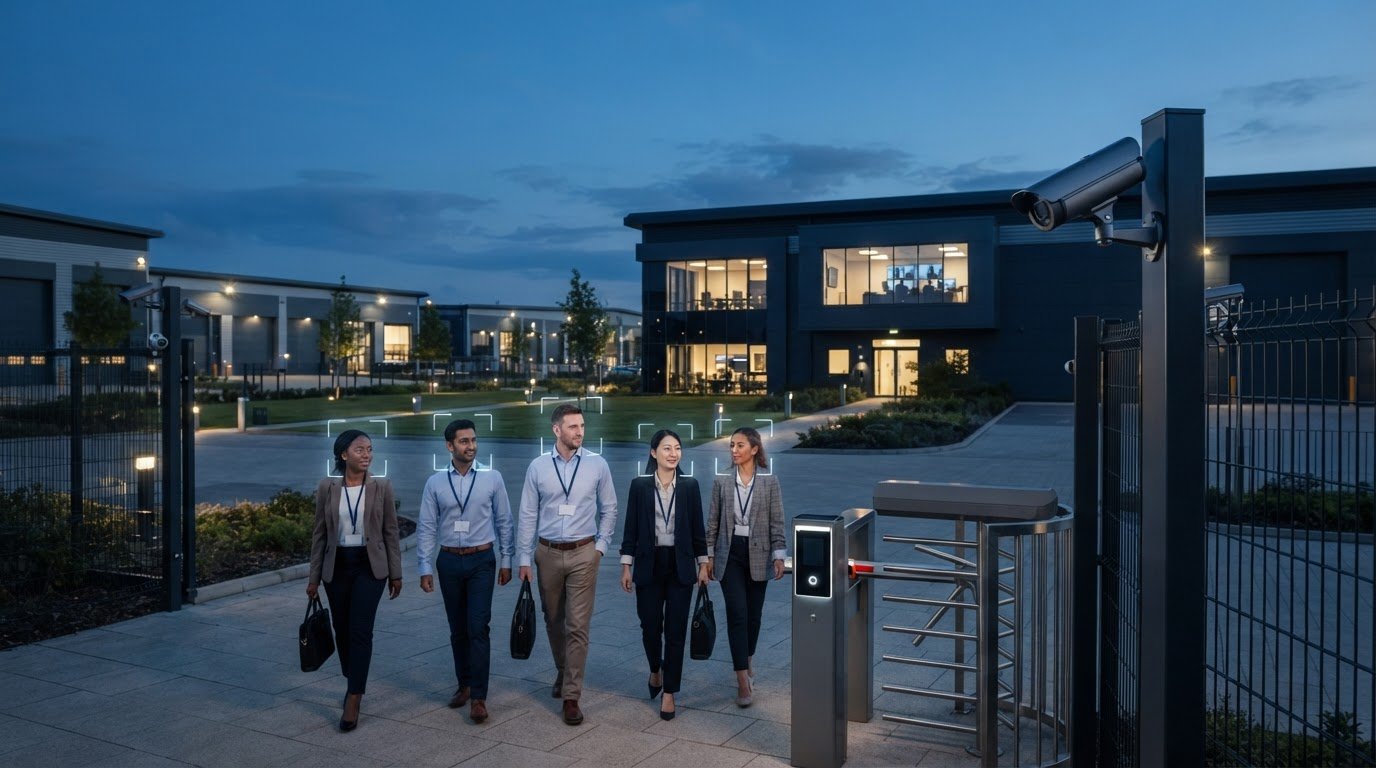
Facial recognition CCTV needs more careful consideration than standard CCTV. Live facial recognition is a stricter category, and retailers considering it need to address lawful basis, a data protection impact assessment and governance. For a business in Essex, a facial recognition CCTV system can form part of a wider security setup, connecting camera activity with access control and other site systems where appropriate.
It’s understandable to want clearer oversight of who enters a site and what happens around key areas, while keeping security practical. This guide explains how facial recognition CCTV may support commercial and industrial sites, how integration can link security systems, and how recording modes affect captured footage. It also covers legal considerations, project factors that shape system design and cost, and what to consider when planning a solution for your premises.
Key Takeaways
- Map key entrances, restricted areas and site risks before deciding where cameras should go.
- Consider how CCTV could work alongside access control, barriers and intercoms to support a coordinated security operation.
- Compare system configurations and recording modes against the coverage and evidence your premises require.
- Plan for facial recognition’s stricter privacy considerations, including lawful basis, a data protection impact assessment and governance.
- Factor in signage and planning considerations early, particularly where cameras may capture areas beyond your site.
Commercial and industrial security
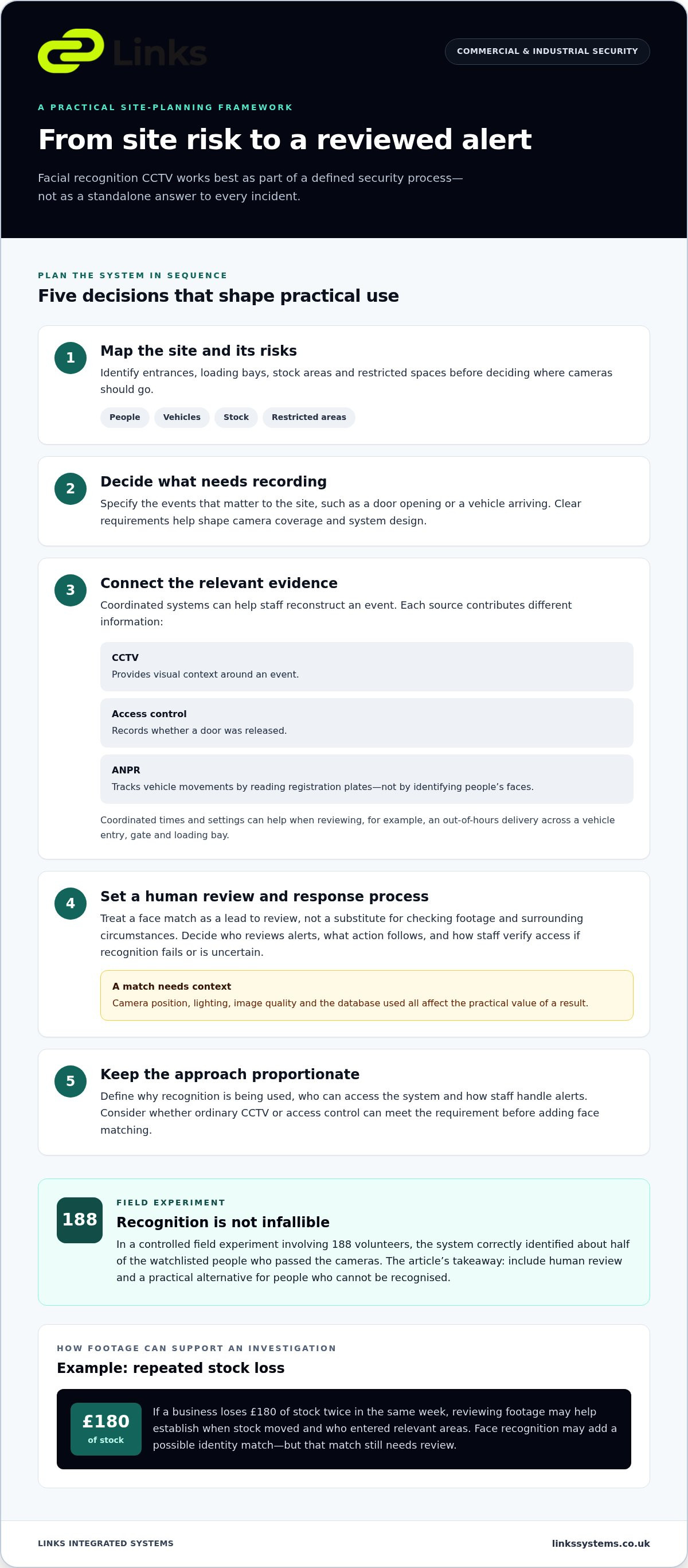
A commercial site needs more than a camera pointed at its entrance. A warehouse, factory or business park may need to monitor people, vehicles, stock and restricted areas. A facial recognition CCTV system in Essex can support this work by comparing faces with an authorised or watchlist database. It should form part of a defined security process, not be treated as a standalone answer to every incident.
Consider a business that loses £180 of stock twice in the same week. Reviewing footage may help establish when stock moved and who entered relevant areas. Facial recognition can add a possible identity match, but a match is a lead for review, not a substitute for checking the footage and surrounding circumstances. Camera position, lighting, image quality and the database being used all affect the practical value of a result.
At a site with vehicle access, ANPR cameras can track vehicles entering and leaving and trigger automatic door access. This connects vehicle movements with entry control, helping staff manage deliveries, contractors and authorised vehicles. Access decisions should follow site rules, such as whether a vehicle is expected and which area it may enter. Clear procedures also help staff respond when a vehicle or face does not match the expected record.
Before specifying equipment, map the site’s security needs:
- Identify entrances, loading bays, stock areas and restricted spaces.
- Decide which events need recording, such as a door opening or vehicle arrival.
- Set out who reviews alerts and what action follows a possible match.
- Plan how staff can verify access when recognition fails or produces an uncertain result.
Recognition performance deserves particular care. A controlled field experiment involving 188 volunteers correctly identified about half of the watchlisted people who passed the cameras. That result shows why a system should not be treated as infallible. Businesses need a human review step before acting on a match, alongside a practical alternative for people who cannot be recognised.
Essex Police has used live facial recognition technology since summer 2024. Police deployments and a private business system serve different purposes, but they underline the importance of clear use policies. A business should define why it uses recognition, who can access the system, and how staff handle alerts. Access logs and documented review steps can make operational decisions easier to trace.
Integration matters after an alert, too. CCTV provides visual context, access control records whether a door was released, and ANPR records vehicle movements. Together, these records can help reconstruct an event if their times and settings are coordinated. For example, a site manager reviewing an out-of-hours delivery can compare the vehicle entry record with footage of the relevant gate and loading bay.
Use facial recognition only for a defined security purpose, with trained staff and a documented response process. Before adding face matching, consider whether ordinary CCTV or access control meets the requirement. This helps keep the system proportionate to the site’s risks and clarifies its role in commercial or industrial security.
Which companies provide facial recognition CCTV systems in Essex?
Businesses seeking a facial recognition CCTV system in Essex may work with several parts of the supply chain. A security integrator can design a coordinated site system, while a CCTV installer may focus on cameras and recording equipment. A specialist software supplier may provide face-matching functions. One business may cover these roles, or a project may involve several companies.
Start by defining the work required. A distribution site, for example, may need cameras at vehicle entrances, coverage around loading areas and controlled staff access. This brief helps establish whether the priority is conventional CCTV, face matching or a combination. It also clarifies whether cameras need to connect with existing access control or video intercom equipment.
Ask each prospective supplier to explain how the system works in practice: how cameras capture usable images, where matching takes place, how an operator reviews a possible match, and what happens next. For instance, a match might prompt a trained staff member to review footage before deciding whether to intervene. The process matters as much as the equipment.
Use these steps to compare proposals:
- Set out the entrances, areas and security events the system must cover.
- Identify which existing cameras, access controls or intercoms need to connect.
- Request a clear description of the matching process and human review.
- Establish who will configure, commission and maintain each system component.
- Check that staff responsibilities and operating procedures are included in the plan.
A proposal should distinguish face recognition from other camera functions. ANPR, for example, reads vehicle registration plates rather than identifying people by their faces. If a site needs both functions, the design should explain how each serves a specific operational task. A vehicle entrance may use ANPR for vehicle access, while staff doors follow separate access permissions.
Compare the proposed design with the site conditions. An outdoor entrance, reception area and dimly lit loading bay each present different camera-placement considerations. Ask how the proposed views suit those conditions and how staff will review footage when an image is unclear. A site walk-through can turn a general brief into a practical camera and system plan.
Also clarify responsibility after installation. Commissioning should leave the system configured for its intended use, with staff understanding how to operate it. Ongoing maintenance can help address faults or changes to the site layout. For businesses planning connected security, a discussion about commercial CCTV and access control can help shape the wider system requirements.
What types of facial recognition CCTV systems are available for homes and businesses in Essex?
Systems differ in when facial matching happens and how cameras record. Live facial recognition compares a face with a watchlist as someone passes a camera. Retrospective face-scanning software searches recorded images later. These functions serve different purposes, so define whether the requirement is live alerts, investigation support or ordinary video evidence.
Live matching may suit a controlled entrance where an operator can review a potential match. Retrospective analysis works differently: footage is captured first, then searched following an incident. A reported case involving a man arrested for a burglary 100 miles away illustrates the risk of mistaken retrospective identification. A possible match needs careful human review, not automatic treatment as proof.
Camera resolution and placement affect the detail available for review. The supplied camera information describes 4K CCTV as offering over four times the resolution clarity of standard-resolution cameras. It also states that facial features can be recorded from 65-100 feet away. Those figures describe image capture, not guaranteed recognition at that distance. Camera angle, lighting and movement still affect the image.
For night coverage, the described cameras provide infrared night vision up to 100ft. They automatically switch to night vision as daylight falls and record in black and white. A business might use this arrangement at a loading entrance after closing. A home installation may instead focus on a front approach, where lighting and the camera’s field of view shape the footage captured.
Recording method is another distinction. Cameras can be set to four modes, each suited to a different recording need:
- Manual: an operator starts recording when required.
- Schedule: recording follows set time periods.
- Motion detection: recording starts when movement is detected.
- Continuous: footage records without interruption.
These modes affect how footage is organised, not whether facial recognition takes place. A warehouse manager might choose continuous recording for a critical goods area and schedule coverage for a quieter office. Motion detection can focus recording around activity, but camera placement and movement in view affect what it captures.
Some systems use cameras hard-wired to a network video recorder, or NVR. The described setup can connect to a monitor or 4K television through an HDMI cable. Wider viewing angles can reduce the number of cameras needed to cover a property, although the required view depends on entrances, obstructions and the detail operators need.
When comparing options in Essex, separate three decisions: whether recognition is live or retrospective, what image detail the camera needs to capture, and how footage should be recorded. A clear specification helps match the system to a home entrance, business reception or industrial access point, without confusing high-resolution CCTV with accurate facial identification.
In January, the home secretary announced that 50 live facial recognition vans would be available to every police force in England and Wales. This announcement concerns police use, rather than the recording modes or network connections described for property CCTV. It does not mean that a home or business system has the same live facial recognition capability; buyers should check which functions their chosen system actually provides.
What are the UK legal requirements for using facial recognition CCTV, including data protection and ICO guidance?
Live facial recognition is treated as a stricter category than standard CCTV. Retailers considering it need to address lawful basis, a data protection impact assessment and governance. The distinction matters because face matching changes how a camera system identifies and assesses people. Define the purpose before selecting equipment or activating recognition.
Start by setting out the specific security problem. A retailer, for example, might consider recognition to manage access to a restricted staff area. Record why ordinary CCTV or access control would not meet that purpose. This helps decision-makers assess whether face matching is appropriate and keeps the system’s intended use clear.
Next, identify and document the lawful basis for the proposed processing. This is not a box-ticking exercise: the business needs to connect its stated purpose with how the system will operate. Set out whose faces may be compared, what circumstances trigger a comparison and who reviews a possible match. A vague aim such as “improve security” does not explain the operational process.
A data protection impact assessment, or DPIA, should examine the planned use and its likely effects on people. Include the locations covered, camera views, matching process, staff roles and response to an alert. At a shop entrance, consider how the system treats customers who pass the camera but are not on a watchlist. Record potential risks and the measures planned to address them.
Governance turns these decisions into an operating framework. Document responsibilities, access permissions, staff training, review procedures and how the system’s use will be monitored. For example, a written procedure can require an operator to assess footage and context before acting. A match should not be treated as proof of identity without further review.
The Information Commissioner’s Office (ICO) is the UK’s data protection regulator, and its guidance is relevant when planning CCTV and facial recognition. Use it to inform the assessment and governance process. Keep a record of decisions, including the purpose, lawful basis, DPIA findings and safeguards. Revisit the assessment if the purpose, camera coverage or operating process changes.
Before deployment, make sure the organisation can explain its approach to staff and the public. Explain why recognition is used, how the system operates and how concerns are handled. Retailers should also set clear internal access rules for footage and matching results. These steps support accountable use and distinguish a carefully governed system from ordinary CCTV.
For an Essex business, the practical sequence is straightforward: define the purpose, assess the lawful basis, complete the DPIA, establish governance and review the planned operation against ICO guidance. Keep these decisions connected to the actual system design. A policy describing one use cannot properly govern a system later repurposed for another.
The assessment should consider the system’s likely effects on people, including customers who pass a camera without being on a watchlist, and document potential risks and safeguards. Governance should also set access permissions, staff training, review procedures and monitoring, with operators assessing footage and context before acting.
What planning permission or signage is required for CCTV installation in Essex
Planning permission and signage are separate considerations for an Essex CCTV project. Planning requirements depend on the proposed installation and property, so assess the camera position, mounting method and building constraints before work begins. Fixing a camera to an existing wall differs from installing equipment that requires structural changes or new external structures. Confirm proposed works with the relevant planning authority where site circumstances call for it.
Start with a site plan. Mark each camera, its direction of view, mounting point and the areas visible in frame. A camera above a warehouse gate, for example, may capture the entrance and part of the adjoining pavement. The plan helps identify physical installation considerations and whether the view extends beyond the business boundary.
Check the building context before choosing brackets or cable routes. A listed building, conservation area or leasehold property may involve additional considerations or approvals. These circumstances can affect where equipment is fixed and how external changes are handled. Record the property status, proposed changes and relevant permissions in the installation plan.
Signage helps people understand that CCTV is operating. Position notices where people can see them before entering a monitored area, such as beside a car park entrance or reception door. Keep the message direct: identify CCTV use and explain where further information about its purpose is available. A sign hidden behind a door or placed after the camera’s view provides little practical notice.
For facial recognition, signage is only one part of responsible operation. Live facial recognition is treated as a stricter category than standard CCTV. Retailers considering it need to address lawful basis, a data protection impact assessment and governance. The Information Commissioner’s Office (ICO) guidance should inform planning alongside the system’s intended purpose and operating arrangements.
Before installation, work through these practical checks:
- Map camera positions, angles and areas captured, including views beyond the boundary.
- Review the building and proposed physical works for planning considerations.
- Place clear notices at approaches to monitored areas, such as entrances and reception points.
- Document the purpose, operation and governance of any facial recognition function.
- Revisit the plan if cameras move or their field of view changes.
Keep the camera plan, signage locations and decision records together. If a loading-bay camera is repositioned, for example, reassess its view and update notices where needed. For support planning a coordinated installation, discuss your CCTV system requirements.
Links Integrated Systems: Speed Gates & Barriers
Links Integrated Systems helps businesses plan connected security infrastructure around site access and surveillance needs. Its systems include Speed Gates & Barriers, Access Control Systems, IP Video Intercom Systems and IP HD CCTV Systems. These can support a coordinated approach, such as managing entry at reception while CCTV monitors relevant areas.
Turn to Links Integrated Systems when planning a commercial or industrial security project that needs CCTV and access arrangements considered together. A clear project brief can identify site entrances, areas requiring camera coverage and how people should enter. Facial recognition also involves separate legal and governance considerations, so define its intended role and operating procedures as part of the wider planning process.
To discuss security requirements for your premises, contact Links Integrated Systems.
Plan the next stage of your site security
Before specifying a facial recognition CCTV system in Essex, decide what it must help staff do and how it will fit existing site operations. A defined brief guides discussions about camera coverage, entry procedures and the responsibilities involved in operating the system.
Links Integrated Systems can help shape the wider security infrastructure for your premises, including Speed Gates & Barriers, Access Control Systems and IP Video Intercom Systems. These can be considered alongside CCTV when a project needs coordinated monitoring and entry management. Facial recognition also requires separate decisions about purpose, governance and day-to-day operation.
Bring together your site priorities, planned camera locations and access requirements to start a focused project discussion. Contact Links Integrated Systems to discuss the security systems that may suit your premises.
A carefully planned approach gives your team a clear basis for the next decision and for developing a system that fits the way your site operates.