

A well-planned business CCTV system can help deter theft, provide recorded evidence for reviewing incidents and give managers a clearer view of activity in key work areas. Businesses looking for business CCTV installers in St Albans should expect coverage to be planned around entrances, sales floors, offices, yards or warehouses, rather than simply adding cameras wherever convenient. Commercial CCTV recorders can be specified for more than 30 days of storage, with capacity shaped by operational needs and system design.
It’s understandable to want visible security without creating blind spots or making staff feel that monitoring is intrusive. This guide explains what CCTV can and cannot do for theft prevention and staff monitoring, how business CCTV installers can plan coverage for sites in St Albans and across Hertfordshire, and what to consider when deciding on camera placement, recording and signage.
An effective plan also considers how footage will be reviewed after an incident and how camera coverage fits the way a site operates. Thoughtful planning can make CCTV a practical security layer for day-to-day management as well as incident investigation.
Key Takeaways
- Camera positioning should reflect whether the priority is recognising people, reviewing an incident or monitoring a particular area.
- Professional configuration can make remote viewing and footage export part of a practical incident-response process.
- Coverage across Hertfordshire depends on the business location and the requirements of its site.
- Set clear purposes for staff monitoring and consider how camera use, signage and privacy fit together.
Looking for reliable CCTV installers in Hertfordshire?
Reliable business CCTV installation starts with a site plan that matches camera views to security priorities. When choosing an installer in St Albans, assess the proposed camera positions, recording plan and commissioning process, and ask for the work scope in writing.
Professional camera placement for clear footage
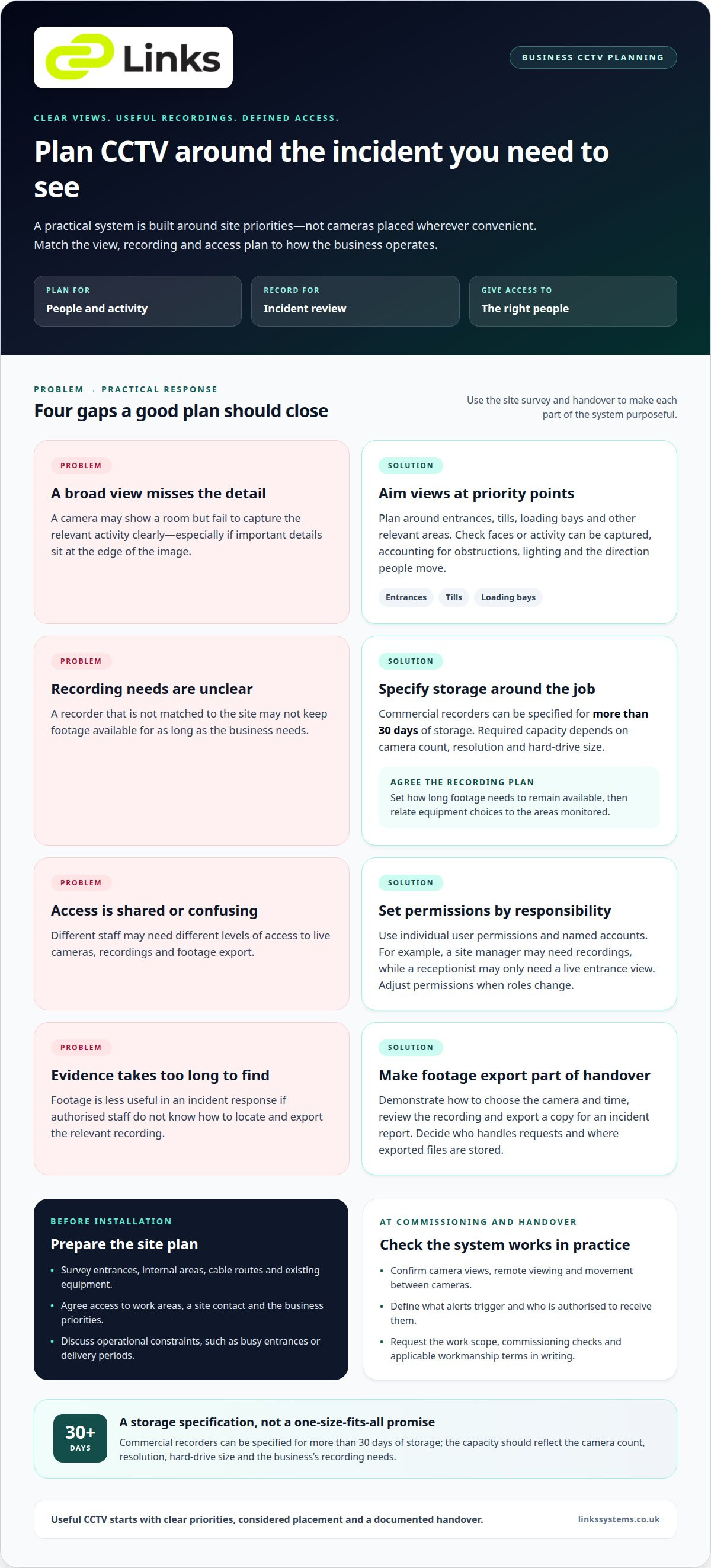
For identification and useful evidence, cameras should capture relevant activity, not just a broad view of a room. An installer can plan coverage around entrances, tills, loading bays and other areas where incidents could occur, while accounting for obstructions, lighting and the direction people move through the site. Ask how the plan captures faces or activity at each priority point, rather than leaving important details at the edge of the image.
Camera and recording equipment options
IP HD cameras can be selected and positioned to suit different business areas, with a recorder supporting review of incidents after they happen. Commercial recorders can be specified for more than 30 days of storage. The required capacity depends on factors including camera count, resolution and hard-drive size. An installer should relate equipment choices to the areas being monitored and how long the business needs recordings available, rather than treating every site as the same.
Installation workmanship and guarantee
Good workmanship includes secure camera mounting, considered cable routes and commissioning the system before handover. Ask for the installation scope and any applicable workmanship terms in writing, including how defects are addressed and any exclusions. Keep this separate from equipment cover, which relates to the cameras or recording equipment. Request a clear account of the commissioning checks and system handover.
Commercial installation timing and preparation
Commercial installation timing depends on the site layout, camera positions, cable routes and access to work areas. A small home installation may take a few hours, but that does not establish a timeframe for a business site. Before work begins, the installer needs access to the areas in scope, a site contact and a clear understanding of business priorities. Discuss operational constraints, such as busy entrances or delivery periods, so the plan can account for them.
Is CCTV effective for business security?
CCTV can support business security by helping staff oversee premises and review incidents, but its practical value depends on how footage is accessed and used. Remote viewing lets authorised users check camera images through a phone app, subject to the system’s capabilities and network connection. During commissioning, the installer can configure access and demonstrate how to view key areas and move between cameras.
Access should match staff responsibilities. An installer can set individual user permissions, limiting who can view live cameras, review recordings or export footage. For example, a site manager may need access to recordings, while a receptionist may only need a live view of the entrance. Named accounts make access clearer than a shared login, and permissions can be adjusted when staff roles change.
Alerts need a defined purpose. Where the system supports them, an installer can configure notifications for selected events or areas and explain what triggers each alert. A delivery entrance may need attention outside operating hours, while a busy customer area could generate frequent activity. Careful configuration helps keep alerts relevant rather than distracting. Remote monitoring still depends on a suitable connection and authorised access to the system.
Footage export is another key part of the handover. The installer can show an authorised user how to find the relevant camera and time, review the recording and export a copy for an incident report. Clear instructions reduce delays when management needs evidence. Businesses should also decide who handles requests and where exported files are stored, limiting access to appropriate people.
For a site that needs CCTV planned alongside connected security infrastructure, review an integrated CCTV design as part of the installation discussion.
Service coverage across St Albans and Hertfordshire
Coverage across Hertfordshire matters when a business needs a site visit, installation or follow-up work. Ware is about 14 miles from St Albans, making it a relevant example for businesses comparing local coverage. For a site near Ware, including the SG12 area, the project scope still depends on premises access, camera locations and the work required.
When reviewing an installer’s credentials, consider how they relate to the work being proposed. Accreditation schemes such as NSI and SSAIB may be relevant, but their scope matters. Assess any accreditation against the specific installation rather than treating a scheme name as proof of every capability.
A site survey provides a practical basis for a tailored installation plan. An engineer can assess entrances, internal areas, cable routes and existing equipment before defining the work. The proposed system can then reflect the premises and business priorities. For example, a warehouse with a yard may need a different coverage plan from a shop with a customer entrance and stockroom.
Customer reviews offer another perspective on installation service. Checkatrade reports that St Albans CCTV installation trades received an average rating of 10 out of 10, based on 228 customer reviews. Treat reviews as one source of information alongside a clear project scope, documented handover and defined maintenance arrangements.
For businesses seeking ongoing support, clarify how maintenance and repair fit into the project. A planned review can identify whether cameras, recording equipment or access control need attention. This is particularly relevant when the premises changes, such as when adding an entrance or reorganising a loading area.
Local coverage is only one part of a suitable installation. The engineer’s assessment should connect the business location, operational requirements and proposed system, so the resulting scope is specific to the site.
Business CCTV uses, including theft prevention and staff monitoring
Business CCTV can support theft prevention by recording activity at entrances, tills, stockrooms and delivery areas. Visible cameras may discourage opportunistic theft, while clear recordings can help managers review what happened. Their value depends on matching coverage to specific risks, rather than monitoring every part of a premises without a defined purpose.
Staff monitoring needs the same care. Set out why cameras are used, such as investigating stock discrepancies or reviewing access to a restricted area. Keep the purpose focused, and avoid treating CCTV as a substitute for direct supervision or clear workplace procedures. If cameras capture public spaces or neighbouring property, the footage brings data protection considerations. The Information Commissioner’s Office explains that data protection rules apply when cameras capture areas beyond a property boundary.
The Data Protection Act and ICO guidance are relevant when business CCTV records public spaces or neighbouring properties. Signage helps people understand that cameras are operating and why, so include it in CCTV planning. Decide who can view recordings, how requests are handled and how long footage is retained. Set retention to reflect the business need, rather than assuming every recording should be kept indefinitely.
Surveys help turn these purposes into a practical camera plan. For example, a shop may prioritise the entrance and point-of-sale area, while a warehouse may focus on goods-in, storage and vehicle movements. Cameras should capture useful activity without collecting more footage than the stated purpose requires. For businesses interested in measuring customer traffic and visitor volumes alongside physical security, specialist providers such as Smart Urban Sensing Ltd offer AI-powered people counting and footfall analytics. Review the plan when staff duties or site layouts change.
For a business in Hertfordshire or London, the takeaway is consistent: define the security purpose, plan proportionate coverage and make footage handling clear. To discuss a system designed around your premises, plan your business CCTV installation.
Links Integrated Systems: IP HD CCTV Systems
Links Integrated Systems installs IP HD CCTV Systems for commercial and professional environments. For a business planning CCTV coverage, the process can include defining site requirements, installation and commissioning, creating a practical next step from the initial plan to an operating system.
Where security also involves controlling entry, Access Control Systems and IP Video Intercom Systems can address related access needs. Speed Gates & Barriers may also suit sites where managing vehicle or pedestrian entry forms part of the security plan. The right combination depends on the premises and the priorities identified for the project.
To discuss CCTV installation for your business, contact Links Integrated Systems and talk through your site requirements.
Plan your next step with confidence
As your premises or working practices change, review whether your security plan still supports the way the business operates. A new entrance, revised staff access or different delivery flow can alter what cameras need to capture. Treat CCTV planning as part of wider operational decisions, with clear priorities for coverage, footage access and staff communication.
When comparing business CCTV installers in St Albans, focus on how the proposed system addresses your site’s requirements and how it will be commissioned and maintained. Links Integrated Systems also installs Speed Gates & Barriers, Access Control Systems and IP Video Intercom Systems, which can be relevant when a project involves managing entry as well as camera coverage.
Bring your site priorities and any planned changes into the initial discussion. That gives the installation team a practical basis for shaping the next steps around your business. Contact Links Integrated Systems to discuss your requirements and move your security planning forward.
Frequently Asked Questions
What features should I look for in a CCTV system?
Choose features around the tasks your team needs the system to support. For a multi-site business, consider whether authorised staff need access across locations; for a single premises, straightforward operation and clear recording retrieval may matter more. Check that the proposed system suits the business’s network, recording requirements and user roles. A useful handover should explain routine operation, access permissions and who manages system settings.
Which companies install business CCTV in St Albans?
Links Integrated Systems installs IP HD CCTV Systems for commercial and professional environments. Businesses seeking business CCTV installers in St Albans can discuss the purpose of each area, the site layout and how the system should fit existing security arrangements. Links Integrated Systems serves projects across Hertfordshire, London, Kent, Surrey and Essex. The installation scope can be tailored to the premises and its operational requirements.
What commercial CCTV systems and services do St Albans installers offer?
Commercial installers may work with different systems, so the proposal should identify the equipment and work included. Links Integrated Systems provides IP HD CCTV Systems, alongside system maintenance and commissioning. Its wider physical security offering includes Access Control Systems, IP Video Intercom Systems, and Speed Gates & Barriers. These options can be relevant when a project needs CCTV considered alongside controlled entry or visitor management.
How do wired, wireless, IP and analogue CCTV systems compare for businesses?
Wired and wireless describe how cameras connect, while IP and analogue describe different system technologies. Wired connections use cabling; wireless connections use a wireless network link. IP systems transmit video over an IP network, while analogue systems use a different video transmission approach. For a business, the decision depends on existing infrastructure, coverage requirements and how users need to access recordings. A site assessment can show which design suits the building.
Do business CCTV installers in St Albans offer maintenance, repairs and remote monitoring?
Services vary by project. Links Integrated Systems provides system maintenance and commissioning for security infrastructure. Its IP-based CCTV systems have cloud-based and multiple-site remote access capabilities, supporting authorised viewing across locations. Remote access is not the same as a staffed monitoring service. For ongoing upkeep, define the equipment covered, the maintenance scope and how operational changes will be handled.
What warranties and aftercare do St Albans CCTV installers provide?
Warranty terms depend on the system and installation agreement, so distinguish equipment cover from workmanship cover. Aftercare can include commissioning and maintenance to support the system after installation. Keep handover information with the relevant warranty documents, including system details and operating guidance. For a multi-site business, consistent records help facilities teams understand which equipment is installed at each premises and what maintenance applies.