
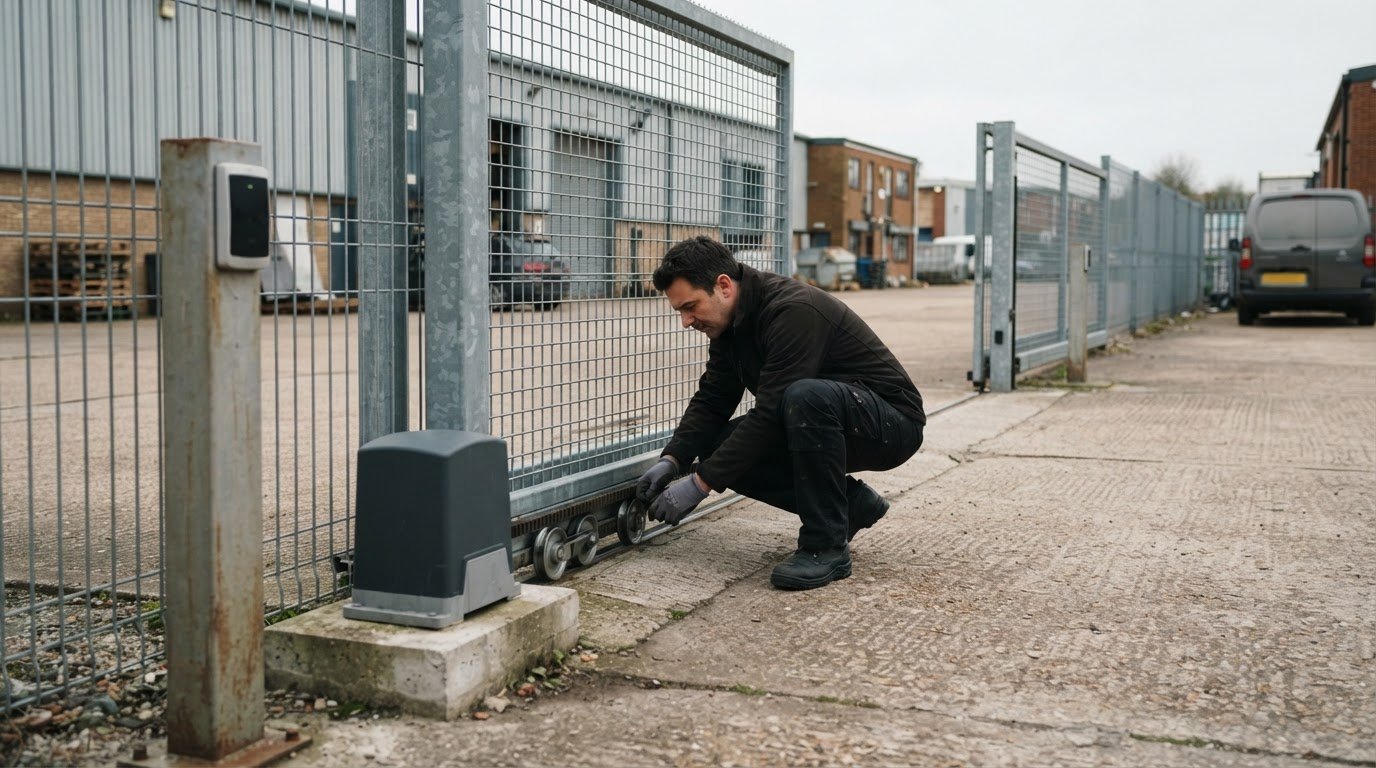
A damaged gate doesn’t automatically mean every entrance needs replacing. Often, one gate can be replaced while the rest of an industrial site’s system remains in place, provided the replacement works with existing access controls and operating arrangements. For security gate maintenance in Tonbridge, assess the gate as part of the wider site setup.
Reliable entrances matter, and planned maintenance can identify wear, damage and system faults before they lead to more extensive repairs. This guide explains what maintenance can cover, how manual, access-controlled and motorised gates differ, and what affects the work required. It also covers single-gate replacement, service coverage for Tonbridge industrial units and how maintenance contracts help plan ongoing security provision. Use these points to decide what your site needs and when professional maintenance or commissioning is appropriate.
Key Takeaways
- A single damaged gate may be replaceable without replacing every entrance; the key consideration is how it fits the site’s wider access arrangements.
- Service coverage for industrial units can depend on the site’s location and the type of gate system requiring attention.
- Manual, access-controlled and motorised gates have different operating requirements, so maintenance needs to reflect how each entrance is used.
- A maintenance contract can help plan routine checks, while traffic levels, gate material and condition shape the work required.
Service coverage across Kent and South East England
For an industrial property, service coverage depends on its location and the gate system requiring attention. In Tonbridge, maintenance planning should account for site access, how often the gate is used, and whether you need a one-off visit or ongoing support.
Tonbridge and Nearby Village Coverage
Commercial gate maintenance is carried out by specialist security-gate and access-control contractors. For a Tonbridge site, the relevant service area may include nearby villages, but the property address helps establish whether visits can be arranged efficiently. Include the gate type, access arrangements and any linked controls when describing the site’s needs. That gives the maintenance provider a practical basis for defining the work.
Planning rules may also matter if a damaged gate is being replaced. According to the UK Government, a new fence, gate or wall beside a highway used by vehicles can usually be up to 1 metre high without planning permission. This rule concerns a new boundary structure, not routine servicing of an existing gate.
One-Off Servicing and Maintenance Contracts
A one-off service can suit a gate with a specific fault, visible wear or inconsistent operation. A maintenance contract sets out recurring system checks, the equipment covered and how visits fit around site operations. Choose based on whether you need to resolve a current issue or manage several gates over time.
Before defining either arrangement, list each entrance, how it operates and any associated access-control equipment. For a site with separate vehicle and pedestrian gates, an asset list makes clear which equipment needs attention. The contract scope can then reflect actual use instead of treating every entrance alike.
Automatic Gate Servicing and Maintenance
For automatic gates in the UK, plan regular servicing, including annual system checks. The maintenance schedule should also reflect site traffic and gate material, both of which affect maintenance needs. A busy industrial entrance may need closer attention than a less frequently used access point.
Servicing can identify deterioration, rust and electrical faults for prompt attention. Specialist commercial gate and access-control contractors maintain these systems in Tonbridge and nearby areas. A service visit can focus on the automated gate and its operating arrangements, helping site managers plan follow-up work around the equipment’s condition. Looking at broader entrance solutions, providers such as Bright Way Automatic Doors showcase how purpose-built automated doors and barrier systems rely on ongoing maintenance to ensure long-term reliability.
Manual, access-controlled and motorised gate operation
Gate operation determines what maintenance needs to cover. A manual gate relies on its physical movement and locking arrangement, while a motorised gate also has powered components. An access-controlled entrance links gate operation to how staff, visitors and deliveries enter. For example, a vehicle gate may need to work alongside a separate pedestrian entrance and its access controls.
Assess locking and access control together. A gate may move correctly but still fail to secure the entrance if its lock or control system does not work as intended. During maintenance, a specialist can consider the gate’s movement, locking action and connection to access control as related parts. This helps identify whether a fault lies with the gate, its controls or the way they interact.
Access options depend on the site’s entry process. An access-control system can be planned around staff entry, visitor handling and vehicle access. An IP video intercom system can support communication with visitors before access is granted. For premises with separate entrances, the scope should identify which gates and controls are included, rather than treating the whole site as one undifferentiated system.
Motorised gates usually require mains power, although some systems include battery backup. Some electric gates can operate during a power cut through a manual release or optional battery backup. Existing gates can sometimes be automated if they are strong enough and compatible with the automation system. Those conditions matter: the gate’s construction and the chosen automation determine whether conversion is suitable. For a review of access control systems, consider how each entrance should operate and which users need access.
Gate maintenance contracts
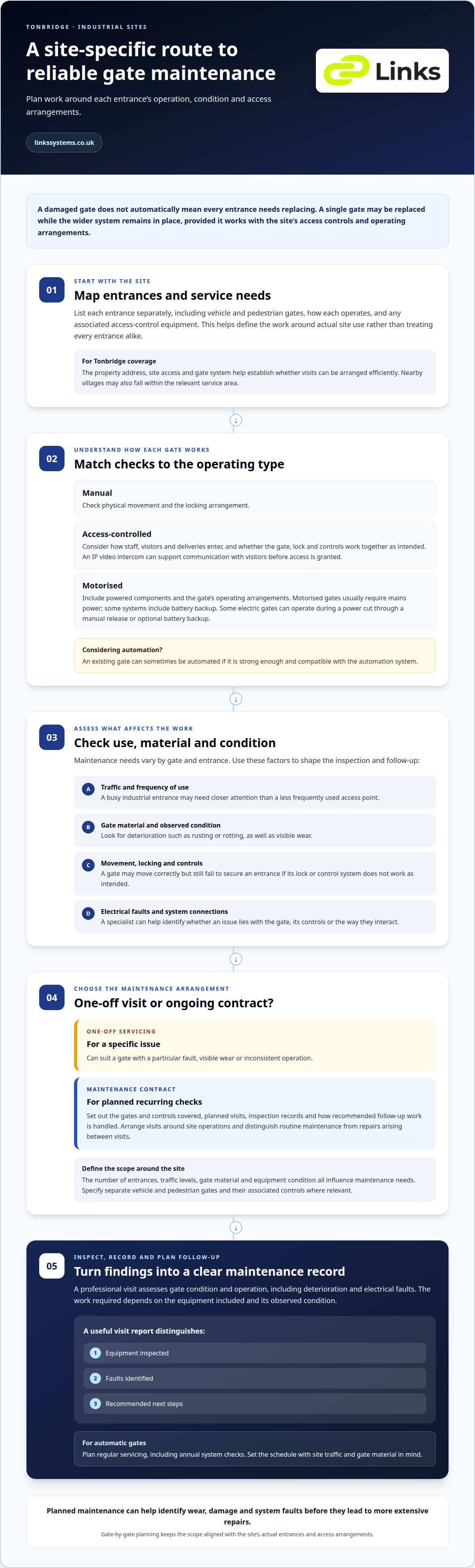
A maintenance contract sets a planned approach to inspecting and caring for site gates. Its value depends on clearly defining the equipment covered, visit arrangements and how findings are reported.
Maintenance Contract Inclusions
Specify which gates and associated controls the agreement covers, including separate vehicle and pedestrian entrances. The scope can also set out planned visits, inspection records and how recommended follow-up work is handled. This distinguishes routine maintenance from repairs that arise between visits.
For electric gates, budget for running costs and maintenance, including annual system checks. A contract can help site managers plan checks and record issues over time. Traffic levels, gate material and the number of entrances all influence maintenance needs, so a site-specific scope is more useful than treating every gate alike.
Professional Maintenance Visit
A professional visit assesses the gate’s condition and operation, looking for deterioration such as rotting or rusting and for electrical faults. The findings help identify issues for prompt attention. The work required depends on the equipment covered and its observed condition.
For a useful record, the visit report should distinguish the equipment inspected, faults identified and recommended next steps. For example, a report for a vehicle entrance can record a mechanical concern separately from an electrical fault. This gives the property manager a clearer basis for prioritising repairs and discussing the work required.
Planned maintenance can reduce the need for repairs and help avoid early replacement or emergency call-out costs. It does not remove the need to assess faults as they arise, but it provides a structured record of gate condition. A contract is most useful when its scope reflects actual use, equipment and follow-up arrangements.
In short, a professional security gate maintenance visit checks condition and operation, including visible deterioration and electrical issues. Contract terms should clarify which gates are included, how findings are recorded and how further work is discussed.
What maintenance do security gates need?
Maintenance should reflect the gate’s construction, operating method and daily use. A professional assessment considers visible wear, movement, locking and electrical controls. Frequent vehicle movements at an industrial entrance can place different demands on a gate than occasional access. Material matters too, since timber and metal can show different forms of deterioration.
During a service visit, a specialist examines the gate for damage and signs of wear, including rotting, rusting or faults in electrical parts. They also assess how it operates, whether its movement is consistent and whether its controls respond as intended. These findings help distinguish deterioration from a fault requiring further attention.
Automated systems need attention to both the physical gate and its powered operation. A movement problem may differ from an electrical fault, so recording each finding separately helps clarify the work required. Where access controls are connected, the assessment can consider their operation alongside the gate. This gives the site manager a clearer picture of the entrance as a working system.
Maintenance frequency should reflect site traffic and gate material. A busy goods entrance and a lightly used staff gate may need different plans. Annual system checks can also be included when planning electric gate maintenance. A professional can use the gate’s condition and site usage to identify suitable ongoing checks, rather than applying one schedule to every entrance.
Proactive maintenance can reduce the need for repairs and help avoid early replacement or emergency call-out costs. A clear record of wear and faults helps the property manager prioritise follow-up work. For example, recording rust or rotting separately from an electrical issue makes the maintenance history easier to review and discuss.
If a gate needs a professional assessment, discuss your system maintenance requirements and the issues affecting its operation.
Links Integrated Systems: Speed Gates & Barriers
Links Integrated Systems provides gate maintenance and commissioning, alongside support for wider entrance requirements at industrial sites. Its work includes speed gates and barriers, access-control systems and IP video intercom systems. This is a practical next step when a gate fault affects site access or a damaged gate needs to be assessed alongside connected controls.
For a Tonbridge industrial unit, note which gate is affected, how it operates and whether access control or an intercom is linked to it. These details help define the maintenance or commissioning requirement and distinguish a gate issue from a wider system concern.
To discuss your site’s gate requirements, contact Links Integrated Systems.
Plan the next step for your site
Use the maintenance findings to decide what to do next: address an immediate fault, plan ongoing servicing or review how the entrance supports site access. For a damaged gate, assess its condition alongside the needs of the wider premises. This helps shape a practical scope of work without assuming every entrance needs the same solution.
For security gate maintenance in Tonbridge, start by outlining the affected entrance, how it operates and the issue requiring attention. This gives the discussion a clear focus and helps establish whether maintenance, commissioning or a wider system review is appropriate. Links Integrated Systems can discuss site gates and access arrangements.
Contact Links Integrated Systems to discuss the next step for your site. A clear plan can help you move forward with confidence.
Frequently Asked Questions
What Areas Do You Cover?
Links Integrated Systems works across London, Kent, Surrey, Hertfordshire and Essex. For a site in Tonbridge or a nearby village, include the property address and whether the affected entrance serves vehicles, pedestrians or both when discussing maintenance. This helps define the relevant gate and access-control equipment for the work.
What checks should a professional carry out on gate safety devices and sensors?
A professional should assess whether each fitted safety device responds as intended during gate operation. This includes checking sensor positioning, visible damage and whether the gate responds when a sensor detects an obstruction. The assessment should also consider how the devices interact with the gate controls. Record any fault or inconsistent response for follow-up instead of bypassing it or treating it as normal operation.
How can a professional maintain a security gate safely between service visits?
Between visits, site staff can keep the gate’s operating area clear and report unusual movement, damage or changes in control behaviour. They should not adjust components, interfere with sensors or override safety functions. For example, if a gate stops unexpectedly, follow site procedures to take it out of routine use, then report the symptoms and affected entrance.
How quickly can Tonbridge security gate companies provide emergency repairs?
Emergency repair timing depends on the fault and service arrangement, so do not assume same-day or out-of-hours attendance. For a Tonbridge industrial gate, report whether it is stuck open, stuck closed or operating inconsistently, and describe any visible damage. This information helps define the issue and an appropriate maintenance response without relying on an unpromised arrival time.
What UK regulations and standards apply to powered security gates?
The Health and Safety Executive treats a powered gate as machinery. Under national permitted development rules, a new gate beside a highway used by vehicles can usually be up to 1 metre high without planning permission; in England, other new gates can usually be up to 2 metres high.