
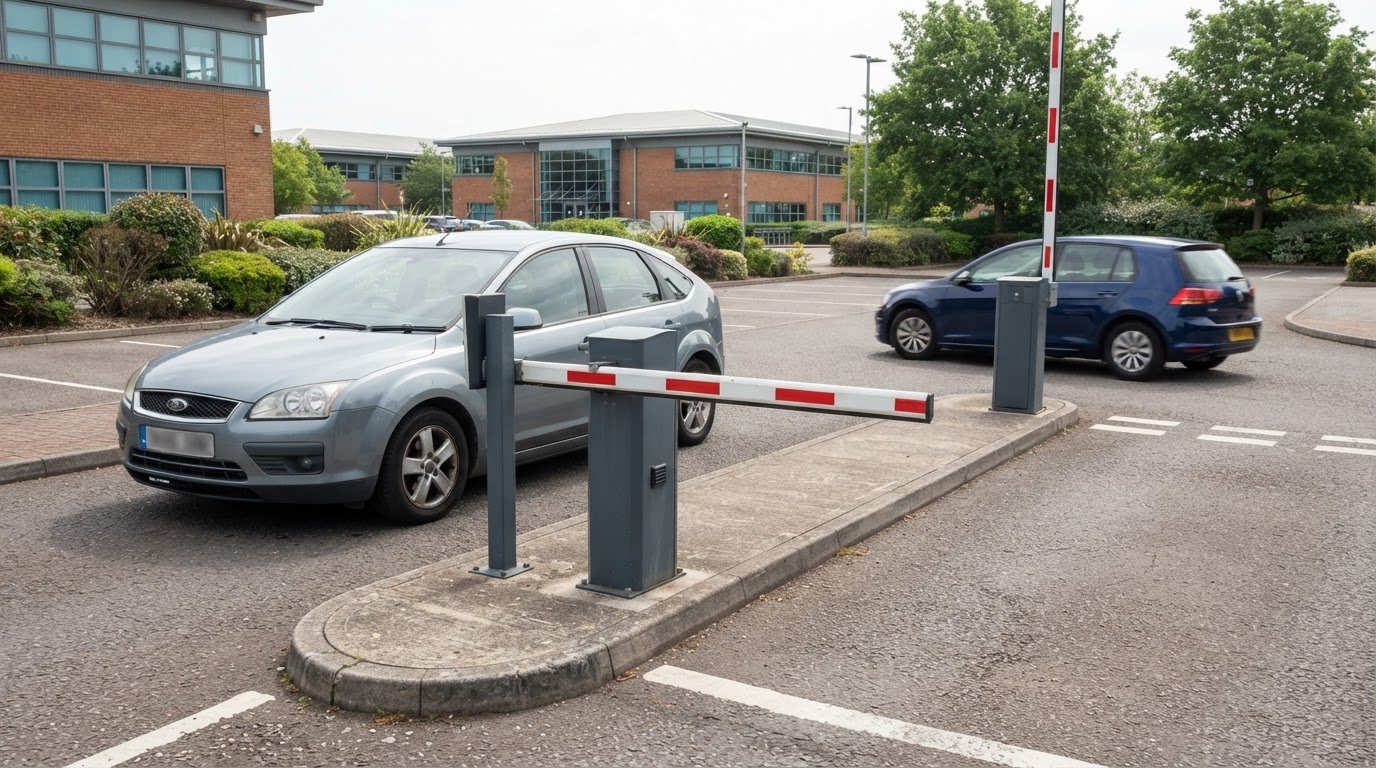
The barrier itself is only part of the cost. If you’re asking how much a car park barrier costs in Essex, the project price depends on the system, access-control features and installation work required. Pricing is provided after a quote request, based on the site layout and how the entrance needs to operate.
It’s reasonable to want a clear budget before choosing a system. Rather than comparing equipment alone, consider vehicle traffic, how access should be managed and what the site installation needs to accommodate.
This guide explains the main cost factors, what installation can involve and how different barrier arrangements suit different sites. It also outlines what to consider when choosing a supplier in Essex, helping you make an informed decision about a system that meets your car park’s requirements.
Key Takeaways
- Build your budget around both the barrier equipment and the installation work, which can vary with the site layout and system requirements.
- Match manual or automatic operation to how the car park is used and how access needs to be managed.
- Consider lane width and boom length when assessing which barrier arrangement will suit the entrance.
- When selecting a supplier, look for a clear approach to safe vehicle and pedestrian movement, system documentation and ongoing maintenance.
Barrier costs and installation expenses
A car park barrier budget covers more than the equipment. Installation, groundworks, access controls and ongoing maintenance can all affect the total project cost.
Installation and groundworks
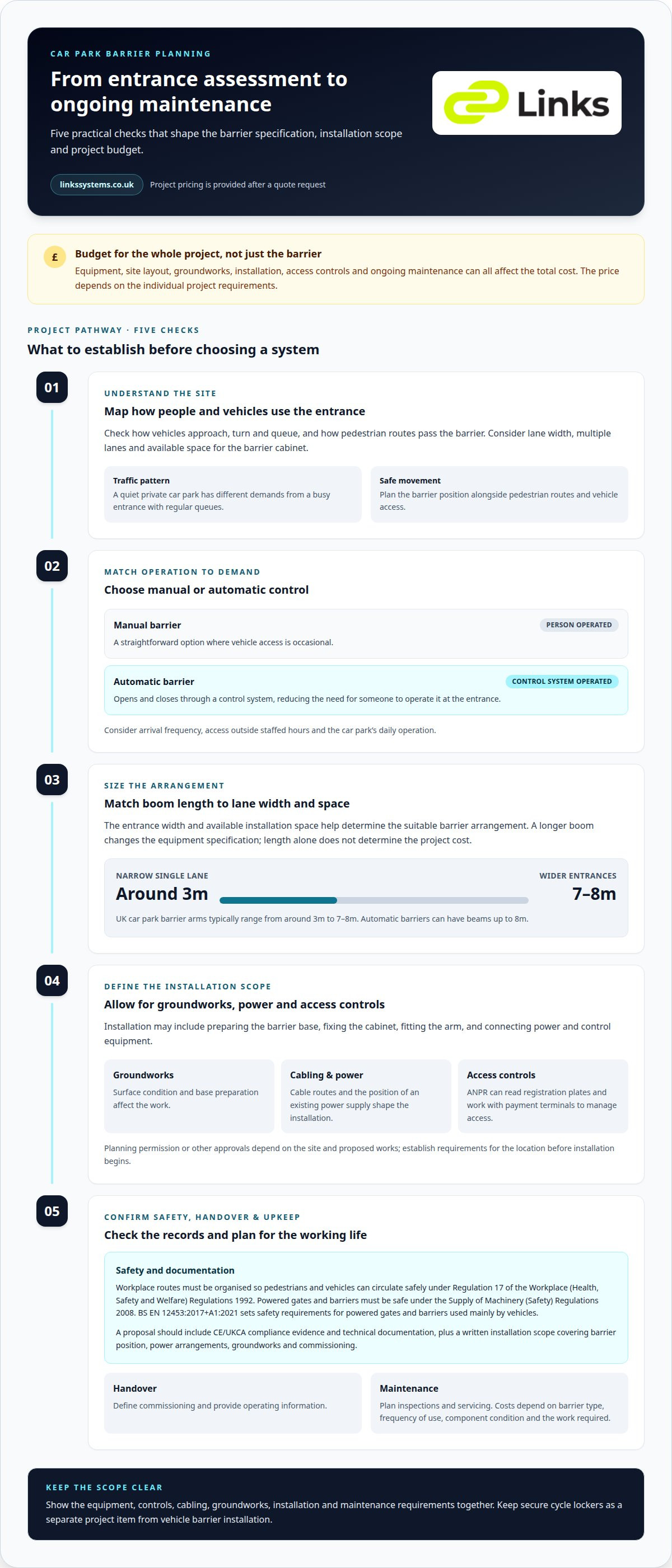
Installation may involve preparing the barrier base, fixing the cabinet, fitting the arm and connecting power and control equipment. The surface and cable routes affect the work required. For example, running a new cable across finished paving involves different preparation from installing a barrier beside an existing power supply. The quote reflects the equipment, site layout, groundworks and installation requirements.
UK Government Legislation states that, under Regulation 17 of the Workplace (Health, Safety and Welfare) Regulations 1992, workplace routes must be organised so pedestrians and vehicles can circulate safely. The barrier position should therefore be considered alongside pedestrian routes and vehicle access, rather than as a separate installation decision.
Factors affecting costs
Traffic volume affects the system required and how frequently its components operate. A quiet private car park has different demands from a busy entrance with regular queues. The layout matters too: a narrow approach, multiple lanes or limited space for the barrier cabinet can change the installation plan. The power supply affects equipment positioning and whether cabling is part of the project.
These details are considered together when establishing the specification. The price depends on the individual project and is provided after a quote request, with equipment, site layout, groundworks and installation among the cost factors.
Ongoing maintenance and repair
Maintenance and repair costs depend on the barrier type, frequency of use, component condition and work required. Routine servicing can identify wear or operational faults; repair costs depend on the affected part and access needed to complete the work. A maintenance plan should define inspection and service requirements for the installed system.
Secure cycle lockers are a separate parking facility, not part of a vehicle barrier installation. Their costs depend on the locker specification, quantity, fixing surface and site preparation. Keep them as a separate item in the project scope so cycle parking and vehicle access are budgeted clearly.
How much does a car park barrier cost in the UK?
The cost depends on the barrier type, boom length and access-control requirements. If you’re asking how much a car park barrier costs in Essex, project pricing is provided after a quote request and reflects the equipment and site requirements.
Manual and automatic barriers
A manual barrier is operated by a person, making it a straightforward option where vehicle access is occasional. An automatic barrier opens and closes through a control system, reducing the need for someone to operate it at the entrance. Consider how often vehicles arrive, whether access must be managed outside staffed hours and how the system will fit the car park’s daily operation.
Boom lengths and barrier costs
UK car park barrier arms typically range from around 3m for narrow single lanes to 7 to 8m for wider entrances. Automatic barriers can have beams up to 8m. A longer boom changes the equipment specification, so the entrance width and available installation space help determine the suitable arrangement. How much a car park barrier costs in Essex also depends on the chosen system configuration, rather than boom length alone.
Planning permission or other approvals for a barrier in Essex depend on the site and proposed works. Establish the requirements for the specific location before installation begins.
Powered gates and barriers must be safe under the Supply of Machinery (Safety) Regulations 2008, according to UK Government Legislation. BS EN 12453:2017+A1:2021 sets safety requirements for powered gates and barriers used mainly by vehicles.
Automatic Number Plate Recognition (ANPR) cameras read vehicle registration plates to manage access automatically. ANPR can form part of a system with payment terminals, with the barrier controlling vehicle entry and exit. The specification should reflect how drivers use the car park, including whether payment or access permissions need to be managed at the entrance.
Choosing a barrier supplier
A suitable supplier should understand the car park’s operating pattern, entrance layout and access requirements. A council-run public car park, for example, may need a different access arrangement from a private workplace entrance. The specification should match the barrier, controls and installation plan to how vehicles and pedestrians use the site.
Technical records matter alongside equipment selection. A barrier proposal should include CE/UKCA compliance evidence and technical documentation. These records explain what system is being supplied and how it is specified. Project documentation should also set out the installation scope, including the barrier position, power arrangements, any groundworks and commissioning.
Assess the proposed project against practical requirements:
- Site assessment: confirm how vehicles approach, turn and queue, and how pedestrian routes pass the entrance.
- System specification: match the barrier and access controls to the site’s traffic pattern and operating needs.
- Installation scope: identify equipment, cabling, groundworks and any changes needed around the entrance.
- Handover and maintenance: define commissioning, operating information and the planned approach to servicing or repairs.
For a car park with separate entry and exit lanes, the design should show how each barrier relates to its vehicle route. A compact workplace entrance may need a simpler layout. Clear drawings and a written scope make these differences visible before installation and help stakeholders understand what the project includes.
Consider the system’s full working life, not just installation. The handover should explain how the barrier operates, while maintenance arrangements should cover inspection and repair needs. A site with frequent daily vehicle movements, for example, has different demands from an entrance used occasionally. Defined servicing and documentation support informed decisions about the system over time.
What are the costs of different car park barrier types and boom lengths?
The barrier type and boom length shape the equipment specification, while the entrance layout affects installation. Project pricing is provided after a quote request and reflects factors such as system configuration, access controls and site requirements.
A person operates a manual arm, while an automatic barrier opens and closes through its control system. This choice affects how the entrance is managed and what equipment installation requires. A simple single-lane entrance has different needs from a multi-lane arrangement with ANPR and payment terminals. Those components form part of the overall specification, not just the barrier arm.
Boom length should match the clear width of the vehicle lane. Typical UK arms range from around 3m for narrow single lanes to 7 to 8m for wider entrances. Automatic barriers can have beams up to 8m. A longer arm may suit a broader opening, but the supporting equipment and available space must also fit the site. The useful comparison is therefore between complete configurations, not arm length in isolation.
For separate entry and exit lanes, the design must account for both approaches and each barrier’s position. A single-lane site has a different layout to assess. The vehicle route, space for the barrier cabinet, power route and access controls all affect installation scope. These details explain why barriers with similar boom lengths can have different project costs.
- Manual arm: assess the operator’s access and the way vehicles are admitted.
- Automatic arm: specify the controls and operation needed for the entrance.
- Longer boom: match the arm length to the lane width and available space.
- Multi-lane system: include the ANPR and payment-terminal requirements in the design.
To discuss a barrier configuration for your entrance, request a barrier system discussion.
Links Integrated Systems: Speed Gates & Barriers
Links Integrated Systems supplies and installs speed gates and barriers to help commercial and professional sites manage vehicle access. It can also integrate access control, IP video intercom and IP HD CCTV systems to support the site’s security requirements.
Turn to Links Integrated Systems when you’re ready to move from cost research to defining a barrier system for your car park. The project can be considered as a whole, from the entrance layout and access controls through to commissioning and ongoing maintenance. This helps align the proposed equipment with site operations instead of treating the barrier as a standalone component.
For a discussion about a car park barrier project, contact Links Integrated Systems.
Plan the right access system for your site
Knowing how much a car park barrier costs in Essex is a useful starting point. Next, define how the entrance should work for drivers, staff and visitors. A clear project brief can outline access needs, vehicle movements and how the system should fit into the site’s wider security arrangements.
Links Integrated Systems can help develop that brief around Speed Gates & Barriers, Access Control Systems and IP Video Intercom Systems. Bringing these requirements together during planning helps shape a coherent system, rather than treating each entrance component as a separate decision.
Share your project requirements with Contact Links Integrated Systems and take the next step towards specifying an access system that fits your car park.
Frequently Asked Questions
Should I choose surface-mounted or root-fixed (concreted-in)?
Choose a fixing method that suits the entrance surface and the barrier’s installation requirements. Surface mounting may suit existing hardstanding with an appropriate fixing point; root-fixing sets the barrier support into a prepared foundation. For a refurbished Essex car park, consider the condition and construction of the existing surface. The installation design should account for the barrier position and vehicle route.
What is the average cost to install a car park barrier in Essex?
There isn’t one useful average for every Essex car park, because pricing depends on the system and work required at the site. A single entrance with straightforward access needs differs from a site requiring multiple lanes or integrated controls. The quote reflects the equipment, access requirements, site layout and installation work.
How much do automatic parking barriers cost in the UK?
The cost of an automatic parking barrier depends on its configuration and the access functions it needs to support. A basic vehicle entrance has a different scope from one requiring plate recognition, payment handling or linked access permissions. For a meaningful budget, define how drivers will enter and exit, who is authorised to use the car park and whether the system must connect with other site controls.
How much does car park barrier installation cost in Essex, including labour and groundwork?
Installation pricing reflects the work needed to prepare and connect the system at the Essex site. A quote can distinguish barrier equipment from labour, foundations, cabling and reinstatement of affected surfaces. For example, an entrance with suitable existing power and a prepared fixing area may require a different scope from one needing new cable routes or surface preparation.
How much do access controls such as keypads, fobs, ANPR and ticketing add to the price?
There is no fixed addition that applies to every system. Each control option changes the equipment and configuration required: keypads and fobs manage authorised entry, while ANPR reads vehicle registration plates. Ticketing creates a different access process for parking users. The project quote should identify the chosen controls and how they work with the barrier, so the cost reflects the intended arrangement.
Which Essex companies install car park barriers, and do they offer quotes or maintenance plans?
Links Integrated Systems supplies and installs car park barriers in Essex, alongside access control and related systems. Project pricing is provided after a quote request and reflects the site and system requirements. The company also provides commissioning and system maintenance. Its service area includes Essex, London, Kent, Surrey and Hertfordshire, supporting commercial and professional environments.