

An office security system that only records an incident is not a complete solution. Future-proofing office security in London starts with layers that control entry and provide visibility, including access control, CCTV, video intercoms, and gates or barriers. CCTV can record and monitor activity, but it cannot intervene in real time to stop an intruder.
Security needs depend on how a building is used. Staff numbers, visitor access, hybrid working patterns and quieter periods can all affect where vulnerabilities arise. This guide explains what office security systems can protect, what CCTV monitoring does and does not do, and how risks can vary across London. It also covers how to plan for changing access needs so your security arrangements can adapt as the workplace evolves.
Key Takeaways
- Map entry points, visitor flows and quieter periods to identify where access control, gates or video intercoms could strengthen protection.
- Separate CCTV recording from active monitoring and response when deciding what level of oversight your office needs.
- Assess local risks in context, including the building’s location, access arrangements and out-of-hours occupancy.
- Choose security systems that can be maintained and adapted as your workplace, staffing patterns and access needs change.
I need London office security to protect my establishment, what can you offer?
Start by mapping staff arrivals, visitor routes and vulnerable doors, then match each risk to a practical security measure. A future-proof solution can combine physical controls, clear procedures and systems that adapt as workplace needs change.
Replacing obsolete access systems
List the current system’s limitations, such as unreliable credentials, poor visibility at reception or doors that no longer reflect how rooms are used. Map entry points, staff and visitor routes, and the response needed when access is refused. Replacing equipment in stages can help maintain authorised entry during the transition. Include commissioning and maintenance in the plan so faults and operating arrangements are addressed as part of the change.
Accessible, personalised workspace access
Plan access around how employees use the building, including people with different physical abilities or support needs. For example, check whether the entrance, reception desk and route to meeting rooms work together without creating avoidable barriers. Assign permissions by role and area, and review them when responsibilities change. CCTV, access records and employee monitoring should have a clear workplace purpose, appropriate access controls and transparent procedures.
Scalable access for staff arrivals and hybrid working
For busy arrival periods, plan access control around reception queues, visitor check-in and staff entrances. Integrated systems can link door permissions with video intercoms, helping reception identify a visitor before granting entry. Define how credentials and procedures work for hybrid staff and out-of-hours access, then review them as attendance patterns change. Protect connected systems with appropriate network security measures, including firewalls, encryption and regular software updates.
Choosing security systems, providers and accreditations
Smart systems record events and manage permissions; guards can assess situations and provide a human response, while alarms alert people to defined events. These measures serve different functions, so compare them against the building’s risks rather than treating one as a complete substitute. According to the UK legislation register, every security guard operating in the UK must hold a valid Security Industry Authority licence under the Private Security Industry Act 2001. When assessing London providers, distinguish this individual licence from company accreditations and ask what each credential covers. Cloud access depends on network availability; biometric data needs careful protection, and AI video can produce incorrect alerts. Define escalation steps and review system access regularly.
Is CCTV monitoring included in office security service packages?
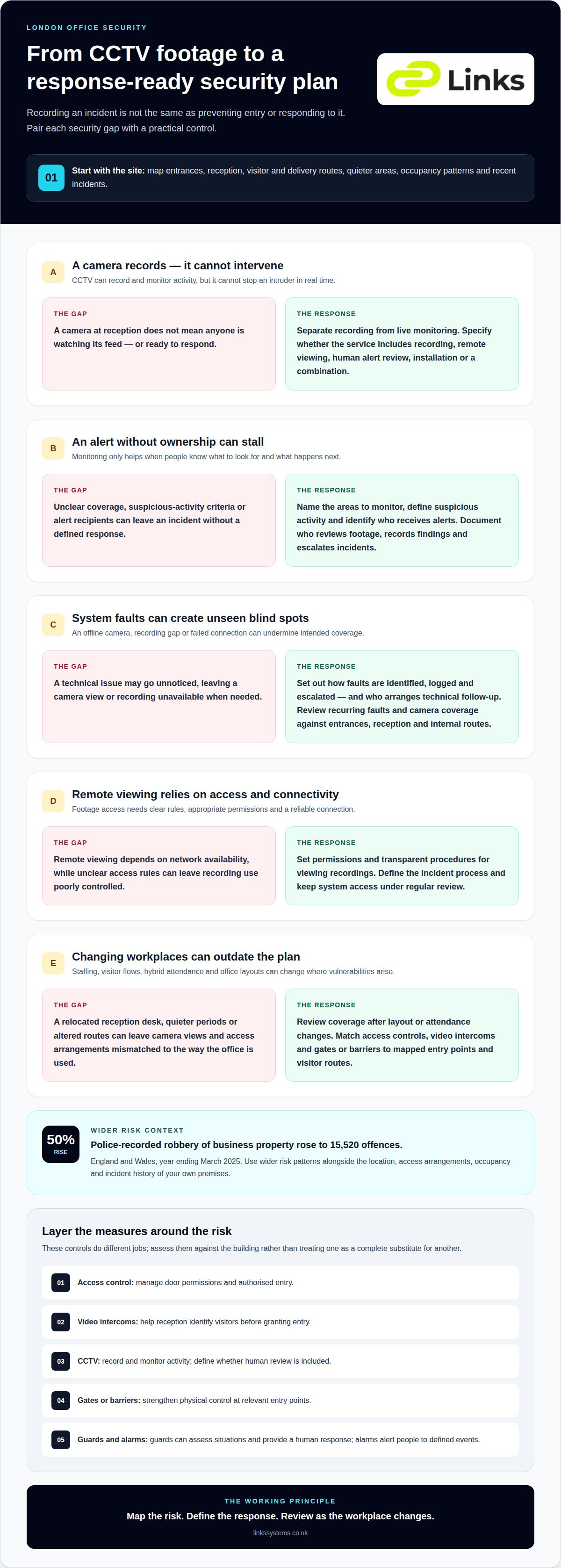
CCTV equipment and live monitoring are separate parts of an office security arrangement. Cameras can record and monitor activity, but they cannot intervene in real time to stop an intruder. Define whether the service includes installation, recording, remote viewing, human review of alerts, or a combination. A camera at reception, for example, does not mean that anyone is watching its feed.
For continuous monitoring, specify which areas need attention, what counts as suspicious activity and who receives an alert. Include system health in the process: a camera going offline, a recording gap or a failed connection can leave a blind spot. Define how an issue is identified, logged and escalated, and who arranges technical follow-up. This helps distinguish a security event from a system fault and gives staff a clear response process.
Remote viewing can help a corporate team review footage without being physically present in the office. It still depends on reliable connectivity, appropriate user permissions and clear rules for accessing recordings. Set procedures for incidents, such as an unfamiliar visitor entering a restricted area, including who reviews the footage and how findings are recorded. Monitoring should support a documented response plan, not replace one.
Review performance to check whether cameras cover the intended entrances, reception points and internal routes. Look at recorded incidents, recurring faults, alert handling and changes to the office layout. Record actions, such as adjusting camera views after reception moves or arranging maintenance when a device repeatedly loses connection. These practical checks help maintain useful coverage as the workplace changes.
Before agreeing a service package, compare its written scope with the monitoring tasks your establishment needs. A planned CCTV system review can help clarify camera coverage, recording requirements and how system maintenance fits the security plan.
London office crime risks
London offices face different risks depending on their location, access arrangements and occupancy. Assess the site, operating patterns and recent incidents, then prioritise practical controls.
Assessing London office crime risks
Map entrances, reception, delivery points and quieter areas, then review when each is occupied. Shoreditch, Canary Wharf and the City of London can face opportunistic out-of-hours crime, so consider evening access and changing staff presence. According to the Office for National Statistics, police-recorded robbery of business property in England and Wales rose 50% to 15,520 offences in the year ending March 2025.
Compare wider risk patterns with those at your premises. Record incidents such as unauthorised entry, theft or repeated attempts to access a restricted door. Note the time, location and operational impact of each event. This gives managers a clearer basis for deciding which entrances, assets and periods need closer attention.
Creating a future-proof security plan
Turn the assessment into a plan with named responsibilities, procedures and review points. For example, document who can authorise visitors, how staff report suspicious activity and what happens when an access system fails. Include overnight operations and hybrid attendance, since an office may be largely empty at 5pm despite staff still working remotely.
Set priorities by considering both consequence and likelihood, then match each risk with a proportionate control. Review the plan after a layout change, a shift in working patterns or a security incident. If guards are part of the arrangement, define their duties and use appropriate vetting procedures. Record decisions and unresolved risks so managers can track actions over time.
For a practical review, walk the site during a normal arrival period and again when occupancy is low. Check whether delivery routes, visitor access and staff entrances create overlooked gaps. Compare your observations with incident records and planned building changes. Then assign an owner and review date to each action, such as improving visibility at a side entrance or updating an out-of-hours access procedure. This documented cycle helps the security plan adapt as London office operations change.
Office security across London
London offices range from compact premises near Shoreditch to large, multi-storey buildings around Canary Wharf and the City. Entrances, visitor flows and out-of-hours occupancy vary, so security systems should reflect each site’s layout and operations. A site walk-through is a useful starting point: map public entrances, staff routes, delivery areas and less visible access points.
Scale changes the operational picture. The 2 London Bridge office building covers 116,538 sq. ft. across seven floors and serves between 700 and 1,500 users. For a building of this size, consider how staff, visitors and deliveries move between floors, and where access needs to be controlled. Smaller offices may need a different balance, focused on reception, shared entrances and periods without staff presence.
Out-of-hours arrangements should match how the building is used. Overnight security can help London businesses manage risks during evenings and weekends, but the plan should reflect actual occupancy and vulnerabilities. Set patrol routes around entrances, shared areas and vulnerable points, with clear procedures for recording concerns and escalating incidents. Where evening and weekend attendance varies, align cover with when the office is occupied and which areas remain accessible.
Plan system changes around building use. At 2 London Bridge, a new access-control system operated alongside the old one before the transition, maintaining tenant access. Existing cabling was reused where possible to reduce disruption. This illustrates two practical planning steps: maintain authorised entry during a changeover, and assess existing infrastructure before deciding how to upgrade it.
For a London site, document who uses each entrance, when access is needed, and how staff report faults or incidents. Review the plan after changes to occupancy, layout or tenant requirements. Discuss your office security requirements as part of planning the next stage for your building.
Links Integrated Systems: Speed Gates & Barriers
Links Integrated Systems helps London organisations plan and install security systems around their access requirements. Speed gates and barriers support controlled entry, while access control systems manage permissions for staff and visitors. IP video intercom systems help reception teams identify visitors, and IP HD CCTV systems provide recorded visibility across selected areas.
Consider an upgrade when reviewing an outdated system, redesigning reception or adapting access for changing staff patterns. The right arrangement depends on the building’s entrances, visitor routes and operational needs. Commissioning and system maintenance can support reliable operation as part of the wider security plan.
Contact Links Integrated Systems to discuss your organisation’s office security requirements.
Make your next security decision part of a longer plan
Future-proofing office security in London is not about adding technology for its own sake. It is about making each change work with the building’s next stage. Before committing to an upgrade, record what has changed, which access points matter most and how the system should adapt if teams, tenants or visitor processes shift. This gives facilities and operations teams a useful reference for future reviews, rather than treating each fault or fit-out as an isolated decision.
Links Integrated Systems can turn those requirements into a coordinated approach, from Speed Gates & Barriers and Access Control Systems to IP Video Intercom Systems. Start with a discussion about your organisation’s layout, access needs and priorities, so the proposed system addresses the actual site rather than a generic brief.
Contact Links Integrated Systems to discuss the next stage of your office security planning. A clear plan can help your team make informed decisions as the workplace evolves.
Frequently Asked Questions
What is future-proofing?
Future-proofing means planning systems and procedures so they can adapt as a workplace changes. For office security, that might mean choosing access technology that supports revised staff permissions, a new reception arrangement or changes to the building’s layout. Future-proofing office security in London also means reviewing whether existing equipment still meets the organisation’s needs, rather than replacing it automatically.
What are the latest office security threats facing businesses in London?
London offices need to consider opportunistic theft, unauthorised entry and risks during quieter periods, including evenings when fewer people are on site. For example, a delivery entrance left in use after reception closes may receive less attention. Hybrid working can also create uneven occupancy, so assess how access procedures work when usual staff are not present.
How can London offices future-proof access control and visitor management systems?
Design the visitor journey from arrival to departure, including how reception identifies guests, records visits and notifies hosts. Review the process for contractors who need access to specific areas, and remove their permissions when the work ends. For a growing office, plan how new teams, entrances or locations will fit into the system. Accessible routes and clear procedures should remain part of that design.
How much does office security cost in London, including installation and ongoing maintenance?
There is no single price for office security in London: costs depend on the building, equipment, installation requirements and maintenance needs. The number and type of entrances, existing infrastructure, coverage areas and system integration all shape the project. Links Integrated Systems provides installations and maintenance across London, Kent, Surrey, Hertfordshire and Essex, with pricing based on the project requirements.
What UK laws and regulations apply to office CCTV, access control and employee monitoring?
The article requires CCTV, access records and employee monitoring to have a clear workplace purpose, appropriate access controls and transparent procedures. It names the Private Security Industry Act 2001 as requiring every UK security guard to hold a valid SIA licence; it does not identify specific laws for CCTV, access control or employee monitoring.