
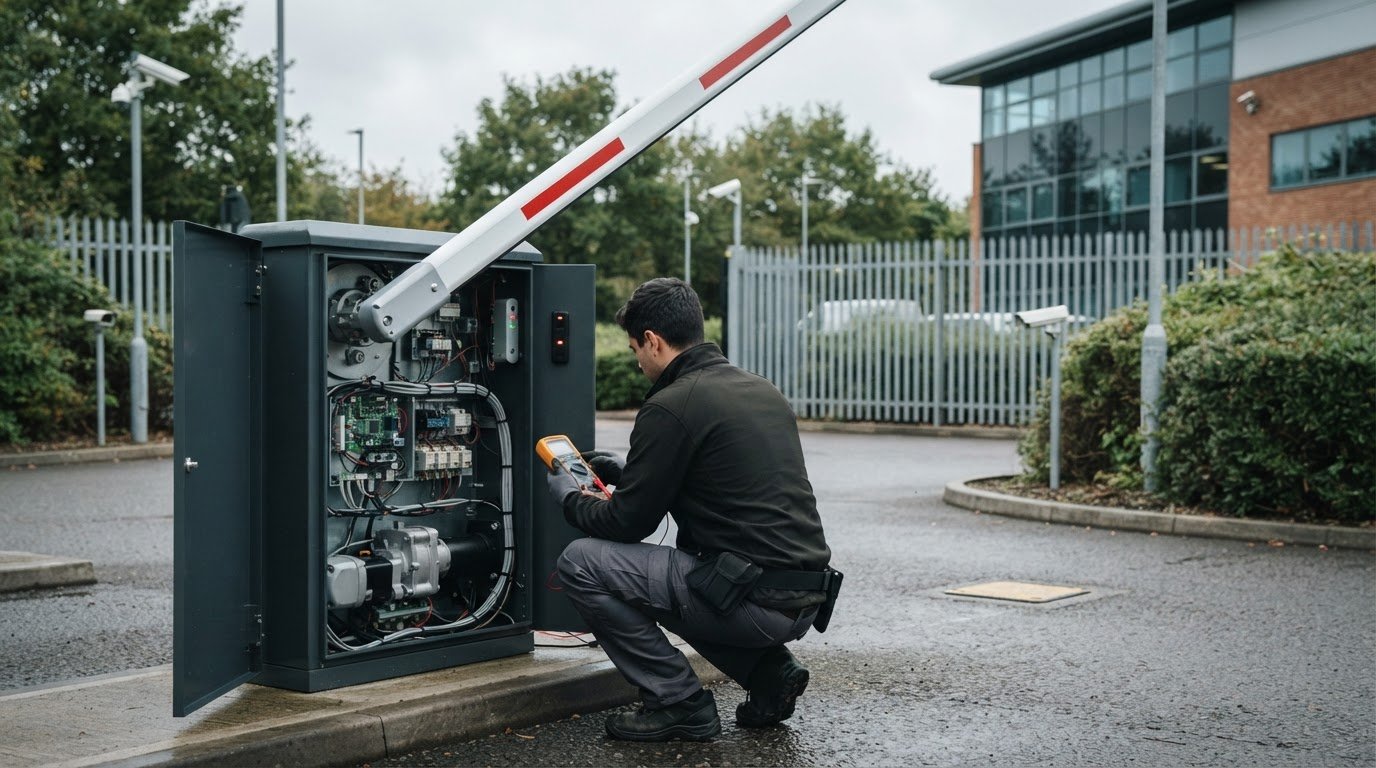
A barrier that still moves can leave an entrance less secure than it should be. The automatic barrier repair cost in Essex depends on the fault, any parts required, site access and when the work takes place. You’ll receive a quote based on these factors after making a request.
It’s understandable to focus first on getting the entrance working again, particularly when a fault disrupts vehicle access. But the cause matters: a problem with the boom, motor, controls or access system can affect reliable operation and how the site manages entry.
This article explains common barrier faults, what influences repair costs and how faults can affect security. It also outlines what a site survey considers, including the entrance, its use and safety, so you can understand the steps towards a suitable repair and quote.
Key Takeaways
- Repair costs depend on the fault, parts, access to the site and timing; identify the symptoms before arranging an assessment.
- A barrier fault can affect more than vehicle flow, so consider how it changes entry control and site security.
- A site survey can assess entrance width, vehicle types, usage, power availability, access control and safety needs.
- Safety checks should consider the UK gate automation standard BS EN 12453, according to the British Standards Institution.
- Regular servicing can help maintain barrier reliability; the right repair or maintenance approach depends on the system and how the site uses it.
Common barrier faults and repair costs
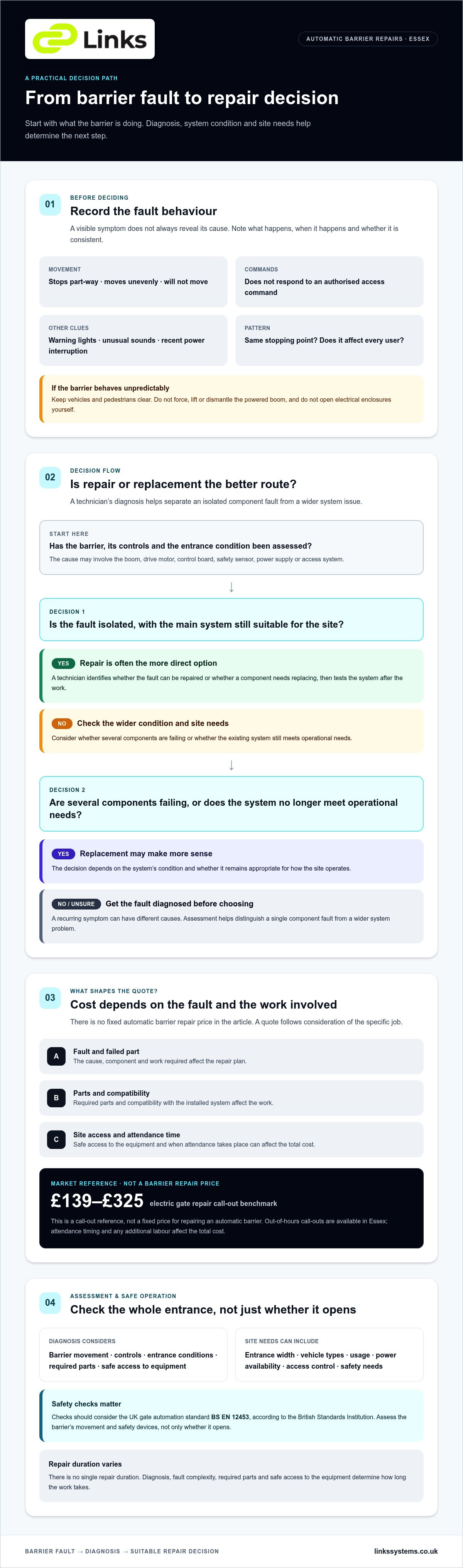
A barrier that stops part-way, moves unevenly or ignores an access command needs diagnosis before repair. The cause may lie in the boom, drive motor, control board, safety sensor or power supply. Record what happens, when it happens and whether the fault is consistent. These details can help distinguish a component failure from an access-control or electrical issue.
Repair costs depend on the failed part, the work required, site access and attendance time. The price depends on the fault and parts involved, and is given after a quote request. As a market reference, electric gate repair call-outs typically range from £139 to £325. That is a call-out benchmark, not a fixed price for repairing an automatic barrier.
Motor replacement, intercom faults and control problems involve different work. A motor fault may require inspection of the drive mechanism and controls, while an intercom issue may affect communication rather than the barrier’s movement. A technician’s diagnosis identifies whether repair or component replacement is needed. The installation, system type and vehicle access arrangements can all affect the work involved.
Electric gate safety checks should ensure compliance with UK gate automation standard BS EN 12453, according to the British Standards Institution. A repair assessment should therefore consider the barrier’s movement and safety devices, not only whether it opens. Keep the entrance clear if the equipment behaves unpredictably, and don’t force the boom or dismantle its mechanism.
Is it cheaper to repair or replace an automatic barrier? Repair is often the more direct option when the fault is isolated and the main system remains suitable for the site. Replacement may make more sense when several components are failing or the existing system no longer meets operational needs.
Do Essex automatic barrier repair companies offer emergency or out-of-hours call-outs? Out-of-hours electric gate repair call-outs are available in Essex. Attendance timing and any additional labour affect the total cost.
How long does automatic barrier repair usually take? There is no single repair duration. Diagnosis, the fault’s complexity, required parts and safe access to the equipment determine how long the work takes.
Are automatic barrier repairs covered by warranty, insurance, or a maintenance contract? Coverage depends on the warranty terms, insurance policy and maintenance contract. Check the relevant documents for exclusions, reporting requirements and which parts or labour they cover.
Common barrier faults and repairs
A powered barrier can fail in several ways, and the visible symptom doesn’t always reveal the cause. A boom that stops midway may point to a drive, control or obstruction issue. A barrier that won’t respond to an authorised access command may have a fault elsewhere in its control chain. Describe the symptom clearly before arranging an assessment.
Useful observations include whether the entrance barrier moves at all, whether it stops at the same point and whether the fault affects every user. Note any warning lights or unusual sounds, and record when the problem first appeared. For example, a barrier that works after a reset but fails again still needs diagnosis. Repeated resets can hide the pattern without addressing the underlying fault.
- Boom movement: A bent, loose or misaligned boom can obstruct vehicle access or prevent consistent movement. A technician can inspect its condition and how it travels.
- Motor or drive: Slow, uneven movement or a barrier that stops under load may indicate a drive problem. The system needs assessment before a component is repaired or replaced.
- Controls and commands: If an authorised user’s command fails, the issue may involve the control equipment, access device or their connection. Compare whether other authorised users experience the same disruption.
- Power interruption: A barrier that appears unresponsive may have a supply or control issue. Report any recent power interruption and avoid opening electrical enclosures yourself.
Diagnosis should begin with the reported behaviour, followed by an inspection of the barrier, its controls and the entrance conditions. A technician can identify the fault, explain the proposed repair and test the system afterwards. If replacement parts are needed, the part and its compatibility with the installed system affect the repair plan. This step-by-step approach helps distinguish a single component fault from a wider system problem.
During disruption, keep vehicles and pedestrians clear of a barrier that moves unpredictably. Only authorised personnel should manage access using the site’s established procedure. Don’t push, lift or dismantle a powered boom: this can cause further damage or create a hazard. If the barrier blocks an emergency route, follow the site’s emergency arrangements and inform the responsible site manager promptly.
After repair, note the fault, work completed and any operating changes. That record helps site teams spot repeat symptoms and explain them accurately if disruption returns. Where faults recur, a planned assessment can consider the complete entrance setup rather than treating each symptom separately. You can discuss a barrier fault as part of planning the next step.
Automatic barrier security
An automatic barrier controls vehicle access, but it cannot assess every security risk at a site. Its effectiveness depends on the boom, access control and how people operate the entrance. At a car park, for example, a barrier that remains open after a fault may allow uncontrolled vehicle entry. A barrier that stops closed can instead disrupt authorised access and site operations.
What safety and legal requirements apply to repairing automatic barriers in the UK? Safety checks should ensure compliance with UK gate automation standard BS EN 12453, according to the British Standards Institution. A repair assessment should examine the barrier’s operation and safety features, rather than treating restored movement as the only measure of completion.
System selection also affects how a barrier performs. Small car park entrances may use booms measuring 3 or 4 metres, whilst wider industrial entrances may need booms up to 9 metres long. A barrier designed for occasional use may not suit a logistics entrance operating hundreds of cycles per day. Match the equipment and repair assessment to entrance width, traffic and usage.
- Check the operating cycle: Observe whether the boom opens, pauses and closes consistently. Note if it stops before reaching its normal position or behaves differently during busy periods.
- Review access control: Test how authorised users request entry and whether the barrier responds consistently. A failed command can indicate a control issue, even when the boom itself moves normally.
- Protect the entrance: If the barrier remains open, use the site’s established process to manage vehicle entry. If it moves unpredictably, keep vehicles and pedestrians clear.
- Record visible damage: Note impact marks, a bent boom or a damaged housing. A collision can affect movement and safety, so include the location and observed behaviour in the fault report.
Regular servicing can help maintain automatic barrier reliability and compliance. A maintenance contract can help reduce downtime and extend system lifespan. These measures support planned checks, but they don’t remove the need to assess a specific fault. For example, after an impact, inspect the boom and its operation before returning the entrance to normal use.
Never dismantle barrier automation or force a boom manually unless you know the correct release procedure. An unfamiliar release mechanism can cause further damage or expose people to moving equipment. If the site’s instructions don’t cover the fault, keep the area clear and follow the established safety process. Record who is managing access while the barrier remains out of service.
After repair, review the barrier alongside its access-control process. Confirm that the entrance operates as intended, authorised users can gain access and the site’s safety procedures remain clear. For a high-use car park or industrial entrance, include actual operating patterns in future servicing discussions. A repair that considers both movement and entry management addresses the barrier’s role in the wider security system.
Site surveys and quote requirements
A site survey connects the barrier fault with the entrance’s actual operating conditions. For industrial premises, a suitable assessment considers entrance width, vehicle types, usage frequency, power availability, access control and safety. These factors shape the repair scope and help establish whether the barrier functions as intended for the site.
Start by describing the fault and its effect on access. For example, note whether the boom stops before opening, remains raised or fails to respond to an authorised command. Include when the problem occurs and whether it affects every vehicle. This gives the surveyor a clear starting point for inspecting the barrier and its controls.
- Entrance width: Measure the opening and identify any constraints beside the barrier. Clearance can affect access for vehicles and the space available for equipment.
- Vehicle types: Explain whether cars, vans, delivery vehicles or larger vehicles use the entrance. Their dimensions and movement patterns help establish how the barrier must operate.
- Usage frequency: Describe busy periods and the usual flow of vehicles. A barrier at a frequently used industrial entrance has different operating demands from one serving occasional visitors.
- Power availability: Identify the power supply serving the equipment and any recent interruptions. This helps distinguish a supply issue from a fault within the barrier system.
- Access control: List how authorised people request entry, such as through a control point or access device. The survey can consider whether those functions work alongside the barrier.
- Safety considerations: Point out pedestrian routes, vehicle queues and areas where the boom could cause damage. These details help shape safe inspection and repair planning.
Before the visit, gather photographs of visible damage, the barrier’s make and model if available, and a short fault history. A record of repeated stoppages, for example, can help distinguish an intermittent issue from a complete failure. Keep the entrance clear for inspection and arrange access to the control equipment through the responsible site contact.
The survey findings inform the proposed work, required parts and access arrangements. Repair prices are confirmed before attendance. The price depends on the fault, parts, site access and timing, and is provided after a quote request. A clear quote helps site managers understand the proposed work before deciding how to proceed.
For an existing system, the survey can also identify maintenance needs that may prevent avoidable disruption and extend service life. For a replacement or new installation, it establishes the entrance requirements before equipment is selected. In both cases, document the agreed work and any operating changes, then use that record to review how the barrier functions on the premises.
Which companies repair automatic barriers in Essex, and what are their prices?
Commercial security and automation specialists handle automatic barrier faults across Essex. A repair quote depends on the equipment, reported fault and work needed on site. The price also depends on parts, access and timing, and is provided after a quote request. Repair prices are confirmed before attendance.
For context, standard Monday-to-Friday attendance runs from 9am to 5pm. A standard electric gate repair call-out includes travel and the first hour on site. Further labour, required parts and site conditions can affect the final cost. High-priority or emergency attendance follows a separate pricing basis, as do evenings and weekends.
Ask for the quote to distinguish the attendance charge from any additional labour or replacement components. This makes it easier to understand what the initial visit covers and what could add to the total. Travel beyond 15 miles may be charged by distance. Parking, tolls and other access charges are added at cost where applicable.
Compare quotes by scope, not just by the first figure. A written breakdown should explain the assessed fault, proposed repair, included parts and any additional charges. For example, a quote for a control fault should distinguish diagnosis from component replacement. If a motor or boom needs attention, the proposed work should identify the affected component.
- Attendance: Check the planned visit period and what the call-out includes.
- Labour: Clarify how additional time is charged after the included first hour.
- Parts: Check which components are included and whether replacement is proposed.
- Travel and access: Note any mileage, parking, toll or site-access costs.
- Urgency: Separate standard attendance from high-priority, emergency or out-of-hours work.
Share the barrier model, location, fault symptoms and site access arrangements when requesting a quote. A photograph of visible damage and a short description can help explain the problem. State whether the barrier is stuck open, stuck closed or moving inconsistently. These details help define attendance requirements and the likely repair scope.
For multiple barriers at one site, ask for the work to be quoted together. Discounted pricing may be available when several gates receive service during one visit. A planned service is different from fault repair, so describe whether the system is operational or needs corrective work. To arrange a quote for your entrance, request a barrier repair assessment.
Commercial security and automation specialists handle automatic barrier repairs in Essex. Prices are quoted according to the equipment, fault, work required, timing and access. A standard call-out includes travel and the first hour on site; additional labour, parts and access costs may affect the total.
Links Integrated Systems: Speed Gates & Barriers
Links Integrated Systems helps commercial sites plan and install Speed Gates & Barriers suited to their entrances and vehicle movements. Turn to the team when a barrier needs to form part of a wider access arrangement or when planning an installation for a new or changing site.
Access Control Systems can manage how authorised users enter, while IP Video Intercom Systems support communication at controlled entrances. IP HD CCTV Systems can complement site security with video coverage. The right combination depends on the premises, entrance layout and operational requirements.
Share details of your site, access requirements and barrier project to discuss a suitable approach. Contact Links Integrated Systems to discuss your requirements.
Plan the next step for your entrance
Use the repair process as an opportunity to clarify how the entrance should operate in future. Consider who needs access, how visitors are managed and what should happen if the barrier becomes unavailable. These decisions can help shape a system that supports daily operations and site security.
The automatic barrier repair cost in Essex is only one part of planning: the proposed work should also suit the site’s access requirements and equipment condition. Links Integrated Systems provides Speed Gates & Barriers, Access Control Systems and IP Video Intercom Systems for commercial environments. Bringing these elements together can help align vehicle entry with how people are authorised and managed on site.
If you’re reviewing a fault, planning entrance changes or considering how access is managed, share your requirements with the team. A clear outline of the site and its operational needs gives the discussion a practical starting point.
Contact Links Integrated Systems to discuss your entrance requirements and move forward with a considered plan.
Frequently Asked Questions
How much does automatic barrier repair cost in Essex?
There’s no single repair price, as the fault and work required vary between sites. The price depends on the case and is provided after a quote request; key factors include diagnosis, replacement parts, labour, timing and site access. For example, a damaged boom may need different work from a barrier that fails to respond to an access command. A clear fault description helps define the quote.
What is the average call-out fee for automatic barrier repairs in Essex?
Across the market, electric gate repair call-outs typically range from £139 to £325, with a median of about £240. This is an anonymous market benchmark, not a fixed Essex tariff or a complete repair cost. The call-out may cover attendance and initial work, whilst parts or additional labour can affect the final bill. Check what the quoted attendance charge includes before comparing estimates.
How much do common barrier repairs cost, such as replacing a motor, control board, or arm?
There’s no single price that applies to every motor, control board or barrier arm replacement. The total depends on the system model, component required, diagnosis and labour. For instance, a compatible replacement part may differ from one needed for an older or uncommon system. A quote should identify the affected component and explain whether repair or replacement is proposed.
What affects the cost of automatic barrier repairs in Essex?
The main cost factors are the fault, parts, labour time, visit timing and access to the equipment. A barrier inside a restricted service area may need different site arrangements from one beside an open car park entrance. The system’s make and model can also affect parts selection. Report any impact damage, intermittent operation or access-control symptoms so the assessment addresses the relevant issue.
How can I get an accurate quote for an automatic barrier repair in Essex?
Give the repair provider the site location, barrier make and model, fault symptoms and access arrangements. Explain whether the boom is stuck open, stuck closed or operating inconsistently, and when the problem occurs. Photos of visible damage can add useful context. Ask for the proposed work, parts, labour and attendance charges to be itemised, so you can understand the scope before agreeing to the repair.