
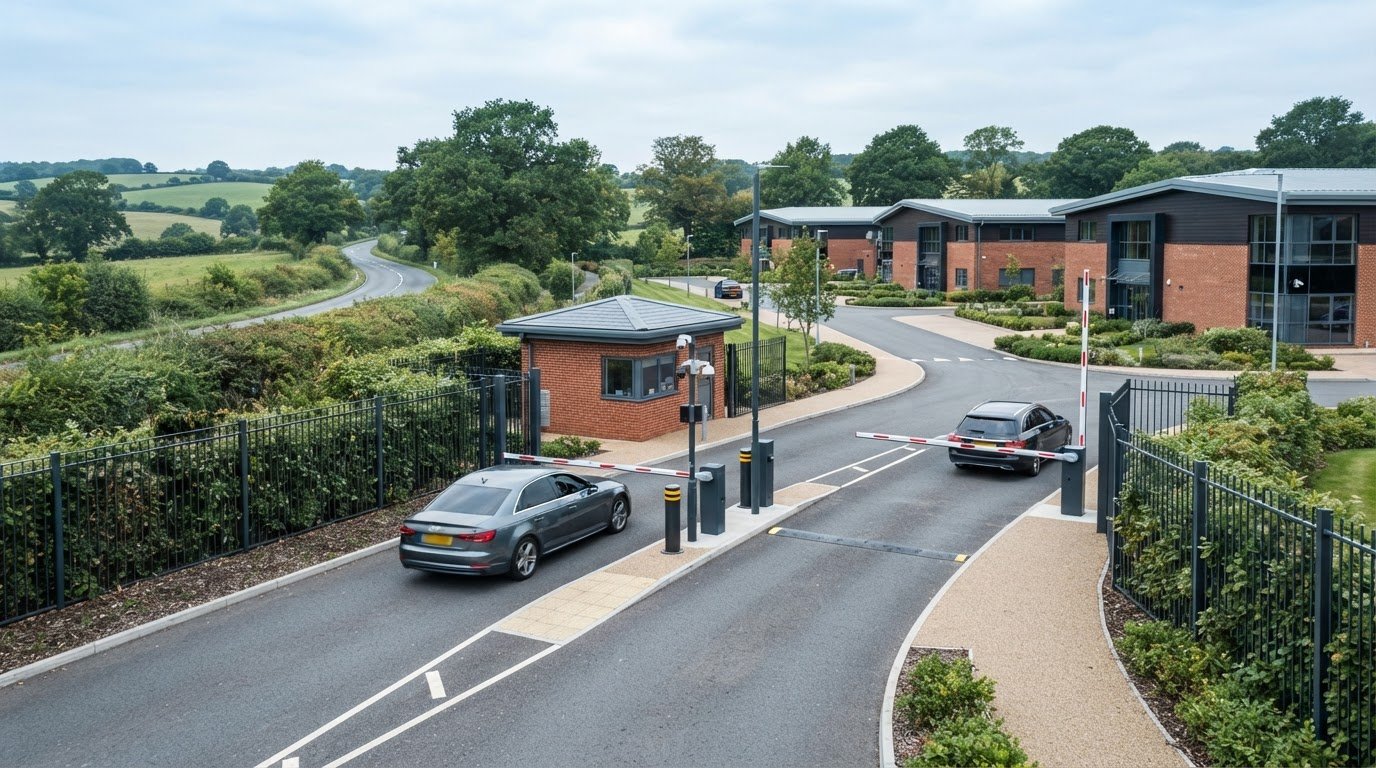
Could a camera aimed at the entrance still miss the details that matter to your site? Effective ANPR camera installation Surrey projects start with vehicle flow: where vehicles approach, where they stop and how entry decisions connect to existing access arrangements. Planning around those details helps ensure the system supports the way your site operates.
ANPR can be considered alongside existing CCTV and access control, but the camera is only one part of the design. Positioning, lighting, network connections and the process for managing authorised vehicles all need consideration. A clear brief helps define what the system should do and how staff will use it.
This guide explains how to plan a system around vehicle movements and operational needs, and how ANPR can form part of a wider commercial CCTV and vehicle-access solution. It also outlines the project pathway from design and installation through commissioning and ongoing maintenance. With 40 years of experience in the security systems industry, Links Integrated Systems supports commercial projects in Surrey from initial planning through to ongoing system care.
Key Takeaways
- Start with the site’s purpose, vehicle routes and entry points to shape an ANPR plan around real operating needs.
- ANPR camera installation Surrey should account for sightlines, camera position and environmental conditions at each capture point.
- Consider how number-plate recognition relates to access control, barriers and CCTV within the wider vehicle-access process.
- Use commissioning to check the installed system against the agreed design and establish how it will be operated and maintained.
- A coordinated project pathway can bring consultation, design, supply, installation and ongoing support together.
ANPR camera installation in Surrey: what it does for a commercial site
Automatic Number Plate Recognition (ANPR) uses cameras and image-processing technology to identify vehicle registration marks. Automatic Number Plate Recognition (ANPR) technology can support a site’s vehicle-management process by capturing a plate and making that information available to the relevant system or staff. In practical terms, ANPR identifies vehicle registration marks to support decisions about vehicle access or parking at a commercial site.
A camera reading a number plate doesn’t, by itself, decide who may enter or what action should follow. The site’s rules, the way vehicle information is handled and any linked access equipment all form part of the operating arrangement. ANPR camera installation Surrey projects therefore need to consider both the capture point and what happens after a plate is read.
Where ANPR can fit into a Surrey commercial site
Entrances, exits and internal routes are the natural starting points for planning. An office may need to manage staff and visitor vehicles at a controlled entrance, while a commercial building could use ANPR as part of a process for managing deliveries or authorised vehicles. For businesses managing commercial transport alongside fixed-site access, specialist providers such as Fleet Software Solutions offer complementary vehicle tracking and integrated cameras to monitor operations beyond the premises. In a managed parking environment, captured registration details may support the site’s parking workflow. The right application depends on the site’s purpose and operating arrangements.
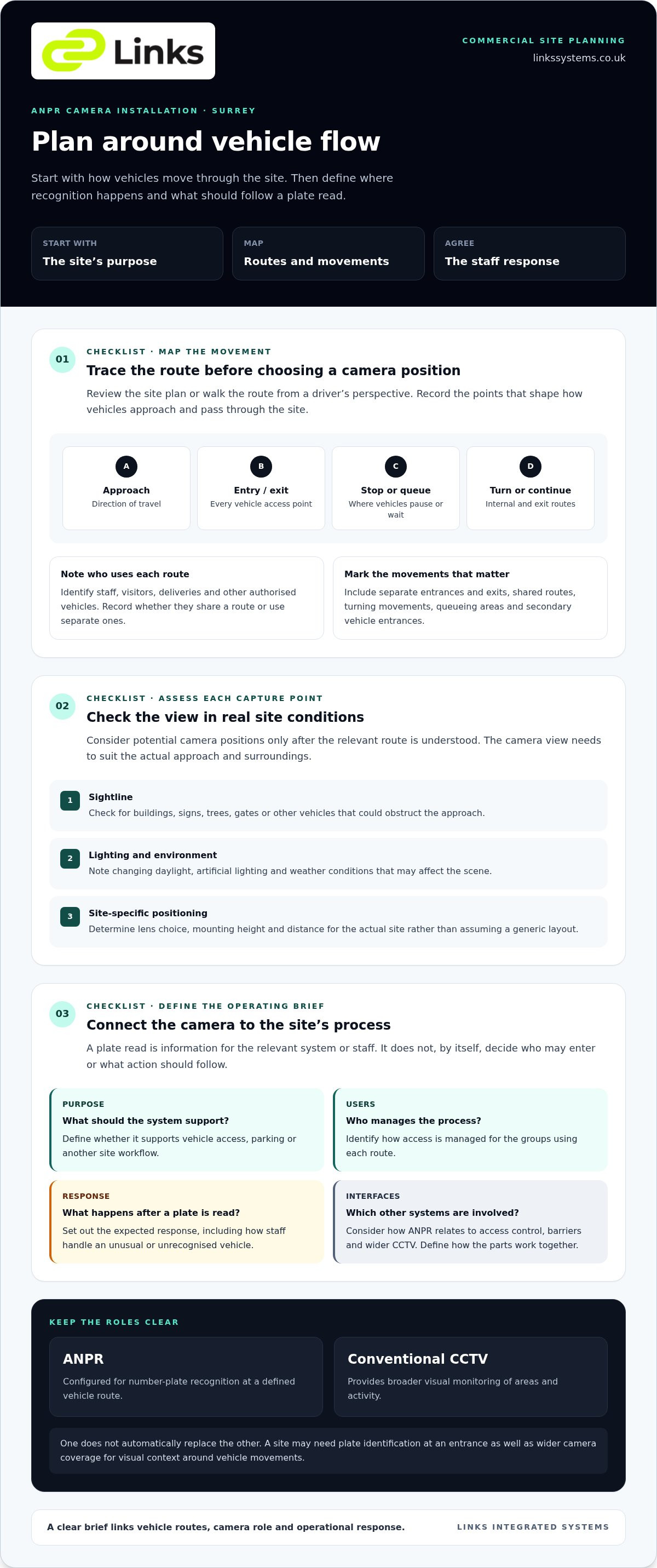
Map how vehicles actually move before deciding where recognition should take place. Note separate entry and exit points, shared routes, queuing areas and any secondary vehicle entrances. A system brief should describe which movements matter and how staff are expected to respond to a recognised or unrecognised vehicle. This gives the design a practical basis, rather than treating every entrance as if it serves the same function.
ANPR cameras and conventional CCTV: different roles
ANPR and general-purpose CCTV can both use cameras, but they serve different functions. ANPR is configured for number-plate recognition at a defined vehicle route. Conventional CCTV provides broader visual monitoring of areas and activity. One doesn’t automatically replace the other: a site may need plate identification at its entrance as well as wider camera coverage to provide visual context around vehicle movements.
When the wider design includes access control, barriers or other CCTV, define how these components relate. For example, a plate read may be used within a vehicle-access workflow, while a barrier controls the physical entrance. The operating rules determine how those parts work together, including how staff handle exceptions. The camera is one element of a site system, not a complete access-management process on its own.
For commercial premises in Surrey, a well-defined brief connects the intended use to the vehicle route, camera role and operational response. Links Integrated Systems includes number-plate recognition within its CCTV capabilities and can plan it as part of a site-specific commercial security and vehicle-access design.
Plan ANPR camera installation in Surrey around vehicle flow
A useful ANPR design begins with the way vehicles move through the site, not with a decision about camera positions. The brief should connect the system’s purpose to the routes it needs to cover and the response expected from staff. For a commercial site in Surrey, consider everyday movements alongside the physical layout so the proposed equipment supports an operating process rather than creating one that’s difficult to manage.
Map vehicle routes before specifying camera positions
Walk or review the site plan from a driver’s perspective. Mark each entrance and exit, the direction of approach, any stopping point and where vehicles may queue or turn. Note whether staff, visitors, deliveries and other authorised vehicles use the same route or different ones. This map helps identify which movements the system needs to support and where a recognition point can be considered without disrupting normal traffic flow.
Then assess the view from each potential camera position. Buildings, signs, trees, gates or other vehicles may obstruct the approach, while changing daylight, artificial lighting and weather can affect the scene. Plan the camera position around a clear view of the relevant route and the way vehicles approach it. Lens choice, mounting height and distance need to be determined for the actual site rather than assumed from a generic layout.
- Purpose: Define whether the system supports vehicle access, parking or another site workflow.
- Routes: Record vehicle approaches, turning movements, stopping points and exit routes.
- Users: Identify the groups using each route and how their access is managed.
- Conditions: Note obstructions, lighting changes and other features that may affect the camera view.
- Response: Set out what should happen after a plate is captured, including how staff handle exceptions.
Set the project brief and system interfaces
Once the vehicle routes are clear, define the operating workflow. Will a recognised registration form part of an access decision, or will the information support a parking process? Clarify who manages the process and how an unusual or unrecognised vehicle is handled. These decisions shape the system brief and distinguish the camera’s role from the actions carried out by staff or other equipment.
Where entry is controlled, consider how ANPR relates to barriers and access control. The brief should describe the intended relationship between a plate read, the access decision and the physical entry point. Other CCTV may provide wider visual coverage, while ANPR is planned for the vehicle route. For further context on system relationships, see this guide to integrating CCTV with access control systems.
Links Integrated Systems tailors its design to site and project requirements, coordinating ANPR with relevant CCTV, barriers and access control. A clear route plan and operating brief provide a practical basis for that work. Businesses planning commercial ANPR system design can use these details to frame the project around their actual vehicle movements.
Standalone ANPR or integrated access control: assess the Surrey site requirement
ANPR can have a focused role, such as identifying registration marks for a site’s vehicle records, or form one element of a wider access-control arrangement. The distinction is what the site expects to happen after a plate is read. A camera captures information; permissions, staff procedures and any physical entry equipment determine how that information fits into the operating process.
For some sites, ANPR may be planned alongside existing systems without changing how entry is controlled. Where vehicle access is managed at a gate or barrier, the design may need to consider how recognition relates to access control and the physical route. The right scope depends on the site brief, existing infrastructure and operating process, not on the camera alone.
When should ANPR connect with access control or barriers?
Consider an entrance where vehicles need permission to proceed. The site’s operating rules may use vehicle information as part of an access decision, while a barrier manages the physical entry point. The design must set out how these roles relate and what staff do if a vehicle’s access needs attention. This is a planned workflow, not an automatic capability to assume of any camera or barrier. Requirements for physical entry can also inform the choice and arrangement of commercial speed gates and barriers.
| Site need | Possible system relationship | Planning question |
|---|---|---|
| Record vehicle movements | ANPR has a defined identification role | Who uses the captured information, and for what purpose? |
| Manage a controlled entrance | ANPR may sit alongside access control and a barrier | How are permissions decided and exceptions handled? |
| Provide wider site visibility | ANPR may form part of a broader CCTV design | Which views are needed beyond the vehicle route? |
| Coordinate more than one location | System scope reflects site-specific operating arrangements | What needs to be consistent, and what differs between sites? |
Questions that clarify the right system scope
Before settling the design, define the security objective and vehicle-access process in practical terms. Which vehicles use the site? Where is access controlled? Who manages permissions, and what should happen when an expected vehicle can’t proceed? These questions help establish whether ANPR has a standalone identification role or needs to be considered alongside other equipment and staff procedures.
Include existing CCTV and access-control infrastructure in the project discussion. Their condition and intended role can affect the proposed system design. If the organisation operates multiple sites, clarify whether the same process applies everywhere or whether each location has different routes and access arrangements.
System scope should follow operational requirements, not camera choice alone. For ANPR camera installation Surrey projects, Links Integrated Systems tailors the design to site requirements, including relevant relationships with access control, barriers and CCTV. Organisations developing their commercial ANPR project plan can use the site brief to define an appropriate scope.
Commissioning, data handling and maintenance for a Surrey ANPR system
Installation is not the end of the project. Commissioning provides a structured opportunity to check the completed system against the agreed design and intended site workflow. It also helps establish how the system will be operated and maintained after handover. For a commercial ANPR project in Surrey, these steps connect the original brief to the day-to-day responsibilities of the people using the system.
What commissioning should establish
Commissioning checks should reflect the project requirements. They can establish whether the installed cameras cover the agreed vehicle routes and whether the system’s operation aligns with the planned process. Where the design includes access control or barriers, relevant components can be checked together as part of that workflow. The aim is to identify issues against the agreed design and clarify how the system is intended to operate, rather than assume the equipment forms a complete solution simply because it has been installed.
Useful handover information gives site teams a practical reference for routine operation. Depending on the project, documentation may set out:
- The system’s intended purpose and the vehicle routes it supports.
- Who is responsible for day-to-day operation and managing access procedures.
- How staff should handle exceptions within the agreed workflow.
- What equipment and system interfaces are included in the installation.
- The maintenance arrangements and how system support is managed.
Clear records help operational teams understand the design and provide a basis for future maintenance or changes. Links Integrated Systems provides commissioning as part of its project services, alongside design, installation and ongoing care for commercial security systems.
Plan ongoing maintenance and responsible data handling
ANPR systems need an ongoing maintenance approach suited to the equipment installed and the site’s operating needs. The plan should identify responsibilities, how maintenance is arranged and how changes to the site or vehicle routes are considered. For example, a revised entrance layout or access process may affect the system’s original design. A defined approach helps the organisation keep its operating arrangements aligned with the installation over time.
Number-plate information also deserves attention in the project’s governance. Organisations should consider the purpose for which information is collected, who is responsible for its handling and how operational procedures are documented. Applicable UK data-protection requirements and current Information Commissioner’s Office guidance should inform those arrangements. This is a planning consideration, not a universal retention setting or a compliance outcome that can be promised through installation alone. Specific policies should reflect the organisation’s purpose and circumstances.
From commissioning through ongoing maintenance, ANPR camera installation Surrey projects benefit from clear responsibilities and a documented operating approach. Arrange ANPR installation and commissioning with Links Integrated Systems to plan the work around your commercial site’s requirements.
Arrange ANPR camera installation in Surrey with Links Integrated Systems
A commercial ANPR project needs a clear route from initial requirements to an operating system. Links Integrated Systems coordinates consultation, design, supply, installation and commissioning, with ongoing maintenance and support considered as part of the project lifecycle. This keeps the proposed arrangement connected to the site’s vehicle movements, access requirements and wider security systems.
With 40 years of experience in the security systems industry, Links Integrated Systems brings established project knowledge to commercial ANPR camera installation in Surrey. The company supports projects in Surrey, London, Kent, Hertfordshire and Essex, including those where number-plate recognition needs to be considered alongside CCTV, access control or barriers.
Coordinate the project with the wider delivery team
ANPR installation may need to align with building works, electrical provision and other security systems. Links Integrated Systems works with project teams, including M&E consultants, electrical contractors and principal contractors, so system requirements can be considered alongside the wider programme. A defined brief also gives building and facilities teams a shared reference for the intended vehicle workflow, relevant equipment and operational responsibilities.
Early coordination can clarify where system elements fit within the project and what information needs to be shared between the teams involved. For example, the design discussion can identify intended camera locations and how planned access-control equipment or barriers relate to the vehicle route. The detailed arrangements depend on the site and project scope.
From consultation through to support, the delivery pathway provides continuity across key stages. The project team can establish site requirements, develop a suitable design, supply and install the agreed system, then commission it against the project brief. Maintenance and support arrangements help address the system’s ongoing operational needs after installation.
Move from site requirements to a project discussion
Commercial building owners, operators and facilities managers can make an initial project discussion more productive by gathering a few practical details:
- The site’s purpose for using ANPR, such as supporting vehicle access or a parking process.
- A plan or description of vehicle routes, entrances, exits and any controlled points.
- The intended access workflow and who will manage it day to day.
- Information about existing CCTV, access control or barriers that may relate to the design.
- Any coordination requirements involving building, facilities or construction teams.
These details help shape a project discussion around the site, rather than treating ANPR as a camera-only decision. Links Integrated Systems can use the brief to develop a tailored approach from design through commissioning and ongoing support.
Schedule a consultation to discuss your commercial site requirements and the next steps for an ANPR installation in Surrey.
Set your Surrey ANPR project in motion
The next step is to turn your site’s access objectives into a clear project brief. Consider how vehicle routes or operating procedures may change, who will manage the system day to day, and how the installation should fit with wider site plans. Addressing these points early gives the design team a stronger basis for shaping an approach around your premises and priorities.
For a commercial site, ANPR camera installation Surrey is best approached as an operational decision, not simply an equipment purchase. A focused discussion can bring the relevant requirements together and establish a practical direction for the project.
Request a consultation about your Surrey ANPR project with Links Integrated Systems. Share your site objectives and the questions you need resolved, then take the next step towards a plan suited to your operation.
Frequently Asked Questions
What is an ANPR camera installation?
An ANPR camera installation uses number-plate recognition to identify vehicle registration marks for a defined commercial site purpose. Unlike general CCTV, which provides broader visual monitoring, ANPR focuses on capturing and interpreting number plates. For example, a building operator might use it to support a vehicle-access procedure or parking process. The system’s scope depends on the site’s operational requirements, including how captured information will be used and who is responsible for the process.
How does ANPR work with access control or a barrier?
ANPR may be included in a designed access workflow where vehicle identification relates to an entry decision. Access control manages permissions, while a barrier controls the physical route. The project brief should define how those roles relate, who handles exceptions and what happens if a vehicle’s access needs review. A camera installation alone doesn’t establish that workflow, and automatic barrier operation shouldn’t be assumed without a design that specifies how the systems are intended to work together.
Can ANPR cameras be used for commercial car parks in Surrey?
Yes. ANPR may support a commercial car park’s parking or vehicle-access workflow, depending on how the site is managed. For instance, a site could plan recognition around a designated entrance and exit, with procedures for vehicles that need staff attention. The design should reflect the car park’s purpose, how users arrive and leave, and the operator’s requirements. A clear brief helps distinguish parking processes from controlled-access arrangements and informs the appropriate system scope.
Do ANPR cameras need to be integrated with CCTV?
Not necessarily. Integration depends on the project objectives and existing security systems. ANPR focuses on number-plate recognition, while general CCTV provides broader visual coverage. A site may use both for different purposes, or plan ANPR as a defined part of its vehicle-management arrangements. Links Integrated Systems provides IP HD CCTV and number-plate recognition capabilities, allowing the project design to consider their respective roles in relation to the site’s security requirements.
How is an ANPR camera installation planned for a commercial site?
Planning typically begins by defining the site brief and intended vehicle workflow. The design then considers routes, capture points and interfaces with existing systems, followed by supply and installation. Commissioning checks the completed arrangement against the agreed requirements, and support and maintenance are considered for ongoing operation. For ANPR camera installation Surrey, sharing site plans, vehicle routes and information about existing CCTV or access control can help focus the project discussion.
What should a business consider about ANPR data in the UK?
A business should consider why it collects number-plate information, who is responsible for handling it and how its procedures are documented. Vehicle registration marks can relate to identifiable individuals, so organisations should consult current Information Commissioner’s Office guidance and applicable UK data-protection requirements when planning their use of ANPR. The appropriate handling arrangements depend on the purpose and circumstances. Avoid assuming a universal retention period or treating installation as a guarantee of compliance.
Does an ANPR system need ongoing maintenance?
Planned maintenance can help an organisation review and care for its installed security infrastructure over time. For ANPR, the maintenance approach should reflect the equipment, site conditions and how the system is used. It can also provide an opportunity to consider whether changes to vehicle routes or site operations affect the original arrangement. Links Integrated Systems provides system maintenance for commercial security solutions, supporting ongoing system care without implying uninterrupted performance.