

When planning a multi-apartment video intercom Essex project, start with how residents and visitors will use the entrance, not with a list of equipment. Mapping the journey helps clarify what the system needs to do, from calling the right flat to viewing a visitor and controlling entry.
A clear, straightforward entrance process is important, but the right specification also needs to account for the building itself. Existing cabling, entrance layouts and equipment can affect whether a new installation or retrofit is practical. Decision-makers should also consider privacy, access permissions and what support will be available after commissioning.
This guide explains how to assess those requirements before choosing a system. It covers questions to ask about video and audio, resident access, and possible links with access control or CCTV. It also explains how to review cabling, installation and commissioning plans, and what to clarify about ongoing maintenance. Use these points to compare proposals against the needs of your building and its users, rather than against features alone.
Key Takeaways
- Map the visitor journey from calling an apartment to authorising entry before comparing system options.
- For a multi-apartment video intercom Essex project, assess entrance coverage, call handling and administration alongside the building’s cabling and network.
- Use a site survey to establish whether existing infrastructure can support a retrofit or whether another installation approach is needed.
- Agree a clear project sequence, from defining requirements and approving a specification to installation, testing and handover.
- Compare maintenance proposals by scope, inspection arrangements, response terms and exclusions, so expectations for ongoing support are clear.
What should a multi-apartment video intercom in Essex achieve?
A multi-apartment video intercom is a visitor-entry system that lets someone at a shared entrance contact the relevant home, communicate with a resident and, where specified, request door release. It connects an entrance point with residents in multiple homes. The equipment and available functions depend on the agreed system design.
Start by specifying the visitor journey: a visitor places a call, the resident sees or hears who is there, decides whether to grant access and releases the door if appropriate. Video can help a resident make an informed decision, but it does not confirm a visitor’s identity on its own. The system should also fit the building’s approach to managing entry, including who can authorise access and who administers permissions.
For a multi-apartment video intercom Essex project, property managers, developers, freeholders and managing agents should consider how the building is used, who manages resident and staff access, and what a site survey reveals about entrances and existing infrastructure. These are property-specific questions, not assumptions about Essex buildings as a whole.
Which people and entry points should the specification cover?
List the people who need to use or administer the entrance, such as residents, visitors, delivery personnel, managing agents and authorised staff. Then identify each entrance and secondary access point that may need intercom coverage. Record users’ communication and accessibility needs. Consider whether the equipment and instructions will be straightforward for people with different levels of confidence using technology.
What does video add to an apartment entrance?
Visual contact gives residents another way to assess a caller before deciding whether to release the door. A video intercom system generally combines an entrance unit with a means for residents to communicate with and view the caller. Arrangements vary between systems.
Some specifications may include functions such as two-way audio or remote door release, but do not assume these are included or suitable for every property. Confirm what each proposed system supports, how residents will receive calls and how access permissions will be managed. Keep these decisions distinct:
- Resident convenience: Can people receive and respond to calls in a practical way?
- Building management: Who administers access and updates resident or staff permissions?
- Accessibility: Are the controls, communication method and call information usable for the building’s residents and visitors?
Agreeing these outcomes gives the project team a sound basis for comparing systems. It also helps the installer develop a specification around actual users and entry points, rather than selecting equipment before the building’s needs are clear.
Which IP video intercom features matter in an Essex apartment building?
Compare proposed systems against the building’s operating needs, not a feature list alone. Check how many entrances need coverage, how calls reach residents, who will manage user changes and whether future alterations are likely. For a multi-apartment video intercom Essex project, these questions help the design team assess the system alongside the building’s network and cabling before selecting equipment.
How should buyers assess an IP intercom system?
Ask the project designer to explain how the entrance equipment communicates with residents’ handsets or other proposed endpoints. Confirm network connections, power provision and cabling routes, including any requirements that may affect existing infrastructure. Clarify who handles faults, software updates and configuration changes, and what the agreed support arrangement covers. IP describes the communication approach; it does not guarantee that a system will suit every site.
For new dwellings, review the relevant Approved Document Q security requirements with the project team. It concerns security in dwellings, including doors and windows, so do not assume it specifies the intercom itself. Confirm how the proposed entrance arrangements fit the wider project requirements.
Which features support residents and building managers?
Test the proposed call and access workflow against the building’s daily operation. Consider how residents will identify calls, how staff will handle authorised access, and who can add or remove users when tenancies or responsibilities change. If cloud administration is being considered, clarify who controls permissions and what connectivity and administration arrangements it requires. See the cloud access control guide for related considerations.
Use the comparison below to distinguish confirmed functions from options that may depend on the chosen system or other building equipment.
| Criterion | Questions to ask | Project-specific considerations |
|---|---|---|
| Entrance coverage | Which entrances and secondary access points are included? | Check call locations, coverage gaps and planned changes to the building. |
| Resident call handling | How does each resident receive and answer calls? | Confirm endpoint type, usability and any accessibility needs. |
| Network and cabling | What connections, power and cabling are required? | Have the technical team assess existing routes and infrastructure. |
| Administration and support | Who updates users, permissions and system settings? | Confirm update responsibilities, fault handling and any dependencies on other systems. |
Ask the supplier to label each function as standard, optional or dependent on another system, and record the answer in the proposal. Links Integrated Systems supplies and commissions IP video intercom systems in Essex. Its IP video intercom project information can help you explore the service in the context of your building’s requirements.
New installation or retrofit: how to compare multi-apartment intercom options
A new-build project gives the design team an opportunity to plan cabling routes, power and entrance equipment alongside the wider building works. In an occupied property, a replacement or retrofit starts with what is already in place. Existing wiring may be usable, require adaptation or prove unsuitable for the selected equipment. Do not assume an approach is feasible until the site and system requirements have been assessed.
For a multi-apartment video intercom Essex project, an older building need not rule out a preferred design, but it may affect the options, scope and installation plan. A survey helps establish practical constraints before a proposal commits to equipment or work. It also gives property stakeholders a basis for discussing access to occupied areas and how installation will be organised, without promising a particular duration or level of disruption prematurely.
What should an existing building survey establish?
Ask the installer to document the entrance layout, existing intercom equipment, available cabling routes and relevant network infrastructure. The survey should also identify occupied areas or access restrictions that may affect planning. Request a record of assumptions and unresolved dependencies, such as infrastructure that needs further testing or details that must be confirmed before the system design is finalised.
This makes it easier to compare proposals on a like-for-like basis. A clear scope should distinguish confirmed work from items that depend on survey findings, equipment selection or access arrangements. If a preferred design is not viable as proposed, ask which requirement creates the constraint and what alternatives the project team can assess.
When should an intercom link with other security systems?
Consider integration only when it addresses a defined building requirement. For example, the project may need the intercom to work alongside access control or CCTV, but compatibility should not be presumed. Ask the technical team to identify the proposed interfaces, confirm the relevant equipment and explain how the combined system will be tested. For broader coordination questions, see the physical security integration guide.
The National Security Inspectorate publishes an NSI Code of Practice for access control. It can be a useful reference when discussing the design, installation and maintenance approach with a project team. Confirm which guidance is relevant to the specific system and scope.
- New build: Coordinate intercom requirements with planned routes, power and entrance details.
- Retrofit: Verify existing equipment and infrastructure before deciding what can be retained or replaced.
Links Integrated Systems supplies, installs and commissions IP video intercom systems in Essex. Review its IP video intercom services alongside the survey findings and proposed scope when assessing the system for your building.
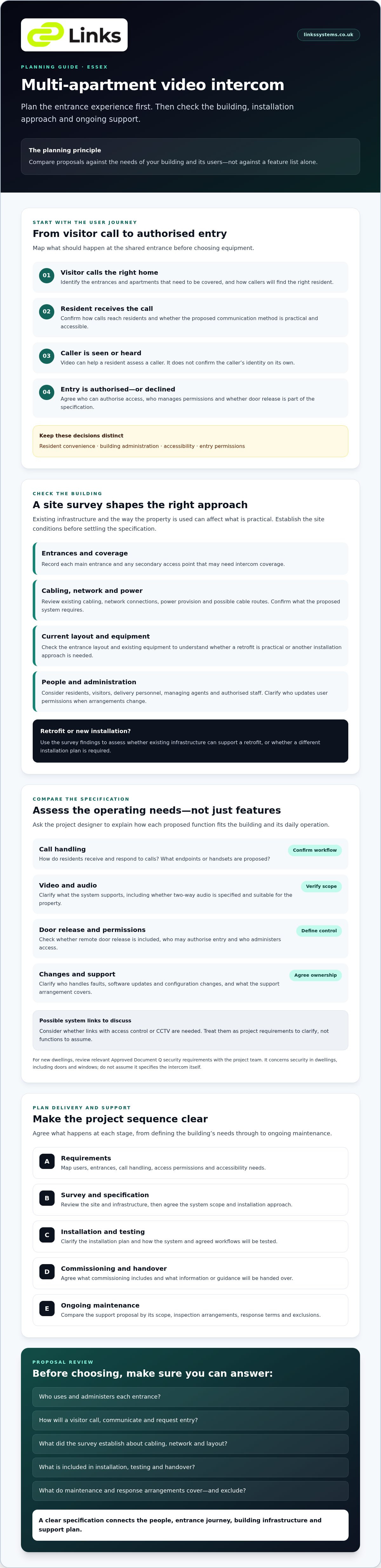
How to plan an Essex multi-apartment video intercom project
A structured project brief helps Essex property managers, developers, freeholders and managing agents turn building requirements into a clear scope of work. Agree who will make decisions, who will coordinate site access and how residents will be kept informed before appointing a contractor. Then use this sequence to take the project from initial requirements to handover.
- 1. Define the brief. Record the number of apartments, entrances and user groups, alongside the visitor call and entry process the system should support. Note whether the work is for a new build, a replacement or a phased upgrade.
- 2. Gather site information. Share available drawings, details of existing intercom equipment and any known cabling or access constraints. A site survey can verify the conditions that will shape the proposal.
- 3. Agree the specification. Ask the project team to document the proposed equipment, coverage, resident call arrangements and any interfaces with other building systems. Clarify assumptions and outstanding technical questions.
- 4. Plan installation and communication. Confirm who arranges site access, coordinates work in shared or occupied areas and communicates relevant arrangements to residents. Agree responsibilities before work begins.
- 5. Test and hand over. Establish how the contractor will check operation against the agreed specification, record outstanding issues and provide operating guidance to residents and building managers.
What information should buyers prepare before requesting a proposal?
Alongside the brief, provide a list of entrances, user groups and desired visitor workflows. Include drawings and existing-system details where available, and identify known site constraints rather than assuming they can be resolved. If the project may be phased, explain which areas or stages are in scope now and what may follow. This helps suppliers state the boundaries of their proposals clearly.
What should installation and commissioning confirm?
Ask the contractor to explain how the system will be configured and tested against the agreed requirements. Clarify who verifies entrance calls, resident responses and any specified door-release functions, and how results or unresolved items will be recorded. Confirm who provides operating guidance, what handover information is included and which party manages any remaining actions.
Before work starts, make sure the proposal also states who is responsible for resident notices, site access and decisions if survey findings require a change to the scope. Clear responsibilities help the property team and installer coordinate the work without assuming a particular installation duration or level of disruption.
Links Integrated Systems supplies, installs and commissions IP video intercom systems in Essex. If you are preparing a multi-apartment video intercom Essex project, discuss your video intercom requirements with the team to explore the project scope.
Commissioning and maintenance: choosing an Essex intercom partner
Commissioning is the stage when the installed system is configured and checked against the agreed specification. For a multi-apartment building, ask the contractor how they will verify each included entrance and the relevant resident call and access workflows. Faults, deviations or outstanding work should be recorded, with responsibility for follow-up made clear.
Maintenance is a separate consideration. Requirements depend on the installed equipment and the service arrangement agreed with the contractor. Compare proposals by what they include, rather than assuming that “maintenance” covers the same work in every contract. Check planned inspection arrangements, response terms, exclusions and how faults are reported. Confirm what support is and is not included. Do not assume a particular response time or out-of-hours service unless it is explicitly agreed.
What belongs in a practical system handover?
Ask for documentation that helps the building team operate and administer the system after installation. A handover should identify who is responsible for routine authorised changes, such as updating resident details, and how future changes will be requested and recorded. Clarify how residents and managing staff will receive operating instructions, and ensure outstanding items, support contacts and the agreed maintenance scope are documented.
These details matter when responsibility changes between a developer, freeholder, managing agent or property manager. A clear handover gives the incoming administrator a record of the system’s agreed configuration and the appropriate route for raising issues, rather than relying on informal knowledge held by one person.
How can property teams assess a specialist contractor?
Ask prospective contractors to describe relevant experience across system design, installation, commissioning and maintenance. Request a clear account of who is responsible for each project stage, what assumptions the proposal relies on and how commissioning results will be recorded. If interfaces with access control or CCTV are in scope, ask how those elements will be confirmed and tested. Compare the written scope and support terms carefully, including exclusions and any work that remains the property team’s responsibility.
Links Integrated Systems supplies, installs, commissions and maintains IP video intercom systems, with Essex included in its regional coverage. If you are assessing a multi-apartment video intercom Essex project, discuss your Essex intercom project with the Links team. A conversation can help establish the requirements to assess; the final specification will depend on the building and agreed scope.
Make your next intercom decision with confidence
A dependable apartment entrance system starts with the people who use it. Define the visitor journey, identify entrances and user groups, then assess the building’s cabling and network before choosing equipment. A site survey helps clarify whether a new installation, retrofit or phased approach is feasible. A written specification and clear commissioning checks give the project team a shared basis for delivery.
For a multi-apartment video intercom Essex project, look beyond installation. Confirm who will manage resident changes, what the handover includes and precisely what any maintenance arrangement covers. These practical details help property teams plan for ongoing use without assuming unconfirmed support levels.
Links Integrated Systems supplies, installs and commissions IP video intercom systems, with Essex included in its service area. The company also provides maintenance for security infrastructure. To discuss your building’s requirements, contact the Links team about your multi-apartment video intercom project in Essex. The team also covers London, Kent, Surrey and Hertfordshire, alongside Essex.
Frequently Asked Questions
What should a multi-apartment video intercom include?
A multi-apartment video intercom should support the building’s agreed visitor-entry process, from a visitor calling the correct home to a resident deciding whether to allow access. The specification should identify the entrances covered, how calls reach residents, what communication is available and whether door release is included. It should also define administration responsibilities and accessibility needs. Confirm each function in the proposal, as capabilities vary by system and configuration.
Can an IP video intercom be installed in an existing Essex apartment building?
Yes, an IP video intercom may be suitable for an existing Essex apartment building, but feasibility depends on the site survey, existing cabling and selected equipment. The survey should assess the entrance layout, cable routes, existing intercom and relevant network infrastructure. Some components may be reusable, while others may need adapting or replacing. Ask the installer to document technical assumptions and constraints before agreeing the system design, work scope or installation plan.
How do I choose a video intercom for a block of flats?
Choose a system by first defining how residents and visitors need to use each entrance. Compare coverage, call handling, ease of administration, accessibility and the building’s cabling or network requirements. Ask who will manage resident changes and access permissions, and check which functions are included, optional or dependent on other equipment. For a multi-apartment video intercom Essex project, a site survey and clearly scoped proposal help connect those criteria to the property’s conditions.
Can a video intercom connect to an existing access control system?
A video intercom may connect to an existing access control system, but compatibility must be confirmed for the specific equipment and configuration. Ask the technical team to identify the proposed interface, any dependencies and what testing will verify the combined operation. Do not assume systems will integrate simply because both use IP communication. If integration is a requirement, include it in the written specification and clarify which contractor is responsible for configuration, commissioning and documenting the result.
What happens during video intercom commissioning?
During commissioning, the contractor checks and configures the installed system against the agreed specification. This can include verifying that included entrance equipment and resident endpoints communicate as intended, and testing specified functions such as calls or door release. Ask which checks are in scope, how results and faults will be recorded, and who resolves outstanding items. Commissioning should also clarify handover information and responsibilities for system administration after the project is complete.
Does a multi-apartment video intercom need maintenance?
Maintenance needs depend on the installed system, its operating environment and the support arrangement agreed with the contractor. Ask what inspections are proposed, what tasks are included, how faults should be reported and what response terms apply. Check exclusions too, so the managing agent understands what falls outside the arrangement. Keep a record of system changes and recurring issues. Do not assume a particular inspection frequency or emergency response unless it is expressly agreed.
How should a managing agent address privacy when specifying video intercoms?
A managing agent should establish why the system captures images, what areas it will cover, who can access recordings and how long data will be retained. Video images may be personal data, so consider applicable UK data-protection obligations when deciding the system’s purpose and operating arrangements. Limit capture to what the building needs, document access responsibilities and provide clear information to residents and visitors. Seek appropriate data-protection advice where the building’s circumstances require it.