

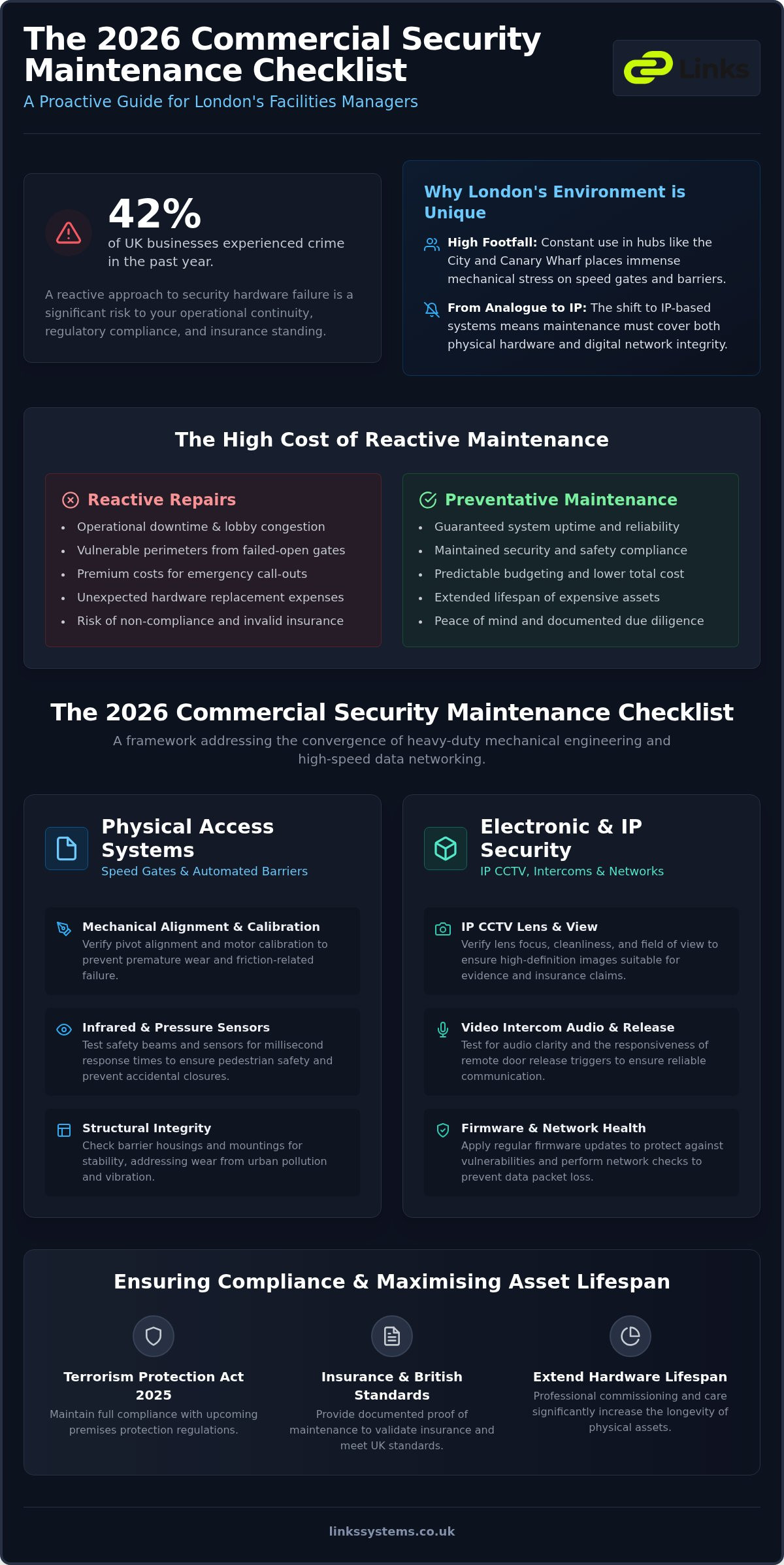
42% of UK businesses experienced some form of crime in the past year, a figure that underscores the vital role of functional physical hardware in the capital’s commercial sector. For many facilities managers, the complexity of integrated security system maintenance London requirements can feel like an administrative burden until a speed gate fails or a CCTV feed drops during a critical incident. You likely recognise that a reactive approach to hardware fatigue isn’t just inconvenient; it’s a significant risk to your operational continuity and insurance standing.
This article provides a comprehensive 2026 checklist designed to move your strategy from emergency repairs to professional commissioning and preventative care. We’ll outline how to maintain full compliance with the Terrorism Protection of Premises Act 2025 and current British Standards whilst extending the lifespan of your most expensive physical assets. By following this methodical approach, you can guarantee system uptime and ensure your security infrastructure remains a dependable pillar of your business environment.
Key Takeaways
- Understand why high-traffic London environments require a proactive maintenance strategy to mitigate mechanical stress on speed gates and barriers.
- Access a comprehensive 2026 checklist covering the mechanical, electrical, and software requirements for modern IP-based security hardware.
- Ensure your facility remains compliant with the Terrorism Protection of Premises Act 2025 and specific UK standards for automated physical security.
- Learn how professional commissioning and integrated security system maintenance London protocols can significantly extend the lifespan of your security infrastructure.
- Discover how to align your maintenance schedule with insurance requirements to avoid non-compliance and unexpected operational downtime.
Why London Businesses Require Specialised Security System Maintenance
Professional commercial security maintenance is far more than a simple repair service. It’s a proactive, commissioning-led programme designed to ensure that IP-based hardware and physical barriers operate within their precise intended parameters. In a city like London, where high-specification offices and transport hubs see constant footfall, the demand on these systems is relentless. Unlike residential setups, these commercial-grade installations face thousands of cycles every week, making integrated security system maintenance London a necessity for operational stability.
High-traffic lobbies in the City or Canary Wharf place unique mechanical stress on speed gates and barriers. If a motor or hinge isn’t calibrated correctly, the cumulative wear leads to avoidable hardware failure. We’ve seen a steady shift from legacy analogue systems to sophisticated IP-based infrastructure. This transition means maintenance now involves managing data integrity alongside mechanical lubrication. Professional integrated security system maintenance London ensures that these two disciplines, the physical and the digital, remain perfectly synchronised.
The Cost of Downtime in Commercial Environments
When a speed gate fails during the morning rush, the impact is immediate. Lobby congestion creates a poor first impression for visitors and a frustrating start for employees. Beyond aesthetics, a failed barrier often defaults to an open position to comply with fire safety regulations, which leaves the building’s perimeter vulnerable. Investing in preventative care is far more cost-effective than reactive hardware replacement. Regular servicing identifies fatigue in components before they snap, avoiding the premium costs associated with emergency call-outs and expedited parts delivery.
IP Security and Data Infrastructure Integrity
Modern security relies on IP HD CCTV and video intercoms that are only as effective as the network supporting them. Maintenance must include regular firmware updates to protect against vulnerabilities and network health checks to prevent packet loss. High-definition feeds are essential for insurance claims and evidence; a blurry image caused by a neglected lens or a failing PoE switch is useless during an investigation. This level of coordination often falls under the umbrella of Physical Security Information Management (PSIM), where various subsystems are unified into a single interface. Reliable maintenance ensures these integrated systems continue to communicate effectively, preventing data silos that could compromise your site’s safety and regulatory standing.
The 2026 Commercial Security Maintenance Checklist
Maintaining complex hardware in the capital requires a methodical framework. Professional integrated security system maintenance London protocols in 2026 must address the convergence of heavy-duty mechanical engineering and high-speed data networking. A robust checklist ensures that every component, from a pivot hinge to a firmware patch, is verified for reliability. Documenting these checks is not just best practice; it’s a requirement for insurance validity and health and safety audits.
Physical Access: Speed Gates and Automated Barriers
High-traffic London environments place immense strain on entry points. For speed gates and automated barriers, maintenance must prioritise mechanical alignment. Misaligned pivots increase motor friction, leading to premature motor failure. Engineers should verify that infrared safety beams and pressure sensors respond within milliseconds to prevent accidental closures on pedestrians. Structural integrity checks are also vital in urban settings where pollution and vibration can affect the stability of barrier housings over time.
Electronic Security: IP CCTV and Intercom Systems
IP-based systems require a different type of vigilance compared to legacy hardware. For IP HD CCTV, verifying lens focus and field of view is critical to ensure identifying details are captured in every frame. Testing IP video intercoms must include a check of audio clarity and the responsiveness of remote release triggers. Storage health is another priority; ensuring that NVRs are correctly overwriting and retaining footage is vital for meeting data protection standards. Adherence to UK cybersecurity regulations is now a core part of maintenance, as unsecured network ports on cameras can become entry points for unauthorised access.
The schedule for integrated security system maintenance London depends entirely on the usage profile of the building. High-traffic zones, such as main reception areas in high-rise offices, typically require quarterly inspections to mitigate wear. Lower-traffic utility entrances or remote barriers may only need bi-annual checks. Regardless of the frequency, every visit must be captured in a digital service log to provide a transparent audit trail. If you need assistance establishing a compliant schedule for your facility, the specialists at Links Integrated Systems can help develop a bespoke plan that aligns with your specific operational requirements.
Commissioning and Preventative Care: Maximising Hardware Longevity
Rigorous commissioning serves as the bedrock of any reliable security infrastructure. It is the process where technical specifications meet real-world application, ensuring that hardware is not just installed, but finely tuned to its specific environment. Without this foundational step, integrated security system maintenance London becomes a cycle of constant repairs rather than a strategy for longevity. At Links Integrated Systems, we view commissioning as a critical phase where every sensor, motor, and network port is calibrated to ensure peak performance from day one.
For sites with existing infrastructure, we provide specialist takeover maintenance. This service involves a comprehensive review and re-commissioning of hardware originally installed by other contractors. By auditing every component and replacing low-grade parts with high-specification alternatives, we stabilise systems that were previously prone to failure. This methodical review brings older installations into alignment with 2026 British Standards, ensuring they meet current insurance and safety requirements.
The Links Approach to System Commissioning
Our methodology focuses on total system readiness. When configuring commercial speed gates, we don’t just check for movement; we calibrate torque and timing to prevent mechanical fatigue during high-volume periods. Meticulous physical security integration requires testing under peak load conditions, simulating the dense traffic typical of a London commuter hub. For facilities managers, this results in a professional handover accompanied by comprehensive documentation, providing a clear roadmap for future servicing and troubleshooting.
Preventative vs. Reactive Maintenance Models
A reactive break-fix model is often the most expensive way to manage a commercial facility. Waiting for a system to fail before intervening leads to operational downtime, lobby congestion, and unbudgeted repair costs. In contrast, a structured maintenance contract focuses on identifying wear and tear before it results in a total system failure. By 2026, professional integrated security system maintenance London has evolved to incorporate remote diagnostics for IP-based hardware. This allows our engineers to monitor network health and storage status in real-time, often resolving software glitches or firmware conflicts before they impact the physical security of the site. This proactive model preserves the integrity of high-quality components and ensures that your initial capital investment continues to deliver value for years to come.
Navigating London Compliance: Insurance and Regulatory Requirements
Compliance within the London commercial sector extends beyond simple functionality; it’s a matter of legal liability and financial risk management. For high-value assets in the City or the West End, integrated security system maintenance London protocols must align with a complex web of UK legislation and insurance mandates. Failing to produce a documented service history doesn’t just risk a system breakdown. It can invalidate your insurance coverage and expose your organisation to significant legal challenges following a security breach or workplace accident.
Insurers increasingly view a proactive maintenance contract as a primary indicator of a managed risk environment. When assessing commercial property premiums, underwriters look for evidence that physical hardware is commissioned and serviced by specialists. A lapsed maintenance schedule often results in reduced claim payouts or a total rejection of liability if it’s proven that a failed barrier or a corrupted CCTV feed contributed to a loss. Maintaining integrated CCTV and access control to the correct specifications ensures that your building meets the stringent requirements often found in high-level corporate policies.
Automated Gate Safety and UK Law
Automated gates and barriers are classified as machinery, meaning they fall under the Health and Safety at Work Act. You have a legal obligation to ensure these systems are safe for employees and the public. Professional servicing must include force testing and safety edge checks to verify that the hardware won’t cause injury if an obstruction is detected. Following the UK’s departure from the EU, the UKCA marking has become the standard for hardware compliance. Ongoing maintenance ensures that your barriers continue to meet these safety benchmarks throughout their operational life, protecting your business from costly litigation.
Insurance Mandates for High-Value London Assets
Most commercial insurance providers in the UK require proof of annual or bi-annual security servicing to maintain valid cover. This requirement often references British Standards such as BS EN 50131 for access systems or BS EN 12453 for power-operated gates. Beyond physical hardware, integrated security system maintenance London must also account for data integrity. GDPR compliance is a critical factor in CCTV maintenance; your provider should verify that privacy masks are correctly configured and that data retention periods align with your legal obligations. Adhering to Secured by Design standards during your maintenance cycle further demonstrates a commitment to the highest levels of physical security.
Ensuring your infrastructure remains fully compliant requires a partner who understands the nuances of UK regulatory frameworks. To secure your premises and protect your insurance standing, you can establish a professional security maintenance programme with the experienced team at Links Integrated Systems.
Securing Your Infrastructure with Links Integrated Systems
Managing the security requirements of a modern commercial facility requires more than just technical knowledge; it demands a partner with a deep-rooted understanding of the London corporate landscape. With over 40 years of industry experience, Links Integrated Systems has established itself as a dependable pillar for stakeholders who value precision and long-term reliability. Our approach to integrated security system maintenance London is built on the principle of professional assurance, ensuring that your complex physical hardware and IP-based networks remain operational without the need for constant, reactive intervention.
Our specialist engineers provide comprehensive coverage across London and the Home Counties, including Kent, Surrey, Hertfordshire, and Essex. We position ourselves as a dedicated service partner capable of handling the full lifecycle of your security infrastructure, from initial commissioning to sophisticated system takeovers. By focusing on the intersection of physical hardware and data integrity, we ensure that your speed gates, barriers, and IP CCTV systems function as a unified, resilient shield for your business assets.
A Dedicated Service Partner for London Professionals
The London business environment presents unique challenges, from the high-density footfall of the City to the stringent regulatory demands of Canary Wharf. Working with a contractor who understands these nuances is vital for maintaining operational continuity. Our 40-year heritage translates into a methodical service delivery model where every maintenance visit is treated as a rigorous audit of system health. We don’t just look for faults; we look for the subtle signs of component fatigue that lead to future downtime. This commitment to precision provides the peace of mind that high-level project managers and facilities directors require when overseeing critical infrastructure.
Next Steps: Evaluating Your Current Maintenance Provision
If you’re currently managing multiple security contracts or experiencing frequent hardware failures, it’s likely time to audit your current provision for gaps. A professional maintenance audit should identify whether your current provider is addressing the firmware requirements of your IP devices and the mechanical calibration of your physical barriers. Many standard contracts overlook the specific commissioning steps necessary to prevent motor wear in high-traffic speed gates, leading to unexpected repair costs.
We invite stakeholders to discuss their specific hardware requirements with our technical team. Whether you’re looking to stabilise an existing installation through a specialist takeover or require a new, comprehensive maintenance framework, our engineers are prepared to provide a detailed assessment of your site’s needs. We focus on creating a steady, predictable maintenance rhythm that aligns with your operational goals and budgetary requirements. To ensure your facility remains compliant and secure, you can contact Links Integrated Systems for a professional maintenance consultation and take the first step towards a more resilient security strategy.
Future-Proofing Your Commercial Infrastructure
A proactive approach to hardware care is the only way to ensure long-term operational continuity in the capital’s high-traffic environments. Transitioning from a break-fix model to a commissioning-led strategy allows you to significantly extend the lifespan of your speed gates and IP-based systems. This methodical framework guarantees system uptime whilst ensuring your facility remains fully compliant with 2026 UK safety standards and insurance requirements. You can move forward with the confidence that your security infrastructure is built to withstand the unique pressures of the London corporate landscape.
Links Integrated Systems brings over 40 years of specialist security experience to every project. Our expertise in high-end physical hardware and IP integration provides a level of professional assurance that generic contractors cannot match. We offer comprehensive coverage across London and the Home Counties, acting as a steady, experienced partner for your complex technical requirements. Professional integrated security system maintenance London represents a strategic investment in your building’s resilience. To secure your infrastructure, discuss your commercial security maintenance requirements with our London specialists. We look forward to helping you maintain a safe and efficient business environment.
Frequently Asked Questions
How often should commercial speed gates be serviced in a London office?
Commercial speed gates in high-traffic London environments usually require servicing every three to six months. This frequency ensures that mechanical pivots and sensors remain calibrated under the stress of constant use. For lower-volume sites, an annual inspection might suffice, provided it includes the necessary safety force testing required by UK standards.
Does my commercial insurance require a security maintenance contract?
Most commercial insurance providers in the UK mandate a valid maintenance contract for high-value properties. If a security breach or accident occurs and you cannot provide documented proof of regular servicing, your insurer may reduce the payout or reject the claim entirely. Professional integrated security system maintenance London protocols provide the audit trail necessary for insurance compliance.
Can Links Integrated Systems maintain a system installed by another company?
We frequently undertake system takeovers for infrastructure originally installed by other contractors. This process begins with a comprehensive audit and re-commissioning to stabilise the hardware and align it with current British Standards. Our 40 years of experience allows us to manage complex technical requirements across a wide range of legacy and modern hardware.
What is the difference between security system commissioning and maintenance?
Commissioning is the foundational process of calibrating a system to its specific environment during installation. Maintenance is the proactive, scheduled programme of inspections designed to prevent hardware fatigue and software errors over time. Whilst commissioning sets the benchmark for performance, maintenance ensures the system stays at that level throughout its lifecycle.
Do IP CCTV systems really need regular maintenance?
IP CCTV systems require regular maintenance to address both physical clarity and network integrity. Firmware updates are essential for cybersecurity, whilst network health checks prevent packet loss that can lead to dropped footage. Regular lens cleaning and housing inspections ensure your high-definition cameras deliver the evidence-grade imagery required for insurance and legal purposes.
What happens if my automated barrier fails and I don’t have a maintenance contract?
A failure without a contract often results in significant operational downtime and expensive, non-prioritised repair fees. Beyond the financial cost, a failed barrier that hasn’t been serviced may not meet legal safety requirements, leaving your business vulnerable to litigation if an injury occurs. Proactive care is a more stable and cost-effective model for managing commercial risk.
Are there specific legal requirements for automated gate safety in the UK?
Automated gates and barriers must comply with the Health and Safety at Work Act and the Supply of Machinery (Safety) Regulations. This includes a legal requirement for regular force testing and safety sensor verification by a competent person. Ensuring your integrated security system maintenance London schedule includes these specific checks is vital for protecting your organisation from liability.
How does remote monitoring affect the need for physical maintenance visits?
Remote monitoring acts as an early warning system for software and network health, but it doesn’t replace the need for physical inspections. Mechanical components such as motors, hinges, and physical barriers require manual lubrication and alignment checks that cannot be performed digitally. A balanced approach combines remote diagnostics with scheduled on-site visits for total infrastructure assurance.