

If a security incident occurs at your facility tomorrow, can you guarantee your footage will provide the forensic clarity needed for a successful prosecution, or will a siloed system leave you with nothing but a pixelated blur? Most facility managers recognise that outdated hardware and disconnected systems often create more liability than they resolve. In an era where the Data (Use and Access) Act 2025 has tightened compliance requirements, simply having cameras in place is no longer a sufficient strategy for comprehensive risk management.
This explainer demonstrates how modern commercial video security systems have evolved into integrated ecosystems. By combining high-definition IP surveillance with physical access infrastructure, you can protect your assets whilst maintaining a professional environment for staff and visitors. We will examine the shift towards 4K imaging, the functional benefits of integrating video with speed gates and barriers, and the specific steps required to ensure your infrastructure remains fully compliant with the latest UK GDPR standards. By the end of this article, you will understand how to transition from basic monitoring to a future-proofed security architecture that delivers actionable intelligence.
Key Takeaways
- Understand why high-duty cycle IP HD hardware is now the essential baseline for modern commercial video security systems.
- Learn how to select camera form factors and Video Management Systems (VMS) that provide the actionable intelligence required for high-traffic environments.
- Discover how integrating surveillance with physical barriers, such as speed gates, creates a seamless verification layer for all access events.
- Recognise the importance of professional commissioning and scheduled maintenance in ensuring hardware longevity and ongoing regulatory compliance.
- Gain insights into evaluating local security contractors based on their technical track record and ability to support complex, integrated infrastructures.
Defining Commercial Video Security Systems in 2026
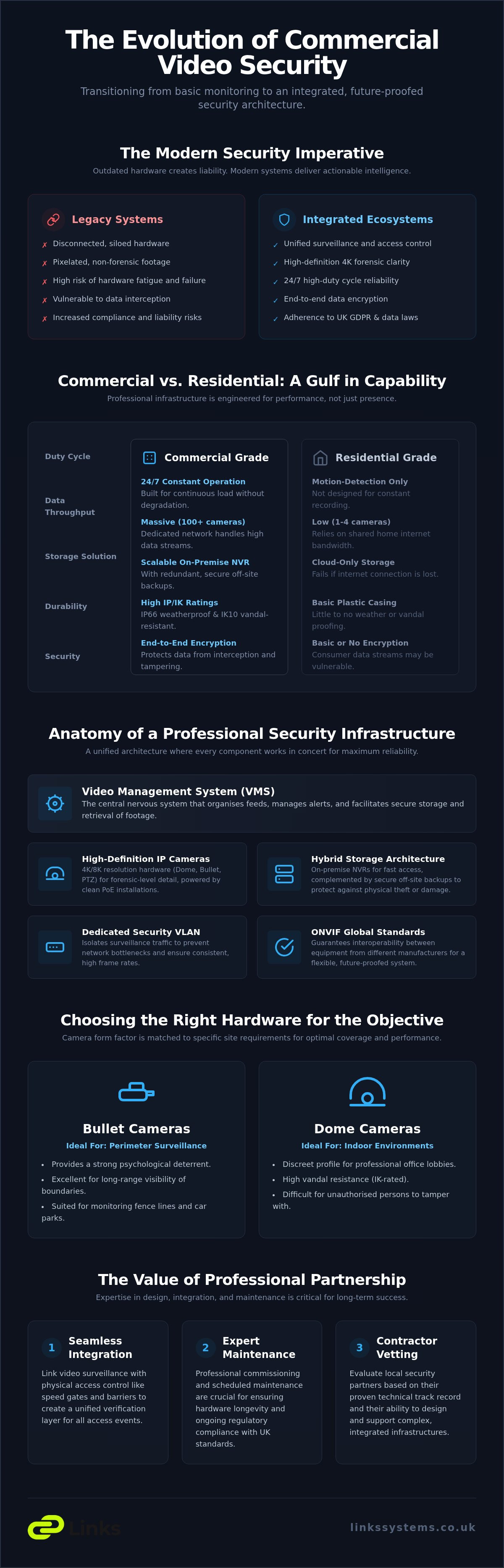
In 2026, the distinction between professional infrastructure and consumer-grade gadgets is sharper than ever. True commercial video security systems are built for high-duty cycles, meaning they operate under constant load without the performance degradation typical of domestic equipment. Whilst a home camera might record only when motion is detected, a professional system maintains 24/7 operational reliability, capturing every frame across high-traffic environments like office lobbies and logistics hubs. This steady performance ensures that no critical incident is missed due to hardware fatigue or software lag.
The industry has moved decisively away from legacy analogue setups. Modern Closed-circuit television (CCTV) now relies on Internet Protocol (IP) HD video as the absolute baseline. This shift isn’t just about resolution; it’s about the intelligence of the data stream. Professional environments require higher frame rates to capture fast-moving events and superior low-light performance to ensure visibility during the hours when a building is most vulnerable. Enterprise-grade hardware uses larger image sensors and high-quality glass optics, which simply aren’t found in ‘off-the-shelf’ retail cameras.
Commercial vs. Residential Video Security
The primary difference lies in the backbone of the network. Commercial systems must handle massive data throughput from dozens or even hundreds of cameras simultaneously. Residential solutions often rely on simple cloud-only storage, which can fail if the internet connection drops or bandwidth becomes throttled. In contrast, professional installations use Network Video Recorders (NVRs) that offer scalable, local storage with redundant backups. Physical durability is also a factor. We specify hardware with IP66 ratings for weatherproofing and IK10 ratings for vandal resistance to ensure longevity in demanding public spaces.
The Role of IP HD CCTV in Modern Infrastructure
High-resolution imaging is no longer a luxury. With 4K and 8K resolutions, security teams can zoom into recorded footage to perform facial recognition or read number plates without losing forensic detail. These systems utilise Power over Ethernet (PoE), which allows a single cable to provide both data and power. This makes for a cleaner, more reliable installation. Crucially, professional IP systems use end-to-end encryption to protect video transmission from interception, ensuring that your security data remains private and secure. This level of protection is essential for maintaining trust and meeting modern compliance standards.
Core Components of a Professional Video Security Infrastructure
A robust security setup isn’t merely a collection of standalone devices; it’s a unified architecture. At the heart of modern commercial video security systems is the Video Management System (VMS). Think of the VMS as the central nervous system that organises incoming feeds, manages alerts, and facilitates long-term storage. To ensure these components work together seamlessly, we prioritise hardware that adheres to ONVIF global standards, which guarantees interoperability between different manufacturers’ equipment. This standardisation is vital for maintaining a flexible, future-proofed infrastructure.
Reliability depends on the underlying network. We recommend a dedicated security Virtual Local Area Network (VLAN) to prevent surveillance traffic from competing with standard office data. This ensures consistent frame rates and prevents network bottle-necks that could lead to dropped frames during a critical incident. Storage architecture must also be balanced. Whilst on-premise Network Video Recorders (NVRs) provide immediate, high-speed access to footage, secure off-site backups protect against physical theft or damage to the recorder itself.
Bullet, Dome, and PTZ: Choosing the Right Hardware
Selecting the correct camera form factor is a matter of matching hardware to specific site objectives:
- Bullet cameras: These are ideal for perimeter surveillance. Their visible profile acts as a psychological deterrent whilst providing long-range visibility for site boundaries and fence lines.
- Dome cameras: These are the standard for indoor environments and office lobbies. They offer a discreet profile and high vandal resistance, making them difficult for unauthorised persons to redirect or tamper with.
- Pan-Tilt-Zoom (PTZ): These units provide active tracking capabilities. They are best suited for large open spaces where a single camera can cover vast areas through manual or automated control.
High-Definition Video Intercom Systems
Office lobbies and entry points require more than just a passive view. IP video intercoms function as the essential bridge between surveillance and access control by providing real-time visual verification at every entry point. By integrating these intercoms with mobile devices, managers can oversee visitor entry from anywhere in the building. If you are unsure which hardware configuration suits your specific site layout, our team can assist with professional system design and commissioning to ensure your commercial video security systems are optimised for performance.
The Power of Integration: Linking Video with Access Control
Modern security strategies no longer treat surveillance as a standalone silo. In 2026, the most effective commercial video security systems function as the primary verification layer for physical access infrastructure. Whilst cameras provide the visual record, integration with access control systems provides the context. This synergy allows facilities managers to move beyond simply recording events to actively managing them. By following established Physical Security guidance from CISA, businesses can ensure their integrated systems meet rigorous global standards for asset protection and risk mitigation.
The most significant operational gain comes from synchronising CCTV feeds with commercial speed gates and barriers. This connection enables a visual audit of every individual who passes through a secure threshold. If a barrier is forced or a tailgating incident is detected, the system can automatically trigger high-definition recording and send real-time alerts to the security team. Centralising these functions into a single interface for video, intercoms, and gates reduces the cognitive load on operators and ensures a faster, more coordinated response to potential breaches.
Video-Verified Access Control Events
Integrated systems significantly reduce false alarms by cross-referencing card swipes or biometric scans with video timestamps. In high-traffic London lobbies, managing the flow of hundreds of employees requires precision. If a credential is flagged as lost or stolen, the system can instantly present the live video feed of the person attempting to use it. This unified reporting provides facilities managers with a clear, forensic trail of who entered which zone and when, simplifying compliance audits and internal investigations.
Enhancing Visitor Management with Integrated Intercoms
First impressions matter in a corporate environment. Integrated IP video intercoms allow reception staff to provide visual confirmation of a visitor’s identity before remotely releasing speed gates or barriers. This interaction is recorded as part of the total security audit trail, ensuring every guest’s arrival is documented with both audio and video data. By combining commercial video security systems with professional entry hardware, you create a seamless, secure, and highly professional experience for every person who enters your building.
Operational Reliability: Commissioning and Maintenance Standards
The long-term efficacy of commercial video security systems depends on the rigour of their initial setup and the consistency of their upkeep. A system that is merely installed but not properly commissioned is prone to failure at the exact moment it is needed most. Professional commissioning ensures that every camera angle, trigger sensitivity, and network path performs according to the original design specification. This process moves beyond basic connectivity to verify that the infrastructure can handle the high data demands of 24/7 high-definition recording without dropping frames or losing packets. For a comprehensive technical overview of current specification standards, our commercial video surveillance system 2026 professional reference guide provides detailed guidance on IP HD CCTV standards and structured maintenance programmes.
Ongoing reliability also requires a proactive approach to hardware health. Environmental factors in the South East, from salt air in coastal areas to urban pollution in London, can degrade lens clarity and housing seals over time. Scheduled commercial cctv maintenance london programmes address these physical issues whilst ensuring that system firmware remains updated. Regular updates are the primary defence against cybersecurity vulnerabilities, protecting your physical hardware from unauthorised network access.
Why Professional Commissioning Prevents System Failure
Commissioning is a technical audit that validates the entire security ecosystem. It involves:
- Load Testing: Verifying that NVR storage write-speeds remain stable when all cameras are recording at maximum resolution and frame rate simultaneously.
- Zone Calibration: Fine-tuning motion detection and AI analytics zones to filter out ‘noise’, such as moving foliage or shifting shadows, which reduces false alerts.
- Network Optimisation: Ensuring the security VLAN is correctly configured to prioritise video traffic and prevent latency.
- Operational Handover: Providing the site team with the training necessary to navigate the VMS and extract forensic evidence efficiently.
Regulatory Compliance for UK Commercial Sites
Compliance in 2026 is governed by the UK GDPR and the Data Protection Act 2018, recently amended by the Data (Use and Access) Act 2025. This legislation introduces new procedural requirements, such as the ‘stop the clock’ provision for Subject Access Requests (SARs), which allows the response period to be paused whilst awaiting specific footage details from the requester. Furthermore, from 19 June 2026, your organisation must have a documented process for handling complaints related to surveillance activities. UK law mandates that clear, legible signage must be displayed to inform the public that surveillance is in operation, identifying the data controller and the specific purpose of the recording. Failure to adhere to these standards, including maintaining a documented justification for retention periods exceeding 30 days, can lead to significant regulatory scrutiny. If you require a detailed audit of your existing infrastructure, our team provides comprehensive system maintenance and commissioning services to ensure your site remains both secure and compliant.
Selecting a Security Partner in London and the Home Counties
Selecting the right provider for commercial video security systems is a decision that impacts the safety of your assets and the efficiency of your operations for years to come. In high-stakes professional environments, such as London’s financial district or regional corporate centres, a transactional approach to security procurement often leads to gaps in coverage or integration failures. We believe in a partnership service model that prioritises the full lifecycle of the project. This means moving beyond a quick installation to focus on a steady, methodical process that ensures every component is optimised for long-term reliability.
With 40 years of industry experience, Links Integrated Systems understands that stability is built during the design phase. We leverage this deep-rooted expertise to avoid common specification errors, such as underestimating network data throughput or selecting inappropriate camera optics for high-traffic office lobbies. Our specialist knowledge allows us to bridge the gap between digital surveillance and physical infrastructure. We ensure your video feeds work in perfect synchronisation with speed gates and barriers, providing a unified layer of protection. This integrated approach has been successfully deployed across diverse environments, from landmark London skyscrapers to expansive business hubs across the Home Counties.
Local support is a critical factor for businesses operating in London and the South East. Having a partner with a dedicated presence in Kent, Surrey, and Essex ensures that rapid response is available for both scheduled maintenance and technical commissioning. This proximity is vital for maintaining the operational uptime of complex systems in high-traffic environments. When a system is designed and supported by local experts who understand the specific challenges of the region, the result is a more resilient and dependable security infrastructure.
Experience and Stability in a Changing Market
In a market where technology evolves rapidly, the value of a seasoned guide cannot be overstated. Our long-standing industry presence allows us to filter out trendy jargon and focus on proven, high-quality solutions that deliver real-world results. By working with a specialist who understands the interplay between physical barriers and high-definition video, you avoid the pitfalls of siloed systems that don’t communicate. Our case studies across London and the South East demonstrate how professional integration secures complex business hubs whilst maintaining a professional aesthetic for visitors and staff.
Next Steps for Your Commercial Security Project
The first step towards a future-proofed infrastructure is a comprehensive site survey. This process identifies potential blind spots and assesses the specific security risks unique to your facility’s layout. We design commercial video security systems that are inherently scalable, allowing your security footprint to grow alongside your business requirements without requiring a total system overhaul. By choosing a partner who values precision and meticulous planning, you secure a steady hand for your complex technical requirements.
Contact our team today for a professional consultation. We will guide you through the process of specifying, installing, and maintaining a high-quality security solution tailored to your professional environment.
Securing Your Facility for the Future
The transition from standalone surveillance to integrated commercial video security systems represents a shift towards proactive risk management. By synchronising high-definition IP video with physical access infrastructure, you create a verification layer that protects both assets and personnel. This approach ensures that your security data isn’t just stored, but utilised to provide actionable intelligence whilst maintaining strict compliance with the latest UK data protection standards.
With 40 years of specialist experience, Links Integrated Systems provides the technical stability required for these complex integrations. Our team understands the nuances of DDA compliance and Secured by Design standards, ensuring your infrastructure meets the highest professional benchmarks across London, Kent, Surrey, and the Home Counties. We focus on the full lifecycle of your project, from meticulous commissioning to long-term maintenance. Request a professional security consultation from Links Integrated Systems today to discuss your specific site requirements. We look forward to helping you build a more resilient and reliable security environment.
Frequently Asked Questions
What is the difference between an NVR and a DVR for commercial use?
An NVR (Network Video Recorder) is the current standard for commercial video security systems because it records digital data from IP cameras over a network. This differs from a DVR (Digital Video Recorder), which processes analogue signals via coaxial cables. NVRs offer superior resolution, easier scalability, and seamless integration with other IP-based infrastructure, making them the preferred choice for modern professional environments.
How long should a commercial business keep CCTV footage in the UK?
The Information Commissioner’s Office (ICO) suggests that a 30-day retention period is sufficient for most routine business purposes. Whilst there’s no strict legal maximum, any retention beyond 30 days must be supported by a documented justification. You must ensure your data retention policy is clearly defined in your privacy documentation to remain compliant with the UK GDPR and the Data Protection Act 2018.
Do commercial video security systems require a privacy impact assessment?
Yes, a Data Protection Impact Assessment (DPIA) is a mandatory requirement before you install a surveillance system that is likely to pose a high risk to individuals’ privacy. This assessment helps identify and minimise data protection risks. It’s an essential step in the planning phase, ensuring that your use of commercial video security systems is proportionate and legally justifiable before any recording begins.
Can I integrate my existing speed gates with a new IP CCTV system?
You can usually integrate existing speed gates and barriers with a new IP system if the hardware supports standard relay interfaces. This integration allows the surveillance feed to act as a visual audit for every access event. It’s a highly effective way to manage tailgating or unauthorised entry attempts by automatically flagging footage when a barrier is forced or remains open too long.
What is the benefit of 4K resolution in a commercial security camera?
4K resolution provides four times the pixel density of standard 1080p HD, which is vital for forensic identification. This extra detail allows security teams to zoom into recorded footage to capture clear facial features or vehicle number plates without losing image clarity. In large open spaces or high-traffic lobbies, this level of detail can be the difference between a successful investigation and an unresolved incident.
How often should commercial video security systems be professionally maintained?
Professional maintenance should be carried out at least once every six to twelve months to ensure hardware longevity. Regular checks prevent performance issues caused by lens contamination, loose connections, or software vulnerabilities. In demanding environments like London construction sites or high-traffic office centres, more frequent inspections might be necessary to keep all components functioning at peak performance.
Are wireless security cameras suitable for large commercial buildings?
Wireless cameras are rarely suitable for large-scale professional applications due to signal interference and bandwidth constraints. Professional installations favour wired Power over Ethernet (PoE) connections because they provide a stable, secure data path and a constant power supply. This ensures 24/7 operational reliability, which wireless alternatives can’t guarantee in complex architectural environments with significant electronic noise.
What are the legal requirements for CCTV signage in London offices?
Legal signage must be clearly visible and legible at all entry points to the monitored area. The signs must identify the data controller, state the purpose of the surveillance, and provide contact details for enquiries. This transparency is a core requirement of the UK GDPR, ensuring that staff and visitors are aware they’re being recorded and know how to exercise their data access rights.