

The security of an entire commercial development often rests on the few seconds it takes for a glass wing to retract and close. For facilities managers in busy hubs like Chelmsford, Colchester, and Basildon, preventing unauthorised tailgating during peak morning hours is a persistent concern. You need a solution that secures the building without creating frustrating bottlenecks for staff. Professional speed gate installation Essex services provide the necessary balance between robust security and high-speed pedestrian throughput. It’s about creating a first impression that reflects professional assurance while ensuring the internal environment remains protected.
You likely recognise that a lobby is more than just a transition point; it’s a statement of your organisation’s commitment to safety and efficiency. This guide offers a comprehensive look at selecting, installing, and maintaining high-performance speed gates for Essex-based commercial properties. We’ll examine how these systems integrate with mobile credentials or existing IP access control hardware to create a seamless user experience. From understanding the legal framework of the Supply of Machinery (Safety) Regulations to ensuring long-term reliability through scheduled maintenance, we provide the technical clarity required for complex security projects.
Key Takeaways
- Understand why modern commercial hubs in Chelmsford and Southend require sophisticated speed gates to prevent tailgating while maintaining a professional lobby aesthetic.
- Learn how to calculate pedestrian throughput and select the correct technical specification, whether you require swing gates, sliding glass wings, or optical barriers.
- Discover the essential stages of a professional speed gate installation Essex, from conducting a site survey for floor loading to the final commissioning of IP access control systems.
- Compare the operational advantages of speed gates over traditional tripod turnstiles to ensure a fluid and non-intrusive entry process for staff and visitors.
- Identify how scheduled maintenance protects your investment by managing the impact of high-cycle usage on sensor accuracy and mechanical components.
Securing Essex Business Hubs with Professional Speed Gate Installation
The commercial landscape across Essex has undergone a significant transformation. Once characterised by traditional industrial estates, hubs like Chelmsford and Southend are now home to sophisticated corporate headquarters and multi-tenanted office developments. This evolution brings a shift in security requirements. Whilst perimeter fencing and external gates manage vehicular access, internal lobby management requires a more refined approach. Professional speed gate installation Essex services address this by providing a secure, high-speed entry point that integrates seamlessly with a building’s architectural intent.
Speed gates have become the preferred choice for modern lobbies because they offer a non-intrusive yet firm security boundary. For many project managers, the decision to invest in speed gate installation Essex is driven by the need to balance aesthetic appeal with the rigorous demands of modern health and safety standards. To support these standards, companies often look to specialists like You Can Do It Training Ltd for accredited health and safety training. These systems use glass wings and reference rapid movement to maintain a welcoming atmosphere, ensuring that security remains a background process rather than a visible hurdle for staff and visitors.
The Growth of Professional Environments in Essex
New-build commercial projects in Colchester and Basildon are increasingly designed with flexible working and hot-desking in mind. These environments experience high volumes of pedestrian traffic at irregular intervals, making manual check-ins at a reception desk impractical. Speed gates support this flexibility by allowing staff to use mobile credentials or ID cards for instant access without the need for constant human intervention.
First impressions are vital. A well-designed speed gate installation demonstrates a commitment to precision and safety. It balances the need for rigorous security with the clean lines of modern architectural design, ensuring that the lobby remains an open, light-filled space. This approach positions the building as a high-tier professional environment, which is essential for attracting and retaining corporate tenants.
Tailgating: The #1 Security Risk for Essex Offices
Unauthorised entry remains a significant concern for facilities managers. This breach can lead to significant corporate liability and may even affect insurance premiums if security protocols are deemed insufficient. Tailgating is the primary vulnerability in high-traffic commercial buildings.
Modern speed gates utilise advanced technology, often referred to as an optical turnstile, to combat this risk. These systems feature sophisticated sensor arrays that monitor the passage of every individual. If the sensors detect two people passing through on a single authorisation, the system can trigger an immediate alert or prevent the barrier from closing properly. This proactive model of security provides peace of mind, ensuring that only verified personnel can enter the secure zones of the building. It’s a reliable, automated method for maintaining the integrity of your workspace.
Technical Specifications: Choosing the Right Speed Gate for Your Building
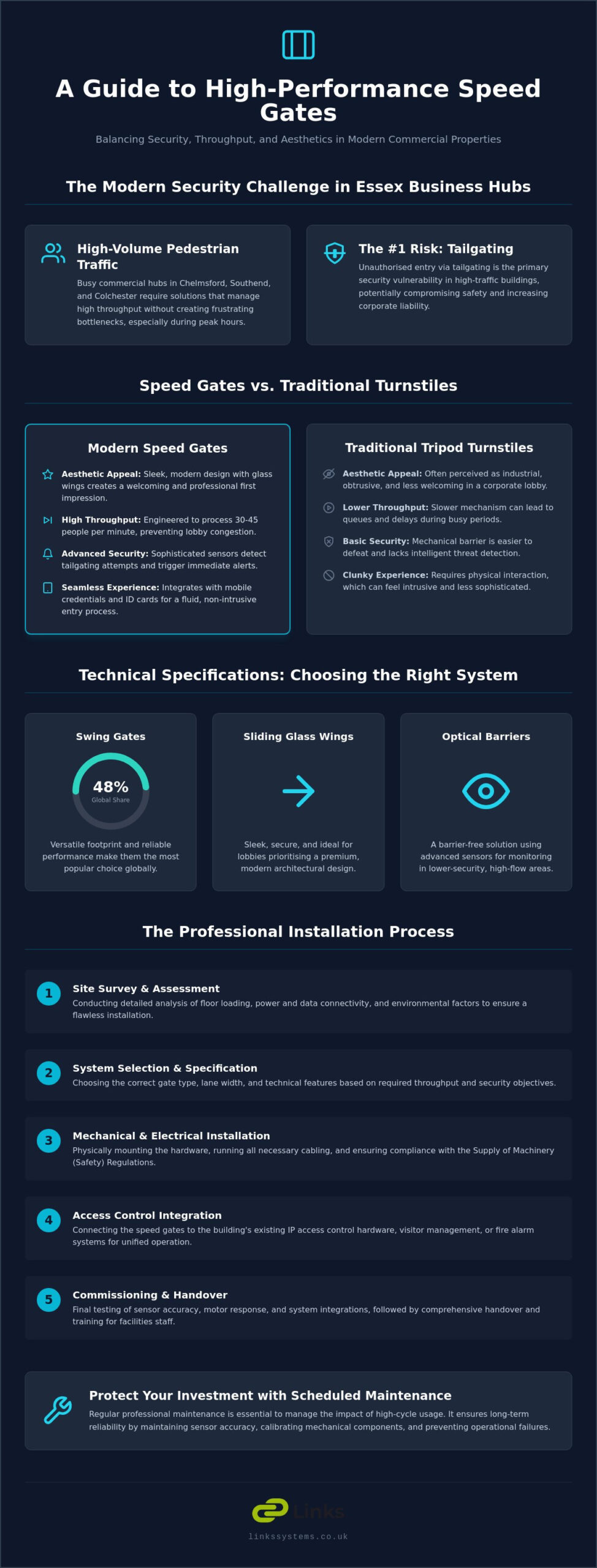
Selecting the appropriate hardware is a critical phase of any speed gate installation Essex project. It requires a precise understanding of both the architectural constraints of the lobby and the specific security objectives of the organisation. The choice between swing gates, sliding glass wings, or optical barriers is not merely aesthetic; it dictates the flow of personnel and the level of physical deterrence provided. For instance, swing door type speed gates currently represent approximately 48% of the global unit share due to their versatile footprint and reliable performance in varied environments. For a detailed breakdown of the latest hardware options and technical benchmarks, our professional commercial speed gates specification guide for 2026 provides comprehensive technical clarity on selecting the right system for your environment.
Throughput capacity is a primary technical consideration. A system that fails to handle peak traffic during morning arrivals will inevitably lead to congestion and frustration in the reception area. High-performance models are typically engineered to process between 30 and 45 people per minute per lane. Achieving this efficiency requires a combination of rapid motor response and precise sensor calibration. Material choices also play a role in the long-term durability of the system. We prioritise high-grade 304 or 316 stainless steel and toughened safety glass to ensure the hardware withstands the rigours of high-cycle commercial use whilst complementing the interior finish of the building.
Optical vs. Physical Barriers
Effective physical security measures often require a tiered approach. Optical-only barriers are suitable for environments where a low-profile security presence is desired, relying on sophisticated sensor arrays and audible alarms to signal unauthorised entry. However, for maximum deterrence in sensitive Essex commercial hubs, high-wing glass barriers are often the preferred choice. These physical obstructions prevent climbers and make tailgating significantly more difficult. In narrow lobbies, the footprint of the pedestal becomes a deciding factor, necessitating slimline models that do not compromise on sensor accuracy or processing speed.
Integration with IP Access Control
A speed gate should never operate in isolation. It must function as an integrated component of the wider security infrastructure. Modern speed gate installation Essex projects focus heavily on IP-based integration, linking the gates directly to IP video intercoms and HD CCTV systems. This connectivity allows for real-time monitoring and remote override capabilities from a central security desk. The system must also support a wide range of credentials, from traditional RFID cards to modern mobile NFC and biometric scanners, ensuring a frictionless experience for authorised users. For project managers seeking to eliminate the vulnerabilities of fragmented hardware, a unified strategy for access control systems UK provides the comprehensive framework needed to specify, install, and maintain high-end commercial security in 2026.
The success of these complex setups relies on professional system commissioning. This process ensures that the hardware and software communicate without latency, preventing delays that could impede the flow of staff. A thorough system commissioning ensures that your investment provides a reliable, secure, and future-proof entry solution for your property.
Speed Gates vs. Traditional Turnstiles: A Commercial Comparison
Tripod turnstiles have long been a staple in industrial settings, yet they often fall short in premium corporate environments. For a speed gate installation Essex project, the objective is typically to secure the premises without making the entrance feel restrictive or industrial. Speed gates provide a much more fluid experience. They replace the physical effort of pushing through a mechanical arm with an automated, sensor-driven response that opens the path only for authorised personnel. This transition from a mechanical barrier to an intelligent system reflects a more modern approach to lobby management.
This shift aligns with the UK Government’s Security Policy Framework, which advocates for a layered and proportionate approach to physical security. Whilst turnstiles are tactical, speed gates are architectural. They allow for a sophisticated blend of access control and interior design that tripod systems simply cannot match. By choosing a system that integrates with the building’s aesthetic, facilities managers in Essex can maintain a high-security posture whilst projecting a professional corporate identity.
User Throughput and Flow Management
In high-rise office developments in Chelmsford or Basildon, transit speed is paramount. Speed gates outperform traditional turnstiles by allowing a “normally open” or rapid-response “normally closed” mode that prevents tailgating without halting the user’s stride. Modern systems often include integrated QR code scanners for visitor management. This allows guests to scan their mobile phones for instant entry, reducing the administrative burden on reception staff during busy periods.
Accessibility is another critical differentiator. The Equality Act 2010 mandates that buildings provide accessible routes for all users. Whilst tripod turnstiles often require a separate, manual pass-gate for wheelchair users, speed gate installations can include wide-lane configurations. This ensures that every member of staff and every visitor enters through the same professional interface. It maintains both legal compliance and a consistent user experience throughout the lobby.
The Aesthetic Advantage
The visual impact of security hardware shouldn’t be underestimated. Glass-wing designs ensure that sightlines remain clear for reception staff and CCTV operators. This transparency reduces the “barrier feel” often associated with security checkpoints. By using toughened glass and polished stainless steel, these systems reinforce a hard security line whilst remaining almost invisible within a minimalist lobby design. This transparency is essential for maintaining a sense of space in smaller Essex offices where floor area is at a premium. It allows the security infrastructure to enhance, rather than detract from, the building’s interior architecture.
The Installation Process: From Site Survey to Commissioning in Essex
A successful speed gate installation Essex project begins long before the first pedestal is bolted to the floor. It starts with a comprehensive site survey to assess the structural and technical requirements of the lobby. We pay particular attention to floor loading capacities, especially in modern office developments in Chelmsford or Colchester where raised access flooring is standard. Cabling infrastructure is another vital consideration. We coordinate closely with your electrical and data contractors to ensure power and network points are positioned with millimetre precision. This meticulous planning prevents the need for unsightly surface-mounted trunking and ensures the hardware integrates perfectly with your interior design.
Managing the installation timeline is essential for minimising disruption to active office environments. We recognise that a lobby is a high-traffic zone that cannot be closed for extended periods. By pre-configuring hardware off-site and scheduling high-impact work during off-peak windows, we ensure the transition to new security measures is as smooth as possible. Every stage of our process adheres to rigorous UK safety standards, including BS EN 16005 for powered pedestrian doors. This ensures that the system is not only secure but also safe for daily use by staff and visitors.
Planning and Site Preparation
Strategic planning involves more than just hardware placement. We design lane configurations that respect the building’s fire safety strategy and emergency egress requirements. Every speed gate must be linked to the fire alarm system to ensure it fails safe in an emergency. This involves mapping out the most efficient routes for Managing Pedestrian Flow in London Office Buildings and Essex hubs alike. We ensure that wide-lane access for wheelchair users is maintained, providing a consistent and inclusive entry experience for all personnel without compromising the security perimeter.
The Commissioning Phase
Commissioning is the most critical phase of any security project. It is the transition from a physical installation to a functional, intelligent system. During this stage, our engineers calibrate the infrared sensor arrays to distinguish between authorised users and potential tailgaters. Testing sensor sensitivity is a delicate balance; settings must be robust enough to detect unauthorised entry whilst remaining precise enough to prevent false alarms that cause frustration. This phase ensures that the speed gate installation Essex project delivers the reliability your organisation expects.
The final handover includes comprehensive training for your reception and facilities management teams. We provide full compliance certification for the Essex site, ensuring all legal and safety obligations are met. If you are ready to enhance your building’s security, contact our expert team to discuss your specific requirements and ensure a compliant, professional installation.
Ensuring Long-Term Reliability through Professional Maintenance
A speed gate installation Essex project represents a significant capital investment for any commercial property. To protect this asset, a structured approach to lifecycle management is essential. High-cycle usage in busy lobbies puts immense strain on mechanical components and optical sensor arrays. Over time, even the most robust systems require recalibration to maintain the precision required for tailgating detection. Regular maintenance doesn’t just prevent mechanical failure; it ensures that the security integrity of the building remains uncompromised. Mechanical wear often manifests in subtle ways, such as a slight lag in wing retraction or a change in the acoustic profile of the motor. Our engineers are trained to detect these early warning signs before they escalate into costly repairs.
Scheduled maintenance is also a mandatory requirement for preserving manufacturer warranties. Most high-end hardware providers insist on a documented service history to keep cover active. By conducting proactive system health checks, we identify potential issues before they lead to operational downtime. This includes reviewing software logs for intermittent faults and ensuring that the latest security patches are applied to the IP-based controller. Ensuring that the data links between your speed gates and the wider IP HD CCTV or access control systems remain robust is just as important as the physical hardware itself. This holistic approach is what distinguishes a professional contractor from a general trader; for insights into protecting other critical building systems through remote monitoring, click here.
Preventative Maintenance Schedules
A typical service programme involves a rigorous inspection of all moving parts. We focus on motor alignment, wing synchronisation, and the cleaning of infrared sensors to prevent false alarms. These checks are vital for Essex-based businesses that operate 24/7 or have high volumes of visitor traffic. Expert care extends the operational life of the hardware, ensuring your investment continues to deliver value for years to come. We also prioritise the testing of fire alarm integration to ensure that all gates fail-safe correctly, maintaining compliance with the latest UK safety regulations.
Expert Support from a Trusted Local Partner
Working with a local specialist provides the advantage of rapid response and deep regional knowledge. Links Integrated Systems has been a steady hand in the security industry since 1984. With 40 years of industry experience, we understand the specific technical requirements of commercial hubs in Basildon, Southend, and Chelmsford. Our heritage and stability offer peace of mind, positioning us as a dependable partner for the full lifecycle of your security infrastructure. We don’t just provide a one-off speed gate installation Essex service; we act as a dedicated partner to help you plan for future requirements as your facility evolves.
Our role as a seasoned guide means we help you manage upgrades seamlessly, whether you’re switching to mobile NFC credentials or expanding your lobby footprint. If you’re planning a new project or need to secure an existing facility, Enquire about speed gate installation and maintenance to ensure your site remains secure, reliable, and compliant.
Advancing Your Facility’s Security Standards
Designing a secure, modern lobby requires a methodical approach that integrates high-performance hardware with your building’s architectural vision. We’ve examined how speed gates provide a superior alternative to traditional barriers by facilitating fluid movement whilst deterring unauthorised access. A successful speed gate installation in Essex depends on precise technical specification, seamless IP integration, and a commitment to rigorous UK safety standards like BS EN 16005. These systems are no longer just tactical tools; they are essential architectural elements of a professional commercial hub. To ensure your specification meets the latest industry benchmarks, review our dedicated commercial speed gates and barriers 2026 specification guide for in-depth guidance on brushless motor technology, disability standards compliance, and IP integration requirements.
With 40 years of experience in commercial security, we provide the steady hand needed for complex commissioning and comprehensive maintenance. This lifecycle support ensures your investment remains a reliable pillar of your building’s infrastructure for decades. Our expertise in high-end commissioning means your hardware and software will work in perfect harmony from the first day of operation. Discuss your speed gate installation with our Essex experts to begin securing your property with a proven, high-quality solution. We’re ready to help you create a lobby that is both exceptionally secure and professionally welcoming.
Frequently Asked Questions
Do speed gates in Essex offices require planning permission?
Internal speed gates typically don’t require planning permission as they’re considered internal alterations to the building’s layout. However, if you’re managing a listed property in a historic district like Colchester or Chelmsford, you must consult your local planning authority for listed building consent. External barriers or those that significantly alter the building’s entrance may also require a formal application depending on local streetscape regulations.
How many speed gate lanes do I need for my building occupancy?
The number of lanes depends on your peak pedestrian flow during morning and evening rush hours. A standard high-performance lane can process between 30 and 45 people per minute. For a building with 500 occupants arriving within a 15-minute window, we usually recommend at least two standard lanes and one wide-access lane to prevent congestion and ensure comfortable throughput for all staff members.
Can speed gates be integrated with existing staff ID cards?
Yes, speed gates can be seamlessly integrated with most existing staff ID cards and access control systems. Our commissioning process involves linking the gate controllers to your current IP-based security infrastructure using industry-standard protocols. This allows staff to use their existing RFID cards, mobile NFC credentials, or biometric profiles without the need for a hardware overhaul or the inconvenience of carrying multiple cards.
What happens to speed gates in the event of a fire alarm?
Speed gates are designed to interface directly with the building’s fire alarm system to ensure fail-safe operation. In the event of an alarm, the glass wings automatically retract or swing open to provide an unobstructed egress route. This is a critical safety requirement under UK building regulations and is verified during the professional system commissioning phase of every speed gate installation Essex project.
How long does a typical speed gate installation take in an Essex location?
A typical installation of a two-lane system generally takes between three and five working days. This timeline includes the physical anchoring of pedestals, cable termination, and the vital commissioning phase. We often perform off-site pre-configuration to reduce on-site time. For active office environments in Essex, we can schedule high-impact work during weekends or evenings to minimise any disruption to your daily business operations.
Are speed gates suitable for external use or just internal lobbies?
Standard speed gates are primarily designed for internal climate-controlled lobbies. Whilst external versions exist, they require specific IP-rated weatherproofing and robust finishes to withstand the UK climate. For perimeter security in Essex business parks, we typically recommend a combination of external automated barriers for vehicles and internal speed gates for pedestrian lobby management to ensure long-term reliability and sensor accuracy.
What is the difference between a speed gate and an optical turnstile?
The terms are often used interchangeably, but a speed gate usually features physical barriers like glass wings or sliding panels. An optical turnstile relies solely on infrared sensors and audible alarms to detect unauthorised passage without a physical obstruction. Speed gates provide a higher level of deterrence and are the preferred choice for Essex commercial hubs where preventing tailgating is a primary security objective.
How much maintenance do commercial speed gates require annually?
We recommend a minimum of two preventative maintenance visits per year for commercial speed gates. High-traffic environments may require quarterly inspections to ensure sensor alignment and motor health. Regular servicing is essential for preserving manufacturer warranties and identifying wear in mechanical components before they lead to system failure. Our Essex-based team provides comprehensive maintenance contracts to ensure your security infrastructure remains fully operational.
2 Comments
Listed Building Consent for Extensions in London: The 2026 Homeowner’s Guide
20 July 2026[…] This design sensitivity is equally important when installing modern security measures like gates or barriers within a property’s grounds; to see how professional access control is handled in high-end settings, you can discover Links Integrated Systems. […]
Key Card Entry Systems for Uptown Charlotte Offices: The 2026 Security Guide
21 July 2026[…] Operating in a high-rise presents unique logistical hurdles that suburban offices don’t face. You aren’t just managing a single suite door; you’re coordinating elevator floor restrictions and integrating parking deck gate access. During peak morning and lunch hours, high-volume foot traffic requires readers that process credentials with zero latency. We design systems that bridge the gap between the lobby and the inner office. This ensures that employees move efficiently while unauthorized visitors are stopped at the perimeter. Real-world security in Uptown requires a multi-layered approach that respects the physics of high-traffic environments, often incorporating specialized hardware like the speed gates and barriers found at linkssystems.co.uk. […]