
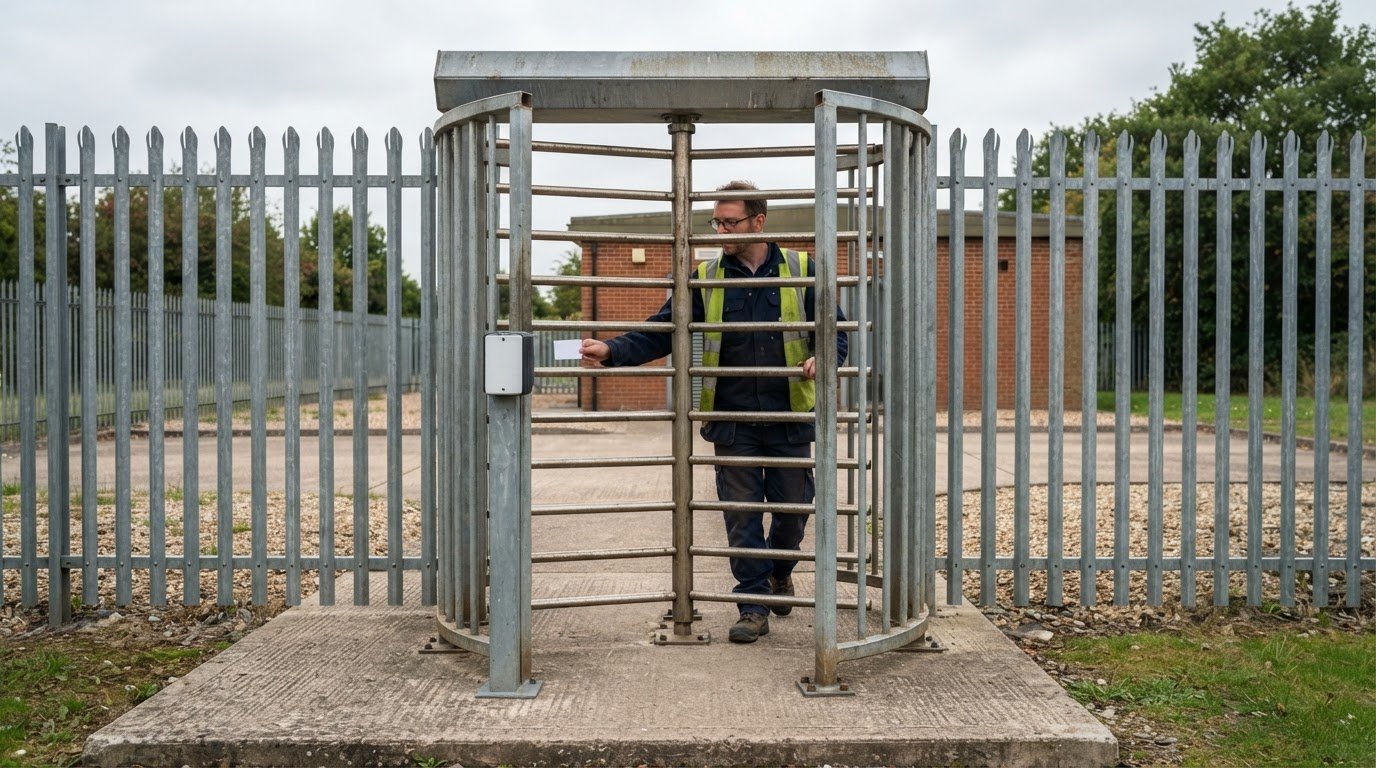
The simplest-looking gate isn’t always right for a sensitive entrance. A turnstile controls pedestrian entry by allowing people through a defined lane, typically one at a time. For high-security turnstiles for sensitive areas in Surrey, a full-height model can provide a substantial physical barrier, with an enclosed rotor that helps deter climbing over or passing beneath it.
Choosing a turnstile involves more than selecting a barrier. Consider the entrance’s security needs, location and expected pedestrian flow. Full-height models suit higher-security sites, external perimeters and unmanned entrances, while speed gates may better suit staffed entrances where a more open crossing is needed.
This article explains how turnstiles control access, which environments can benefit from them and how single-direction and bidirectional operation work. It also compares full-height turnstiles with tripod turnstiles and speed gates, so you can assess their practical differences and identify the right type of entrance control for your site.
Key Takeaways
- Assess the entrance’s security needs and whether a full-height barrier is appropriate for its location and level of supervision.
- Match the turnstile type to the site, from controlled office access to more sensitive environments such as data centres.
- Choose single-direction or bidirectional operation according to how people need to enter and exit.
- Compare full-height turnstiles, tripod turnstiles and speed gates by considering the balance between physical control and pedestrian flow.
High Security Full Height Turnstiles: When Are They Required?
Full-height turnstiles suit entrances where a physical barrier and controlled pedestrian passage are priorities. The right choice depends on the site’s security needs, access arrangements and emergency routes.
Turnstile types and full-height construction
A full-height pedestrian turnstile has a tall enclosed rotor, limiting opportunities to climb over or pass underneath. Its height and enclosed construction can suit an external perimeter, an unmanned entrance or a sensitive facility. Waist-high turnstiles provide a less enclosed crossing, while speed gates use moving barriers to manage pedestrian access. Select the format according to the barrier required and how the entrance operates.
Access control can release a turnstile after valid authorisation. Systems can use swipe cards, barcodes or biometrics, as well as coins, tokens or tickets. England and Wales recorded 443,995 shoplifting offences in the 12 months leading up to March 2024, according to the Office for National Statistics. Recorded offences were 30% higher than in the previous year.
UK safety, egress and accessibility requirements
No single security standard determines the right turnstile for every UK site. Assess the installation against the project’s security, fire-safety and accessibility requirements. Plan the exit route and release arrangements together so the turnstile does not obstruct people leaving. Accessibility planning should also provide a suitable passage for people who cannot use the turnstile lane.
Consider lane width, approach space, access-control placement and how authorised users will pass. These factors help determine whether a full-height unit, speed gate or separate pedestrian gate suits the entrance.
Risks in sensitive facilities
A poorly planned turnstile can obstruct emergency movement, exclude some users or create queues at a controlled entrance. In a data centre, for example, access control must distinguish authorised entry from exit without blocking the wider route. A site assessment should consider pedestrian flow, accessibility, egress and how staff will monitor the entrance.
Specialist security integrators serving Surrey supply and install turnstiles. Maintenance and commissioning support can help keep installed security systems operational; warranty terms and service arrangements depend on the agreement for the equipment and work.
Which environments benefit from security speed gates and turnstiles?
The right entrance system depends on who needs access, how pedestrian traffic moves and which areas require separation. Offices, data centres and industrial premises have different access-control needs, so the installation should reflect the site’s layout and daily use.
At an office, speed gates can manage staff entry at reception while visitors approach a separate desk. Integrated access control can assign different permissions to staff, contractors and guests. This creates a defined pedestrian route without treating everyone entering the premises in the same way.
Data centres and other secure areas need deliberate control between public-facing spaces and restricted zones. A turnstile can form part of an integrated security system, with access permissions controlling entry and monitoring helping staff oversee the entrance. Full-height turnstiles may suit an exposed perimeter or less-supervised entrance, while speed gates can fit a staffed reception where an open appearance and smooth passage matter.
Industrial and commercial environments also use turnstiles to direct people through designated entry points. At a warehouse, for example, a pedestrian lane can be kept distinct from vehicle access. A manufacturing site can use controlled entrances to separate staff routes from delivery areas. The required height, position and access method depend on the building’s security zones and movement patterns.
Other applications include stadiums, transport hubs, utility facilities and leisure venues. A ticketed venue can use turnstiles to admit people with a valid ticket or pass, while entry monitoring can help operators understand pedestrian flow. Gyms and shared facilities can similarly restrict access to authorised members.
Planning an installation starts with mapping entry points, pedestrian routes and restricted areas. Then the access method, monitoring requirements and suitable gate type can be aligned with each entrance. For premises where permissions need to work alongside the hardware, consider integrated access control as part of the design.

Single-direction and bidirectional operation
A turnstile can permit passage in one direction or both. Choose the arrangement according to how people enter and leave each building, not simply the number of lanes. At a staff entrance with separate entry and exit routes, single-direction operation can keep movements distinct. Where one doorway serves arrivals and departures, bidirectional operation can support both flows through the same barrier.
With a bidirectional turnstile, the access control system determines when passage is authorised in each direction. A facility might allow authorised staff to enter and use the same lane to exit. In a data centre, access permissions can reflect the site’s controlled zones and the movements expected at each entrance. Define entry and exit behaviour before installation.
The mechanism uses stiles and a ratchet, with a drive where fitted, to allow rotation in one or both directions. After authorisation, the user passes through the rotating section, and the barrier controls the next passage. The selected direction and settings need to match the physical layout. For example, a turnstile beside a reception desk must not direct people exiting into an incoming queue.
Plan the route by mapping the entrance, adjoining corridors and the destination beyond the barrier. Then decide whether entry and exit share a lane, use separate lanes or operate in different directions at different times. This matters in buildings where shift changes or visitor arrivals create opposing flows. Clear operating logic also helps staff understand which route to use.
For high-security turnstiles for sensitive areas in Surrey, direction is only one part of the access design. The number and position of barriers, authorised-user permissions and movement through connected spaces all influence the arrangement. A well-planned configuration links the turnstile’s operation to the site’s access rules instead of treating direction as an isolated setting.
Comparison with tripod turnstiles and speed gates
Tripod turnstiles, full-height models and speed gates address different entrance requirements. Compare the barrier, pedestrian traffic and level of protection needed at each site.
Tripod turnstile comparison
A tripod turnstile uses rotating arms to control passage and can suit regular pedestrian traffic at a staffed entrance, where operators monitor access and the main aim is to organise entry. A full-height turnstile creates a more substantial physical barrier and can help restrict unauthorised passage at a perimeter or less-supervised entrance. The key question is whether the site needs managed flow or a more substantial barrier.
Consider the setting as well as the entrance. A leisure facility with a staffed reception may prioritise straightforward pedestrian control, while an unmanned secure area may call for the enclosed construction of a full-height unit. At a stadium, the right arrangement depends on how ticket checks, entry flow and the venue’s wider security plan work together.
Speed gate comparison
Speed gates use moving barriers to manage entry and can suit modern reception areas where an open appearance is preferred. Their physical format differs from a full-height turnstile, so assess how the entrance will control tailgating and unauthorised access. Balance the required protection with the building’s layout and expected traffic.
Capacity figures need context. Turnstiles can have a free-access crossing capacity of 60 users per minute, or a single-access crossing capacity of 25 people per minute. These figures describe different operating conditions, not a guaranteed rate for every entrance. Lane arrangement, authorisation steps and pedestrian behaviour affect the flow in practice.
For a secure facility, compare the physical barrier, access method, monitoring needs and likely queue points before selecting a format. A speed gate may fit a controlled reception, while a full-height turnstile may better suit an exposed perimeter. Discuss speed gates and barriers as part of planning the entrance’s security and pedestrian flow.
Links Integrated Systems
Links Integrated Systems helps organisations plan and install entrance control suited to their site’s security requirements and pedestrian routes. For a sensitive facility, the design involves more than selecting a turnstile: access permissions, direction of travel, surrounding barriers and adjacent entrances all matter.
Links Integrated Systems supplies and installs speed gates and barriers alongside access control systems. IP video intercom and IP HD CCTV systems can also support a coordinated security arrangement, adding communication and visual monitoring around controlled entrances. The right combination depends on the building layout, areas requiring restricted access and how authorised people move through the premises.
Contact Links Integrated Systems to discuss entrance control for your Surrey site, including speed gates, barriers and integrated access control.
Plan the next stage of your entrance design
Planning high-security turnstiles for sensitive areas in Surrey is an opportunity to align entrance security with the building’s wider operation. Before developing a design, bring together the people responsible for security, facilities and daily site operations. Their input helps define how the entrance should work during routine use, visitor arrivals and operational changes.
Consider how future changes to the premises could affect access routes or permissions. A coordinated design treats the entrance as part of the wider security arrangement, rather than an isolated installation. Links Integrated Systems can discuss your project requirements and how access control, speed gates, barriers, intercoms or CCTV may fit the site.
Contact Links Integrated Systems today to take the next step towards a considered entrance plan. A clear starting point helps turn your site requirements into a practical project discussion.
Frequently Asked Questions
What is a turnstile?
A turnstile is a pedestrian access-control gate that permits passage through a controlled lane. Depending on its design, it may use rotating arms, a rotor or moving barriers. At a staff entrance, for example, an authorised credential can release the mechanism for an individual, separating controlled access from an open doorway.
How do I go about installing them?
Start by defining the entrance’s purpose, users and routes, including how people will leave the area. Next, select a gate type and access method that suit the site layout. Coordinate installation with power, access-control equipment and surrounding building work. Commissioning then tests the installed system against the agreed access arrangements.
What is the difference between a turnstile and a flap barrier?
A turnstile controls a lane using rotating arms or a rotor, while a flap barrier uses panels that move across the pedestrian route. Both can control access, but their physical form and movement differ. A reception design, for example, may favour the open appearance of moving panels, while a more enclosed entrance may call for another barrier type.
Where are they used?
Turnstiles are used at entrances where pedestrian access needs to be managed. Examples include staff entrances, reception areas, ticketed venues and restricted rooms within larger premises. A business might control the main building entrance, then apply separate permissions at an internal doorway leading to confidential records or equipment.
Why are they used?
Turnstiles help organise pedestrian movement and limit access to people with valid credentials, tickets or passes. They can also support visitor counting at a controlled entrance. For instance, a venue can direct ticket-holders through a defined access point instead of relying on an unmonitored doorway.
What types of high-security turnstiles are suitable for sensitive areas?
Full-height turnstiles suit entrances needing a substantial physical barrier, including exposed or less-supervised locations. Tripod turnstiles can suit regular pedestrian traffic, while speed gates may fit staffed reception areas. For high-security turnstiles for sensitive areas in Surrey, choose according to the barrier required, supervision, access permissions and pedestrian route.