

Could you show, today, who can enter each area of your Kent premises, why they have access and whether the system records activity as intended? An access control audit for compliance Kent organisations can use should link permissions, reliable evidence and system performance to clear corrective action, not simply confirm that equipment is installed.
Keeping user records current and gathering evidence of system operation can be challenging, particularly when access arrangements have changed over time. The review should reflect each site’s risks and policies, including how personal data in access logs is handled.
This practical 2026 checklist covers active users, role-based permissions, access schedules, credentials, visitor records and physical system components. It also explains how to record findings, assign owners and track remedial actions, helping you plan commissioning, maintenance or improvements. A structured review gives your team a dependable basis for checking that access arrangements remain appropriate and that important decisions are documented.
Key Takeaways
- Set a clear audit scope by mapping the premises, entry points, restricted areas, system components and review period.
- Use an access control audit for compliance Kent sites can apply to compare approved access rules with current users, role changes and leaver records.
- Test authorised and denied access using an agreed, safe plan. Record the method, evidence, result and required follow-up.
- Prioritise findings by risk and assign each action an accountable owner, target date, evidence requirement and closure approver.
- Address technical findings through a structured sequence of site review, agreed work, commissioning checks and recorded handover.
Access control audit for compliance in Kent: define the scope before checking
An audit should test whether documented access controls match each site’s needs, the organisation’s policies and the obligations that apply to its activities. It involves more than counting readers or checking that staff have working cards. A well-scoped access control audit for compliance Kent organisations can use sets out what is being reviewed, who is responsible and what evidence will support each finding.
Set the boundary before examining records or testing equipment. Record the premises and review period, then identify entrances, restricted areas, controlled external access and the people or teams involved. Requirements vary with the organisation, its use of personal data, site risks and applicable rules. A checklist provides structure, not one standard for every Kent site.
Which Kent sites, doors and users should the audit cover?
Map each relevant location, including staff-only areas, visitor routes and controlled gates or barriers. Include the access readers, controllers, credentials, management software and any integrations within scope. The broader access control concept covers selective restriction of access to places or resources. For this review, specify which physical entry points and system records matter at your premises.
Document who is responsible for each site, system, policy and audit action. This helps prevent gaps, such as when one team manages doors while another approves user permissions.
What does an access control audit assess?
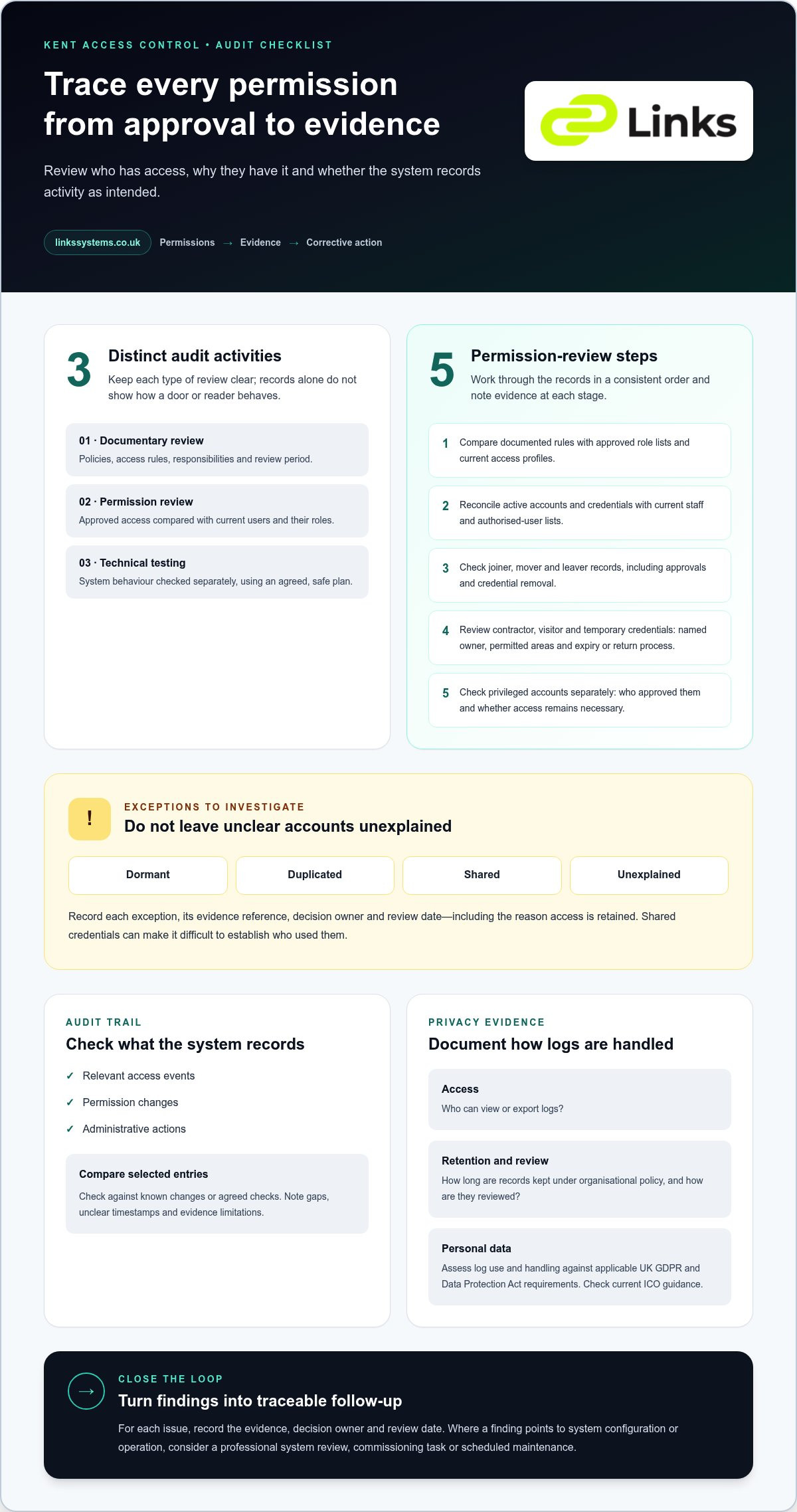
Check whether written access rules reflect current job roles, operating procedures and site risks. Keep three activities distinct: reviewing documents, checking user permissions against approvals, and testing system operation. Records alone don’t show whether a door or reader behaves as intended.
- Documentary review: examine policies, access rules, responsibilities and the chosen review period.
- Permission review: compare approved access with current users and their roles.
- Technical testing: assess system behaviour separately, using an agreed and safe test plan.
An internal review can identify gaps and organise follow-up. A technical inspection or commissioning activity examines system operation and configuration. A formal legal assessment is separate. This checklist helps structure the review, but it isn’t a substitute for site-specific legal advice where needed. Agree the scope and evidence requirements with relevant stakeholders before testing begins.
Check access permissions, joiner-mover-leaver records and audit trails
Once the scope is agreed, compare the permissions people should have with the credentials and access levels currently recorded. An access control audit for compliance Kent organisations conduct is more useful when decisions can be traced to an approval, a role and a review record, rather than relying on a list of active cards alone.
How should organisations review access permissions?
Work through the records in a consistent order and note the evidence checked at each stage:
- Compare documented access rules with approved role lists and current access profiles.
- Reconcile active accounts and credentials against current staff and authorised-user lists.
- Check joiner, mover and leaver records, including approvals for new access, role changes and credential removal.
- Review contractor, visitor and temporary credentials for a named owner, permitted areas and an expiry or return process.
- Check privileged accounts separately. Confirm who approved them and whether the access remains necessary.
Investigate dormant, duplicated, shared or unexplained accounts. A shared credential, for example, can make it difficult to establish who used it. Don’t assume an unfamiliar entry is harmless. Record the exception, evidence reference, decision owner and review date, including any reason access is retained. This creates a clear route from finding to resolution.
What should the audit trail demonstrate?
Check whether the system records relevant access events, permission changes and administrative actions as expected. Logs are useful evidence only when they capture the events needed for the review and can be interpreted reliably. Compare selected entries with known changes or agreed checks, and record any gaps, unclear timestamps or evidence limitations.
Document who can view or export logs, how long records are retained under organisational policy and how they’re reviewed. Access logs may contain personal data, so assess their use and handling against the organisation’s applicable UK GDPR and Data Protection Act requirements. Check current Information Commissioner’s Office guidance when reviewing privacy practices, and align retention decisions with the organisation’s purpose and obligations.
Use the findings to agree proportionate next steps. Where an issue points to system configuration or operation, a professional access control system review, commissioning task or scheduled maintenance may help address the technical cause. Explore access control system support as part of that follow-up.
Test access control operation, physical security and privacy evidence
Records show what the system is configured to do. Operational checks establish whether it behaves as expected at the site. For an access control audit for compliance Kent premises, agree a safe test plan in advance. Specify which doors, gates, credentials and schedules will be tested, who will oversee the checks and how normal site activity will be protected.
Which operational checks belong in the audit?
Test representative authorised and denied access scenarios against approved permissions and documented outcomes. For example, check that a credential assigned to a permitted role works at an appropriate entrance, and that access is refused where permission doesn’t apply. Review relevant door hardware, reader response, time schedules, alarms and integrations within scope. Plan any checks involving doors, gates or barriers to avoid unsafe conditions or disruption to essential access.
Record the test conditions and retain an evidence reference for each result. Note exceptions, the equipment or system version where available, and whether CCTV or an IP video intercom forms part of the entry workflow. Assess those integrations only where they affect how access is granted, monitored or managed.
| Control objective | Test method | Evidence | Result | Required follow-up |
|---|---|---|---|---|
| Authorised access works as approved | Test a representative credential at its permitted point | Credential reference, location and test record | Pass, fail or exception | Record owner and next action |
| Unauthorised access is refused | Use an agreed test credential or scenario | Test conditions and system event record | Pass, fail or exception | Investigate unexpected access |
| Schedules and integrations operate as intended | Check an agreed schedule and relevant linked function | Configuration reference and observed outcome | Pass, fail or exception | Assign technical review if needed |
How should privacy and technical evidence be handled?
Collect only evidence needed for the defined audit purpose. Limit access to logs, exports, images and personal information to appropriate reviewers, and store findings in line with organisational policy. Before setting or asserting specific retention periods, verify current ICO guidance and the legal duties that apply to the organisation and its data use.
Keep evidence proportionate and traceable: identify the test, date, location, outcome and supporting record without copying unnecessary personal details. This makes findings easier to review and follow up while keeping privacy in view.
Prioritise access control audit findings and document a Kent action plan
An audit is useful only if its findings lead to accountable decisions. For an access control audit for compliance Kent organisations can apply consistently, describe each issue factually: identify the affected door, permission, record or system function, explain what was observed and cite the evidence. Avoid assuming the cause before it has been investigated.
How can teams turn findings into proportionate actions?
Assess each finding using your organisation’s risk method. Consider potential impact, exposure, urgency and any compensating controls already in place. Don’t apply invented universal severity scores. The same fault may have different consequences depending on the site, the area affected and how it’s used.
Separate immediate access risks from planned improvements, policy updates and routine maintenance. For every finding, record whether the organisation will resolve, mitigate, investigate or formally accept it, along with the decision and its rationale. Assign an accountable owner and target date, then identify any interim measure needed while work is pending.
What evidence closes an audit action?
Closure should be supported by evidence that matches the action. This might include an approved access change, a revised procedure, relevant training evidence or a technical test result. Retest affected controls where appropriate, and record the outcome, evidence reference, reviewer and review date. If the test fails, keep the action open and document the next step rather than marking it complete.
Where a finding involves connected systems or shared entry workflows, record which functions are affected and whether wider coordination is needed. For relevant projects, see physical security integration for commercial buildings.
A practical action register can include:
- Finding: location, control affected and observed issue.
- Priority and decision: assessment under your organisation’s risk method, plus the agreed response.
- Ownership: accountable person, target date and any interim control.
- Closure evidence: required records, retest outcome and approving reviewer.
For technical findings that require system work, Links Integrated Systems provides access control commissioning and scheduled maintenance for commercial premises in Kent. Discuss access control commissioning and maintenance for your Kent site.
Arrange professional access control commissioning and maintenance in Kent
Some audit findings point to a technical issue that needs more than a permissions update. A specialist system review, commissioning task or scheduled maintenance can help investigate configuration, equipment response or an integration that isn’t performing as intended. Tie the work to the recorded finding and the site’s operating requirements so the outcome can be checked against the original concern.
For context on how these systems are used in commercial settings, see commercial access control systems.
What should a commissioning or maintenance visit establish?
Use a clear sequence: agree the scope and relevant audit findings, review the site and operating constraints, confirm the work to be carried out, complete the agreed commissioning checks, then provide a recorded handover. The records should identify completed checks, outstanding items and any actions that remain with the site team. They should also clarify responsibility for system administration, access changes and future reviews.
This documented process connects technical work to audit follow-up. If CCTV and access control share an operational workflow, consider the relevant questions around integrating CCTV with access control systems.
How can Kent organisations prepare for a system review?
Preparation gives the site team and system specialist a shared view of the issue. Gather current site plans, access policies, user records and previous audit actions. Identify relevant stakeholders, operational constraints and areas requiring controlled access, such as spaces with restricted entry or busy visitor routes. Note which findings need technical investigation and what evidence will demonstrate completion.
Links Integrated Systems provides professional commissioning and scheduled maintenance for commercial security systems in Kent, London, Surrey, Hertfordshire and Essex. The work can be planned around the site’s requirements, with agreed checks and handover information forming part of the process. This gives the organisation a practical route from an access control audit for compliance Kent review to documented technical follow-up.
To discuss commissioning or maintenance requirements for your site, discuss your Kent access control requirements.
Turn your audit findings into confident next steps
A useful access control audit for compliance Kent organisations can rely on brings together three essentials: a clear review scope, current permissions and records, and documented tests of system operation. It should turn findings into actions with an accountable owner, target date and evidence of closure.
Keep the review relevant to your premises and operating needs. Where findings point to a technical issue, commissioning or scheduled maintenance can provide a practical route to address it and record the resulting checks. Links Integrated Systems supplies and installs commercial access control systems and supports them with commissioning and scheduled maintenance for customers in Kent, London, Surrey, Hertfordshire and Essex.
Ready to plan technical follow-up? Discuss access control commissioning and maintenance for your Kent site. A structured review and clear next steps can help your team maintain dependable access arrangements.
Frequently Asked Questions
Is an access control audit a legal requirement for businesses in Kent?
Not necessarily as a standalone audit duty for every business. Requirements depend on the organisation, the data and systems involved, its policies, contracts and applicable law. An audit can help assess whether controls are documented and operating as intended, but it isn’t automatically a legal certification. Check current Information Commissioner’s Office (ICO) guidance and confirm obligations with an appropriately qualified adviser where needed.
What should an access control compliance audit include?
Define the sites and systems in scope, then review access policies, active permissions, credential changes, visitor and contractor access, system logs, operational tests and previous findings. Record the evidence examined, exceptions, action owners and follow-up dates. Include privacy considerations where logs or images may identify people. Tailor the review to the premises, operational risks and applicable requirements rather than treating one checklist as suitable for every organisation.
How often should a business review its access control system?
Set a review frequency that reflects site risks, organisational policy, system changes and applicable obligations. Review permissions when someone changes role or leaves, and consider additional checks after significant system alterations or incidents. Record each review’s date, scope, rationale and resulting actions. There isn’t one interval that should be treated as a universal legal rule, so base your schedule on your circumstances and verify any specific obligations.
Can an access control audit check CCTV and intercom integrations?
Yes, if CCTV or an intercom forms part of the defined access workflow. The review can check whether relevant events, permissions or visitor processes work as intended, and whether associated evidence is handled appropriately. Keep the scope clear: checking a connection or shared workflow doesn’t automatically amount to a full CCTV, privacy or cybersecurity audit. Document the interfaces tested, results and any limitations so the findings are understood.
What records should we prepare for an access control audit?
Gather the current access policy, site or door list, authorised-user records, role approvals, joiner-mover-leaver procedures, visitor arrangements, system-change records and previous findings. Relevant commissioning and maintenance records, along with available test evidence, can help explain system operation and past work. Share logs and personal data through controlled channels, limiting access to people who need them for the review. Note any records that are incomplete or out of date.
What happens if an access control audit finds a weakness?
Describe the issue, identify affected areas or permissions, and assess its significance using your organisation’s risk method. Assign an owner, target date and proportionate response, then retain evidence of the completed action. A technical fault may require commissioning or maintenance work, followed by a retest and documented approval of closure. Links Integrated Systems provides commercial access control commissioning and scheduled maintenance across Kent, London, Surrey, Hertfordshire and Essex.
Does an access control audit assess UK GDPR compliance?
It can review personal-data practices linked to access records, such as who can view logs, why information is retained and how it’s protected. However, an access control review doesn’t establish overall UK GDPR compliance. The relevant requirements depend on the organisation and its processing activities. Check current ICO guidance, and seek suitable advice if the legal position or the data-protection impact of your access records is uncertain.