

A security system is only as robust as its weakest integration point, and in 2026, those points are multiplying. With hardware accounting for over 61% of the UK market share, the pressure to correctly specify and install modern access control systems has never been higher for estate managers. You likely understand the frustration of managing high-volume pedestrian traffic in a busy London lobby whilst trying to bridge the gap between legacy hardware and new IP-based software. It’s a delicate balance between maintaining fluid movement and ensuring absolute site integrity.
This guide provides the technical clarity needed to master the complexities of professional-grade security. We’ll outline how to achieve a reliable, future-proof ecosystem that meets the latest UK fire safety regulations and Secured by Design standards. From the initial specification of speed gates to the meticulous commissioning required to avoid day-one failures, we’ll walk through the entire lifecycle of a commercial installation.
Key Takeaways
- Understand how the transition to networked IP-based infrastructure allows for a more cohesive and manageable security ecosystem.
- Identify the most effective hardware combinations, including biometric readers and speed gates, to streamline access control systems for high-volume pedestrian traffic.
- Navigate the specific UK regulatory requirements, such as BS EN 60839 and Secured by Design, to ensure your building remains compliant and secure.
- Recognise the importance of professional commissioning and robust cable infrastructure in establishing a reliable, future-proof security environment.
- Learn why scheduled preventative maintenance is essential for reducing long-term operational costs and defending against modern security vulnerabilities.
What are Modern Access Control Systems for Commercial Use?
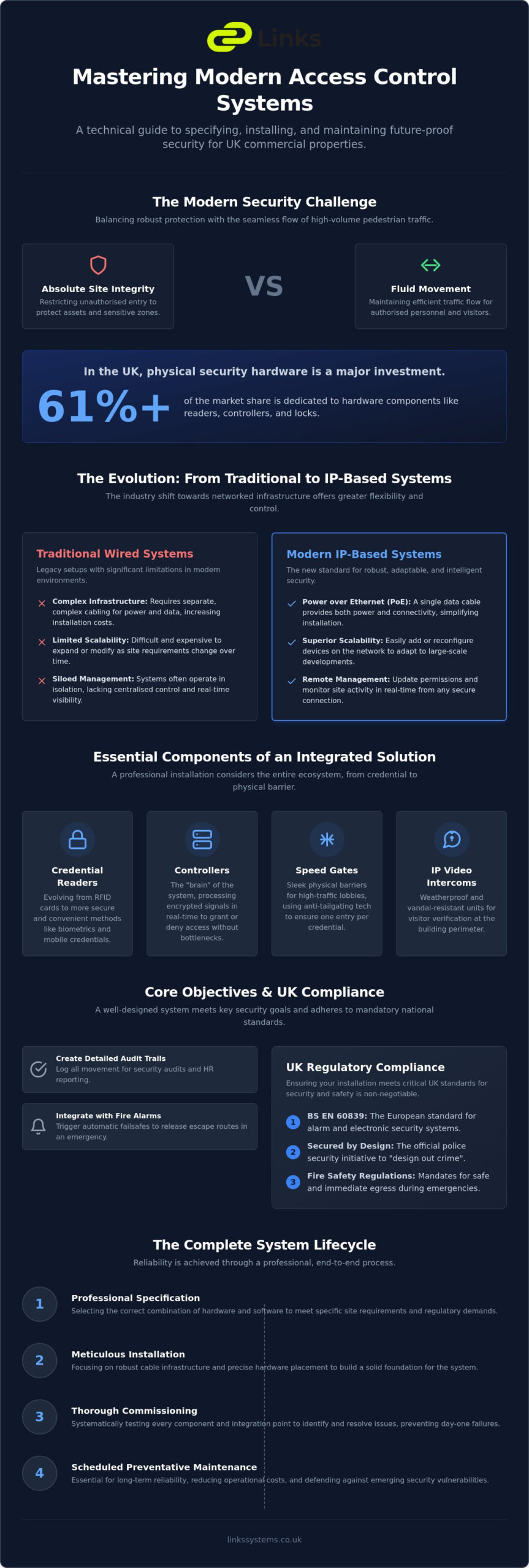
The concept of Access control has evolved from simple mechanical barriers into a sophisticated ecosystem of networked hardware and software. For a commercial environment, this infrastructure manages the movement of pedestrians and vehicles with precision. It’s a significant shift from the legacy standalone locks of the past. Today’s professional security landscape relies on networked IP-based security infrastructure that centralises control and provides a comprehensive view of site activity.
Commercial sites require a level of robustness that residential-grade hardware cannot provide. High-traffic environments like London office blocks or logistics hubs demand components tested for millions of cycles. Beyond simple entry, modern access control systems serve as a cornerstone for asset protection and health and safety compliance. They ensure that sensitive zones remain restricted while providing the data necessary to meet rigorous corporate governance standards.
The Core Objectives of Site Security
A well-designed system balances two competing needs: restricting unauthorised entry and maintaining the efficient flow of authorised personnel. In a professional setting, this is achieved through a combination of credential readers and physical barriers like speed gates. The system doesn’t just grant entry; it creates a detailed audit trail. This log of movement is invaluable for security audits and HR reporting, providing a clear record of who was in the building at any given time. Integration with fire alarm systems is equally vital. In the event of an emergency, the access control software must interface with the fire panel to trigger automatic failsafes, releasing all designated escape routes instantly.
IP-Based vs. Traditional Wired Systems
The industry has largely transitioned from traditional hard-wired setups to IP-based configurations. One of the primary drivers is the use of Power over Ethernet (PoE). By utilising a single data cable to provide both power and connectivity, installers can reduce the complexity of the cable infrastructure. This approach offers superior scalability, which is essential for large-scale developments where site requirements often change. IP systems allow for real-time monitoring and remote management. Security teams can update access permissions or monitor door statuses from any secure network connection, providing a level of agility that older, siloed systems simply cannot match.
Essential Components of an Integrated Access Solution
An integrated security strategy relies on the seamless interaction between software logic and physical hardware. Whilst many providers focus solely on readers, a professional installation considers the entire ecosystem. The Essential components of access control include not just the credential, but the controller that processes the request and the physical barrier that executes the command. In 2025, hardware such as readers, controllers, and locks accounted for over 61% of the UK market share, reflecting the significant investment required in tangible site infrastructure.
Credential readers have evolved beyond basic RFID cards and fobs. In modern commercial environments, biometric authentication and mobile-first credentials are becoming the standard. These systems offer higher security levels and greater convenience for staff. However, this hardware is only effective if the central controller, the “brain” of the operation, can process encrypted signals in real-time. This prevents bottlenecks at entry points and ensures that access control systems remain responsive during peak traffic periods.
Speed Gates and Pedestrian Barriers
For high-traffic lobbies, particularly in London’s corporate sector, the choice of physical barrier is a critical decision. Glass wing speed gates are often preferred over traditional turnstiles due to their sleek aesthetic and high throughput capabilities. These units utilise sophisticated safety sensors and anti-tailgating technology to ensure that only one authorised person enters per valid credential. This physical layer is often the most visible part of a security strategy, requiring a balance between firm site protection and an inviting architectural design that doesn’t hinder movement; for bespoke timber elements that enhance these spaces, click here.
IP Video Intercoms and Visitor Management
Managing visitors professionally starts at the building perimeter. IP video intercoms provide high-definition visual verification, allowing reception teams to see and speak with guests before granting access. These devices are built to be weatherproof and vandal-resistant, ensuring reliability in external environments. When integrated with the wider network, they allow for a seamless check-in process that enhances the overall visitor experience whilst maintaining a secure boundary. This integration ensures that guest movement is logged with the same precision as permanent staff.
For those overseeing large-scale developments, ensuring these components are correctly specified is a prerequisite for long-term site stability. Achieving effective physical security integration for commercial buildings means unifying speed gates, access control, and IP CCTV into a single cohesive ecosystem that simplifies oversight and reduces long-term maintenance costs. You can learn more about professional access control systems and how they integrate into modern building management to provide peace of mind for stakeholders.
Compliance and Standards for UK Commercial Security
Adhering to technical standards ensures that a security installation is both legal and effective. In the UK, the BS EN 60839 series governs electronic access control systems, providing a rigorous framework for performance and reliability. Whilst global summaries, such as this Security Industry Association overview, explain the general logic of different access models, UK-specific compliance requires a more granular approach. This includes managing data under GDPR, which applies to every entry log and biometric template stored on your servers. Transparency in data retention and privacy policies is a legal necessity for any modern business.
Safety integration is a primary concern for project managers and estate owners. UK building regulations mandate that these systems must link directly to the fire alarm panel. During an emergency, the system must automatically release all designated fire exit doors to ensure safe egress. The configuration between fail-safe and fail-secure hardware depends entirely on the door’s role in the escape route. Recent changes to Approved Document B, which came into effect in September 2026, now require a second escape staircase in new buildings over 18 metres. This update increases the volume of fire-rated hardware and control logic required for large-scale developments. For facility managers navigating these evolving requirements, working with experienced integrated security system installers in London who understand the full scope of 2026 regulatory demands, including Martyn’s Law compliance, is increasingly a matter of necessity rather than preference.
Equality Act Compliance in Access Design
Compliance with the Equality Act 2010 is essential for any professional commercial development. Access points must be usable by everyone, regardless of mobility or sensory ability. This means installing card readers, biometric scanners, and exit buttons at accessible heights, typically between 900mm and 1200mm. Speed gates and barriers must also include wider lanes to accommodate wheelchair users and mobility aids. Providing both audible and visual feedback on credential readers ensures the system is inclusive for all staff and visitors.
Secured by Design (SBD) Standards
Secured by Design (SBD) represents the police-preferred specification for security products and installations. Achieving SBD accreditation for a site often leads to more favourable commercial insurance terms, as it demonstrates that the hardware has undergone rigorous testing against forced entry. Selecting SBD-compliant components ensures that your perimeter isn’t just a deterrent, but a proven physical barrier. Professional commissioning ensures these standards are met from the first day of operation, providing long-term peace of mind for stakeholders and occupants alike.
Planning for Professional Installation and Commissioning
A successful security deployment begins long before the first cable is pulled. Precision in the planning phase is what separates a reliable system from one prone to day-one failures. A comprehensive site survey and risk assessment are the first steps, though for new developments, this may also involve specialist site preparation from GCS Contractors Ltd to ensure the groundworks and civil engineering support the intended infrastructure. These allow engineers to identify physical vulnerabilities and operational bottlenecks that might influence hardware selection.
Robust cable infrastructure is the backbone of any IP-based installation. Whilst previous sections highlighted the benefits of PoE, the physical routing of these data paths must be meticulously planned to avoid interference and ensure long-term stability. Integration with existing Building Management Systems (BMS) is another critical factor. A unified approach allows security hardware to communicate with lighting, HVAC, and elevator controls, creating a more efficient and responsive facility. This level of coordination requires a high degree of technical expertise during the mounting and wiring stages.
The Importance of Professional Commissioning
Fitting hardware to a door is only a fraction of the process. Professional commissioning involves the detailed configuration of the software layer to ensure permissions accurately reflect the building’s operational needs. Every scenario must be tested, from standard entry to emergency lockdown procedures. Stress-testing the system during simulated peak flow periods prevents bottlenecks that could frustrate staff or compromise security. The final stage is a thorough handover. Providing staff training ensures the end-user can manage the system effectively, reducing the likelihood of user error during daily operations.
Selecting an Installation Partner in London and the South East
For projects within London and the Home Counties, local expertise is a significant advantage. Having a partner familiar with the specific logistical challenges of Kent, Surrey, and Essex ensures that project timelines remain on track. Complex installations involving speed gates and pedestrian barriers demand a contractor with a proven history of handling large-scale commercial developments. You should look for a provider that offers an end-to-end service, moving seamlessly from initial design through to the final commissioning phase.
If you’re overseeing a new development or upgrading a legacy site, professional guidance is essential for a smooth transition. Contact our team for expert advice on access control systems and comprehensive commissioning services tailored to your specific site requirements.
Ensuring Reliability through Scheduled Maintenance
A security ecosystem is a long-term investment that requires meticulous care beyond the initial handover. Relying on reactive repairs is a high-risk strategy that often leads to inflated costs and operational disruption. In contrast, preventative maintenance ensures that access control systems remain functional and secure, identifying potential failures before they compromise site integrity. This proactive model is essential for commercial property managers who must balance security requirements with the need for uninterrupted pedestrian flow. A system that doesn’t receive regular attention is a vulnerability.
Digital security is as important as physical robustness. Regular firmware and software updates are necessary to protect against emerging cyber threats. As these systems become more integrated with IT networks, keeping the underlying code current is a non-negotiable aspect of site management. Physical inspections complement these digital updates. Engineers must check speed gate motors, credential readers, and electronic locks for signs of wear. High-traffic speed gates in London lobbies can undergo thousands of cycles daily. This makes regular mechanical calibration and lubrication vital for operational longevity.
Minimising System Downtime
Planned maintenance schedules are designed to avoid disruption to core business hours. By conducting inspections during off-peak times, we ensure that site security remains constant without hindering staff movement. Remote diagnostics play a critical role here. By utilising the connectivity of IP-based systems, faults can often be identified and sometimes resolved before an engineer even arrives on-site. This doesn’t just save time; it reduces the carbon footprint of the service contract. Maintaining a reliable supply chain for replacement components further reduces downtime, ensuring that hardware like barriers or intercoms are returned to service quickly.
The Links Integrated Systems Approach
With over 40 years of experience in maintaining complex London security infrastructure, we understand the specific demands of the capital’s commercial sector. Our heritage is built on a commitment to precision and reliability. We view professional commissioning as the foundation of any maintenance contract. A system that has been correctly configured from day one is inherently more stable and easier to maintain over its lifecycle. This methodical approach provides stakeholders with the peace of mind that their assets are protected by a steady, experienced hand. If you require a dependable partner to oversee your site’s security lifecycle, we invite you to Enquire about our professional maintenance and commissioning services.
Establishing a Resilient Security Foundation
Modern site security is no longer just about installing hardware; it’s about managing a complete lifecycle of integration, compliance, and reliability. We’ve explored how the transition to networked IP infrastructure and adherence to BS EN 60839 standards creates a future-proof environment for any commercial development. Professional commissioning ensures that your access control systems operate with absolute precision from day one, whilst structured maintenance protects that investment against emerging physical and digital threats.
With over 40 years of experience in professional security commissioning, Links Integrated Systems provides the technical expertise required for large-scale projects. As specialist installers for London, Kent, Surrey, and the Home Counties, we offer comprehensive maintenance contracts that prioritise long-term site stability. Our methodical approach ensures that every component, from speed gates to intercoms, remains a dependable part of your building’s infrastructure.
Discuss your commercial access control requirements with our specialists to ensure your next project is delivered with the technical excellence it deserves. We’re ready to help you build a secure, compliant, and efficient environment for the years ahead.
Frequently Asked Questions
What is the difference between fail-safe and fail-secure access control?
Fail-safe hardware unlocks automatically when power is cut, ensuring that occupants can exit a building safely during a fire or power failure. Fail-secure hardware remains locked during a power loss, maintaining site security for external perimeters or high-value zones. The choice between these configurations is a critical legal requirement under UK fire safety regulations and depends on the door’s role in an escape route.
Can modern access control systems integrate with existing CCTV?
Modern IP-based access control systems are designed to integrate seamlessly with high-definition CCTV infrastructure. This allows security teams to link specific access events with synchronised video footage, providing visual verification of every entry attempt. This integration creates a more cohesive security ecosystem where different hardware components share data over a single secure network to improve incident response times.
How much does a commercial access control system cost to install?
The total investment for a professional installation depends on several variables, including the number of entry points, the type of credential readers selected, and the complexity of physical barriers like speed gates. Costs are also influenced by whether the project is a new build or a complex retrofit involving legacy hardware. A detailed site survey is necessary to determine the specific infrastructure and cabling requirements for your building.
What are the benefits of using speed gates over traditional turnstiles?
Speed gates provide a significantly higher pedestrian throughput whilst offering a more refined aesthetic suitable for modern corporate lobbies. Unlike traditional turnstiles, speed gates utilise sophisticated infrared sensors to detect tailgating and can be easily configured with wider lanes to ensure DDA compliance. They offer a superior balance between firm security and a welcoming architectural environment for staff and visitors.
Do I need a maintenance contract for my office security system?
A professional maintenance contract is essential for ensuring the long-term reliability of your security infrastructure. These agreements cover scheduled preventative inspections, essential firmware updates, and priority repairs that help avoid costly system downtime. For commercial property managers, a formal contract provides the assurance that the building remains compliant with all relevant UK safety and security standards.
Are biometric access control systems legal under UK GDPR?
Biometric access control systems are legal in the United Kingdom provided they comply with rigorous GDPR requirements for processing sensitive personal data. This involves conducting a Data Protection Impact Assessment (DPIA) and ensuring that all biometric templates are encrypted and stored securely. Businesses must also have clear data retention policies and provide transparent information to users about how their data is managed.
How long does it take to commission a new access control system?
The commissioning phase typically takes between several days and a full week, depending on the scale of the development and the complexity of the integrated devices. This period is vital for stress-testing the software logic, verifying user permissions, and ensuring that all failsafes interface correctly with the building’s fire alarm panel. Meticulous commissioning is the foundation of a reliable system that avoids day-one operational failures.
3 Comments
Physical Security Integration for Commercial Buildings: The 2026 Professional Guide – Links Integrated Systems
19 July 2026[…] Managing security data requires strict adherence to GDPR and the Data Protection Act. Every camera feed and access log contains personal data that must be stored and processed securely. Additionally, integrated speed gates and barriers must meet stringent fire safety standards. They must be configured to release automatically upon a fire alarm trigger to facilitate safe egress. For a deeper look at these requirements, see our Commercial Access Control Systems: A Professional Guide for 2026. […]
Integrated Security System Installers in London: 2026 Commercial Roundup – Links Integrated Systems
26 July 2026[…] Security must be rigorous, but it cannot become a bottleneck that hinders productivity. Integrated access control systems allow for seamless pedestrian flow by synchronising speed gates with credential readers. By using […]
Commercial Integrated Security Systems UK: A 2026 Professional Reference – Links Integrated Systems
27 July 2026[…] site management relies on the seamless communication between your hardware and your access control systems. When a credential is presented, the system doesn’t just log the event; it orchestrates a […]